Downtown Harrisburg in Dauphin County, Pennsylvania — The American Northeast (Mid-Atlantic)
Riverfront Park
Photographed by Beverly Pfingsten, March 15, 2008
1. Riverfront Park Marker
Inscription.
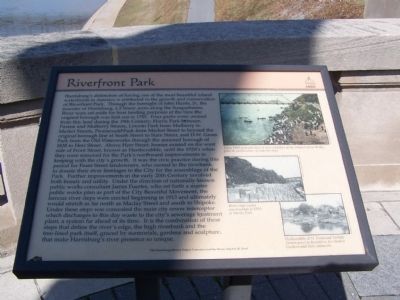
Riverfront Park. . Harrisburg's distinction of having one of the most beautiful inland waterfronts in America is attributed to the growth and conservation of Riverfront Park. Through the foresight of John Harris, Jr., the founder of Harrisburg, 6.2 linear acres along the Susquehanna River were set aside for boat landing purposes at the time the original borough was laid out in 1785. Four parks were created from this land during the 19th Century; Harris Park between Paxton and Mulberry Streets, Lincoln Park from Mulberry to Market Streets, Promenade Park from Market Street to beyond the original borough line at South Street to State Street, and D.W. Gross Park from the Old Waterworks through the annexed borough of 1838 to Herr Street. Above Herr Street, houses existed on the west side of Front Street, known as Hardscrabble, until the 1920's when they were removed for the Park's northward improvements in keeping with the city's growth. It was the civic practice during this period for Front Street landowners, who owned to the riverbank, to donate their river frontages to the City for the assemblage of the Park. Further improvements in the early 20th Century involved both beauty and utility. Under the direction of nationally-known public works consultant James Fuertes, who set forth a master public works plan as part of the City Beautiful Movement, the famous river steps were erected beginning in 1913 and ultimately would stretch as far north as Maclay Street and south to Shipoke. Under these steps was concealed the main city's sewage interceptor which discharges to this day waste to the city's sewerage treatment plant, a system far ahead of its time. It is the combination of these steps that define the river's edge, the high riverbank and the tree-lined park itself, graced by memorials, gardens and sculpture, that make Harrisburg's river presence so unique. , Top Photo , Circa 1908 postcard view of river activities at the Walnut Street Bridge prior to construction of concrete steps. , Middle Photo , River steps under construction in 1913 at Harris Park. , Bottom Photo , Hardscrabble at N. Front and Verbeke Streets prior to demolition for Sunken Gardens and Park extension.
Harrisburg's distinction of having one of the most beautiful inland waterfronts in America is attributed to the growth and conservation of Riverfront Park. Through the foresight of John Harris, Jr., the founder of Harrisburg, 6.2 linear acres along the Susquehanna River were set aside for boat landing purposes at the time the original borough was laid out in 1785. Four parks were created from this land during the 19th Century; Harris Park between Paxton and Mulberry Streets, Lincoln Park from Mulberry to Market Streets, Promenade Park from Market Street to beyond the original borough line at South Street to State Street, and D.W. Gross Park from the Old Waterworks through the annexed borough of 1838 to Herr Street. Above Herr Street, houses existed on the west side of Front Street, known as Hardscrabble, until the 1920's when they were removed for the Park's northward improvements in keeping with the city's growth. It was the civic practice during this period for Front Street landowners, who owned to the riverbank, to donate their river frontages to the City for the assemblage of the Park. Further improvements in the early 20th Century involved both beauty and utility. Under the direction of nationally-known public works consultant James Fuertes, who set forth a master public works plan as part of the City Beautiful Movement, the famous
Click or scan to see this page online
river steps were erected beginning in 1913 and ultimately would stretch as far north as Maclay Street and south to Shipoke. Under these steps was concealed the main city's sewage interceptor which discharges to this day waste to the city's sewerage treatment plant, a system far ahead of its time. It is the combination of these steps that define the river's edge, the high riverbank and the tree-lined park itself, graced by memorials, gardens and sculpture, that make Harrisburg's river presence so unique. Top Photo
Circa 1908 postcard view of river activities at the Walnut Street Bridge prior to construction of concrete steps.
Middle Photo
River steps under construction in 1913 at Harris Park.
Bottom Photo
Hardscrabble at N. Front and Verbeke Streets prior to demolition for Sunken Gardens and Park extension.
Erected by The Harrisburg History Project Commissioned by Mayor Stephen R. Reed.
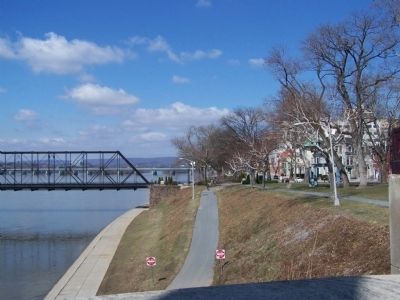
Looking north from Market Street Bridge toward the People's Bridge at Walnut Street.
N, 76° 52.998′ W. Marker is in Harrisburg, Pennsylvania, in Dauphin County. It is in Downtown Harrisburg. It is at the intersection of N. Front Street and Market Street, on the right when traveling south on N. Front Street. Touch for map. Marker is at or near this postal address: 16 Market St, Harrisburg PA 17104, United States of America. Touch for directions.

Regionally, this marker is in South-Central Pennsylvania, specifically in Pennsylvania Dutch Country, and in the Susquehanna Valley. It is also in the American Northeast and in the Mid-Atlantic. Globally, it is in North America, the Western Hemisphere, the Western World, and the Anglosphere. Historically, it finds itself in what was once the Haudenosaunee (Iroquois) Confederacy and also one of the original Thirteen Colonies.
Credits. This page was last revised on June 16, 2016. It was originally submitted on March 19, 2008, by Bill Pfingsten of Bel Air, Maryland. This page has been viewed 2,680 times since then and 60 times this year. Photos:1, 2. submitted on March 19, 2008, by Bill Pfingsten of Bel Air, Maryland.