El Rito in Rio Arriba County, New Mexico — The American Mountains (Southwest)
Welcome to the Church of San Juan Nepomuceno
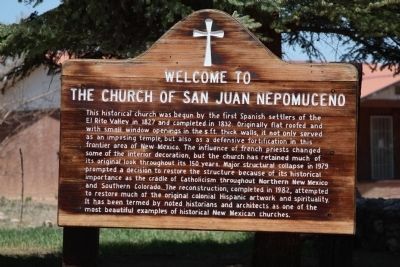
Photographed by J. J. Prats, April 28, 2013
1. Welcome to the Church of San Juan Nepomuceno Marker
Topics. This historical marker is listed in this topic list: Religion & Religious Structures. A significant historical year for this entry is 1827.
Location. 36° 20.658′ N, 106° 11.304′ W. Marker is in El Rito, New Mexico, in
this page online

Regionally, this marker is in Northern New Mexico. It is also in the American Southwest, in the Mountain West, and at the Four Corners. Globally, it is in North America, the Rocky Mountains, the Western Hemisphere, the Western World, and the Anglosphere. Historically, it finds itself in what was once New Spain, the territory of the Ancestral Puebloans, and the Republic of Texas.
Other nearby markers. At least 7 other markers are within 14 miles of this marker, measured as the crow flies: El Rito (approx. 0.6 miles away); a different marker also named El Rito (approx. 0.8 miles away); Santa Cruz (approx. 8.4 miles away); Abiquiú (approx. 11.8 miles away); Agueda S. Martinez (1898–2000) (approx. 12.6 miles away); Georgia O’Keeffe (approx. 13.3 miles away); Red Rocks (approx. 13.3 miles away).
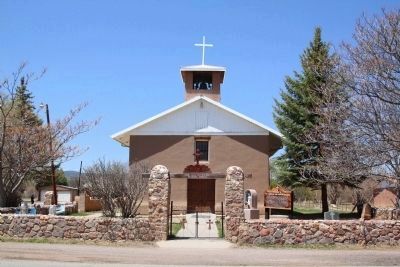
Photographed by J. J. Prats, April 28, 2013
2. The Church of San Juan Nepomuceno and Marker
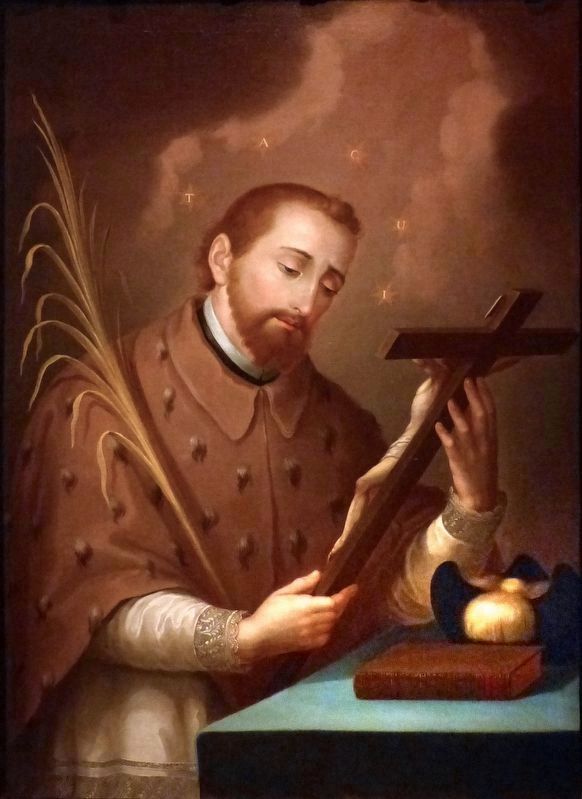
Photographed by Allen C. Browne, March 12, 2016
3. San Juan Nepomuceno
This c. 1798 portrait of Jan Juan Nepomuceno by José Campeché hangs in the Smithsonian American Art Museum in Washington, DC.
“The halo of five stars around the head of San Juan Nepomuceno, the patron saint of confessors, spells out TACUI, Latin for "I was silent." The saint was martyred because he refused to divulge what he heard in confession; the letters rest on five stars that refer to the five wounds of Christ and link the saint's sacrifice to the Savior's. This painting reminded priests and their congregants of the seal of the confessional, which required both to hold their confessions in strict confidence.
Jose Campeché was a descendant of freed slaves who became an artist and architect. His work blends local folk traditions native to Puerto Rico with the high style imported From Europe. The ornate, hand-carved frame calls attention to the ambitions of the artist and the significance of his subject. The painting displays the strong influence of the Catholic Church in America's New Spain at a moment when the Spanish Empire's reach spanned the globe.” — Smithsonian American Art Museum
“The halo of five stars around the head of San Juan Nepomuceno, the patron saint of confessors, spells out TACUI, Latin for "I was silent." The saint was martyred because he refused to divulge what he heard in confession; the letters rest on five stars that refer to the five wounds of Christ and link the saint's sacrifice to the Savior's. This painting reminded priests and their congregants of the seal of the confessional, which required both to hold their confessions in strict confidence.
Jose Campeché was a descendant of freed slaves who became an artist and architect. His work blends local folk traditions native to Puerto Rico with the high style imported From Europe. The ornate, hand-carved frame calls attention to the ambitions of the artist and the significance of his subject. The painting displays the strong influence of the Catholic Church in America's New Spain at a moment when the Spanish Empire's reach spanned the globe.” — Smithsonian American Art Museum
Credits. This page was last revised on November 9, 2016. It was originally submitted on May 2, 2013, by J. J. Prats of Powell, Ohio. This page has been viewed 2,328 times since then and 121 times this year. Photos: 1, 2. submitted on May 2, 2013, by J. J. Prats of Powell, Ohio. 3. submitted on November 8, 2016, by Allen C. Browne of Silver Spring, Maryland.
