Near Megiddo in Jezreel, Haifa District, Israel — West Asia (the Levant in the Middle East)
The Southern Stables
Photographed by Dale K. Benington, March 8, 2013
1. The Southern Stables Marker
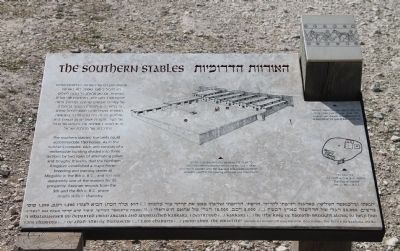
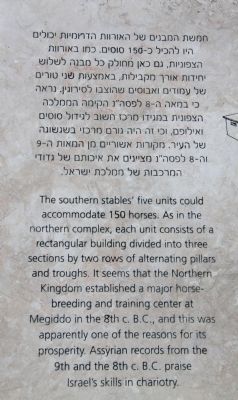
The southern stables' five units could accommodate 150 horses. As in the northern complex, each unit consists of a rectangular building divided into three sections by two rows of alternating pillars and troughs. It seems that the Northern Kingdom established a major horse-breeding and training center at Megiddo in the 8th c. B.C., and this was apparently one of the reasons for its prosperity. Assyrian records from the 9th and the 8th c. B.C. praise Israel's skills in chariotry.
[Text across the Bottom of the Marker]:
"I (Shalmaneser III) departed from Argana and approached Karkara. I destroyed (...) Karkara (...) he (the king of Hamath) brought along to help him 1,200 chariots (...) of Adad-'Iori of Damascus (...) 2,000 chariots (...) from Ahab, the Israelite" (Assyrian monolith inscription, describing the Battle of Karkara, 853 B.C.)
Topics and series. This historical marker is listed in these topic lists: Anthropology & Archaeology • Forts and Castles • Settlements & Settlers. In addition, it is included in the Tel Megiddo series list.
Location. 32° 35.086′ N,
this page online

Regionally, it is in Asia, specifically in West Asia, in the Middle East, in The Levant, on the Red Sea, in a coastal Mediterranean country, and in the Western World. Historically, it finds itself in what was once the Byzantine Empire, the Ottoman Empire, a British Mandate, and the Roman Empire.
Other nearby markers. At least 8 other markers are within walking distance of this marker: The Water System (within shouting distance of this marker); A Public Grain Silo (within shouting distance of this marker); The Southern Palace (within shouting distance of this marker); Schumaker's Excavations (about 90
Photographed by Dale K. Benington, March 8, 2013
2. The Southern Stables Marker
Close-up view of the Hebrew and English text displayed on the left side of the historical marker.
More about this marker. The "Megiddo National Park" handout/brochure has this to say about Stop 16, "The Southern Stables" on the historic tour:
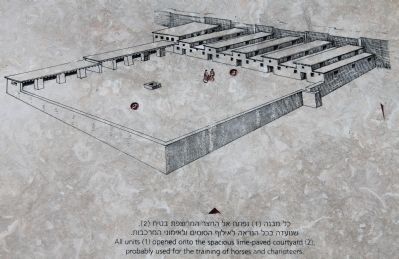
This is one of Megiddo's two stable complexes dating from the period of the Israelite kings. It includes five lengthwise structures that opened onto a large training ground, with a square trough in the center. Each structure was divided into three lengthwise units separated by rows of stone pillars flanking troughs. The excavators discovered bite-marks of horses on the troughs, as well as holes, probably to tether animals. Each structure featured a central hall with a thickly plastered floor. The horses would pass through this hall to side rooms with stone-paved floors. One of the five stables has been reconstructed.
Related markers. Click here for a list of markers that are related to this
Photographed by Dale K. Benington, March 8, 2013
3. The Southern Stables Marker
Close-up view of the illustration of the Northern Stables displayed on the historic marker. The caption reads: "All units (1) opened onto the spacious lime-paved courtyard (2), probably used for the training of horses and charioteers."
Also see . . .
1. Tel Megiddo. This is a link to information provided by Wikipedia, the free encyclopedia. (Submitted on May 8, 2013, by Dale K. Benington of Toledo, Ohio.)
2. The Megiddo Expedition. The Megiddo Expedition website homepage (Submitted on May 8, 2013, by Dale K. Benington of Toledo, Ohio.)
3. Tel Megiddo. This is a link to information provided by the BibleWalks.com website. (Submitted on May 8, 2013, by Dale K. Benington of Toledo, Ohio.)
4. Ahab. This is a link to information provided by Wikipedia, the free encyclopedia. (Submitted on May 8, 2013, by Dale K. Benington of Toledo, Ohio.)
5. Ahab the Israelite. This is a link to information provided by the Associates for Biblical Research. (Submitted on May 8, 2013, by Dale K. Benington of Toledo, Ohio.)
6. Shalmaneser III. This is a link to information provided by Wikipedia, the free encyclopedia. (Submitted on May 8, 2013, by Dale K. Benington of Toledo, Ohio.)
7. Shalmaneser III and Assyria. This
Photographed by Dale K. Benington, March 8, 2013
4. The Southern Stables Marker
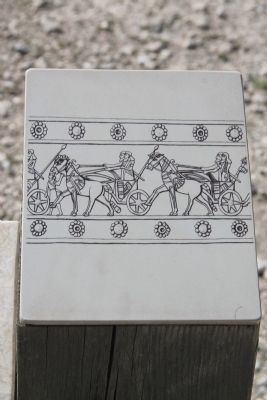
View of photo displayed as part of the historical marker with the following caption: "Assyrian war chariots of Shalmaneser III as depicted on the gate of Balawat (N Iraq)."
Photographed by Dale K. Benington, March 8, 2013
5. The Southern Stables Marker
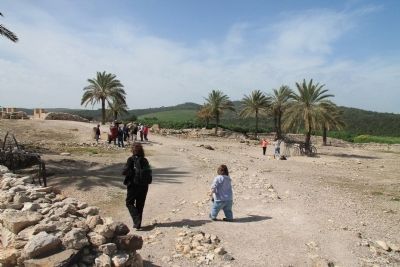
Distant view of the historical marker (with tour group gathered around it) and of the ruins of the southern stables on the high ground to the left of the historical marker.
Photographed by Dale K. Benington, March 8, 2013
6. The Southern Stables
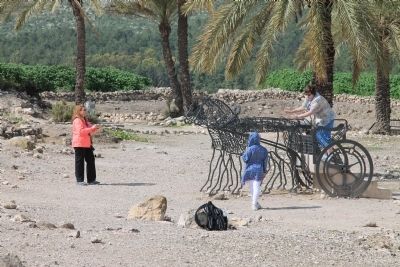
View of visitors on a nearby display of a chariot.
Photographed by Dale K. Benington, March 8, 2013
7. The Southern Stables Marker
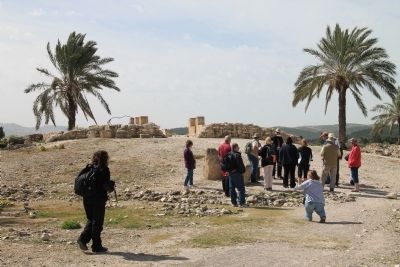
View of the historical marker (with tour group gathered around it) and of the ruins of the southern stables on the high ground a short distance behind the historical marker.
Photographed by Dale K. Benington, March 8, 2013
8. The Southern Stables Marker
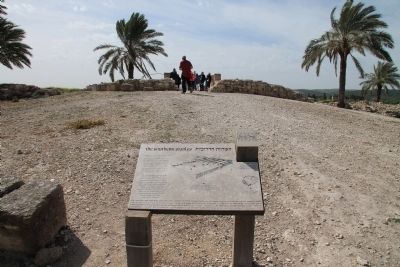
View of the historical marker with the ruins of the southern stables on the high ground a short distance beyond the historical marker.
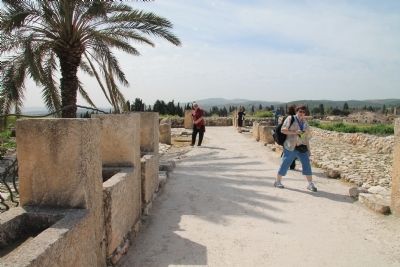
Photographed by Dale K. Benington, March 8, 2013
9. The Southern Stables
View looking south (the historical marker is a short distance behind me) of the interior ruins of the southern stables.
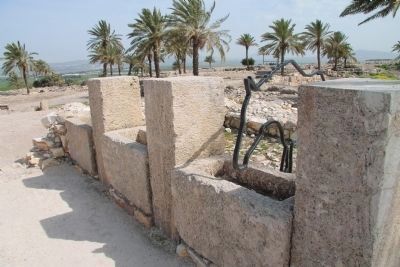
Photographed by Dale K. Benington, March 8, 2013
10. The Southern Stables
View, looking north, of the (feeding or watering) troughs inside the ruins of the southern stables.
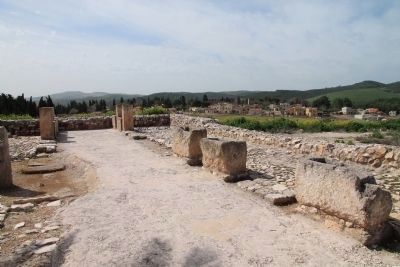
Photographed by Dale K. Benington, March 8, 2013
11. The Southern Stables
View, looking south, of the interior ruins of the stable (including several feeding or watering troughs).
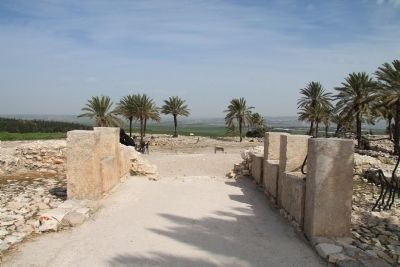
Photographed by Dale K. Benington, March 8, 2013
12. The Southern Stables Marker
View, looking north, through the entrance to the stable ruins, with a distant view of the historical marker, and the landscape beyond.
Credits. This page was last revised on September 30, 2024. It was originally submitted on May 8, 2013, by Dale K. Benington of Toledo, Ohio. This page has been viewed 904 times since then and 29 times this year. Photos: 1, 2, 3, 4, 5, 6, 7, 8, 9, 10, 11, 12. submitted on May 9, 2013, by Dale K. Benington of Toledo, Ohio.
