Dodge City in Ford County, Kansas — The American Midwest (Upper Plains)
Dodge City, a frontier legend
Photographed by William Fischer, Jr., November 10, 2012
1. Dodge City, a frontier legend Marker
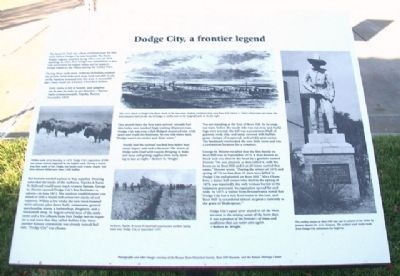
The Santa Fe Trail was a busy overland route for fifty years before Dodge City was founded. The heavy freight wagons rumbled along where you are now standing. In 1865, Fort Dodge was established to provide protection for wagon trains and to support troops based on the Plains during the Indian Wars.
During those early years, millions of buffalo roamed the prairie. With hides and meat both valuable in the 1870s, hunters swarmed over the area. A successful day's hunt could net a hunter a hundred dollars.
Every ravine is full of hunters, and campfires can be seen for miles in any direction.
- Kansas Daily Commonwealth, Topeka, Kansas,
November 1872
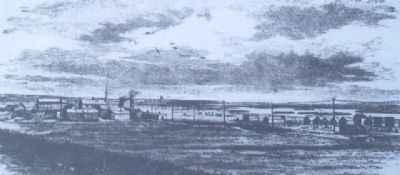
But hunters needed a place to buy supplies. Hearing news that the tracks of the Atchison, Topeka & Santa Fe Railroad would soon reach western Kansas, George M. Hoover opened Dodge City's first business - a saloon - in June 1872. His outdoor establishment consisted of only a board laid across two stacks of sod supports. Within a few weeks the new town boasted more saloons, plus dance halls, restaurants, general merchandise stores, a barbershop, drugstore, and a blacksmith shop.
this page online
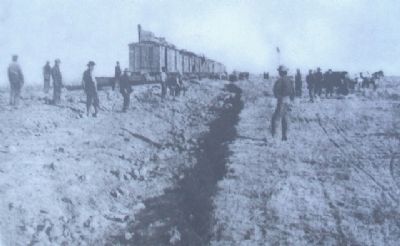
One month later the first train arrived. Already buffalo hides were stacked high waiting shipment east. Dodge City was now a full-fledged chartered city, wide open and ready for business. As one old-timer said, "Dodge warn't no nickel and dime town."
Hardly had the railroad reached here before businesses began; and such a business! The streets of Dodge were lined with wagons bringing in hides and meat and getting supplies from early morning to late at night.
- Robert M. Wright
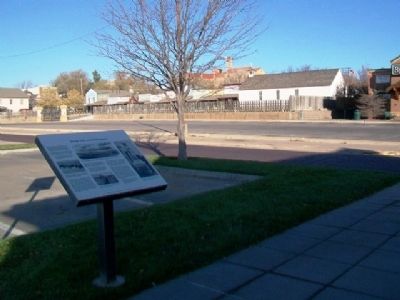
You are standing at the foot of Boot Hill. In its original state, before the south side was cut away and buildings were erected, the hill was a prominent bluff of gypsum, rock, clay, and sand, covered with buffalo grass, clumps of soapweed, and prickly pear cactus. The landmark overlooked the new little town and was a convenient location for a cemetery.
George M. Hoover recalled that the first burial on Boot Hill was in September 1872. A man
Photographed by William Fischer, Jr., November 10, 2012
2. Dodge City, a frontier legend Marker
Dodge City's equal never existed in all the West, not even in the mining camps of the boom days. It was a product of the frontier - of times and conditions that can never exist again.
- Robert M. Wright
Photographs and other images courtesy of the Kansas State Historical Society, Boot Hill Museum, and the Kansas Heritage Center
Topics. This historical marker is listed in these topic lists: Industry & Commerce • Railroads & Streetcars • Settlements & Settlers • Wars, US Indian. A significant historical month for this entry is June 1872.
Location. 37° 45.184′ N,
Photographed by Unknown, 1872
3. Image on Dodge City, a frontier legend Marker

Regionally, this marker is in the American Midwest, in the Corn Belt, on the prairies, on the Great Plains, on the Southern Plains, on the High Plains, and on the Santa Fe Trail Corridor. Globally, it is in North America, the Western Hemisphere, the Western World, and the Anglosphere. Historically, it finds itself in what was once the Comanchería, the Dust Bowl, the Louisiana Purchase, and the Republic of Texas.
Other nearby markers. At least 8 other markers are within walking distance of this marker: Boot Hill Cemetery (within shouting distance of this marker); Rosemary & Lewis Mock (within shouting distance of this marker); Burt Reynolds (within shouting distance of this marker); Ken Curtis (about 300 feet away, measured in a direct line); The Boot Hill Special
Photographed by Unknown, 1872
4. Image on Dodge City, a frontier legend Marker
Also see . . .
1. History of Dodge City, Kansas. (Submitted on May 11, 2013, by William Fischer, Jr. of Reynoldsburg, Ohio.)
2. A Cowboy in Dodge City, 1882. (Submitted on May 11, 2013, by William Fischer, Jr. of Reynoldsburg, Ohio.)
3. Dodge City, Ford County, Kansas. (Submitted on May 11, 2013, by William Fischer, Jr. of Reynoldsburg, Ohio.)
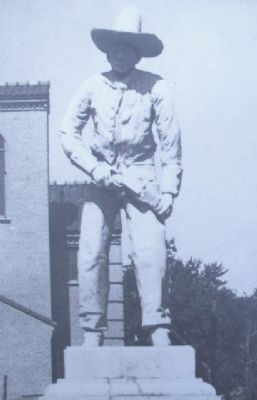
Photographed by Unknown, undated
5. Image on Dodge City, a frontier legend Marker
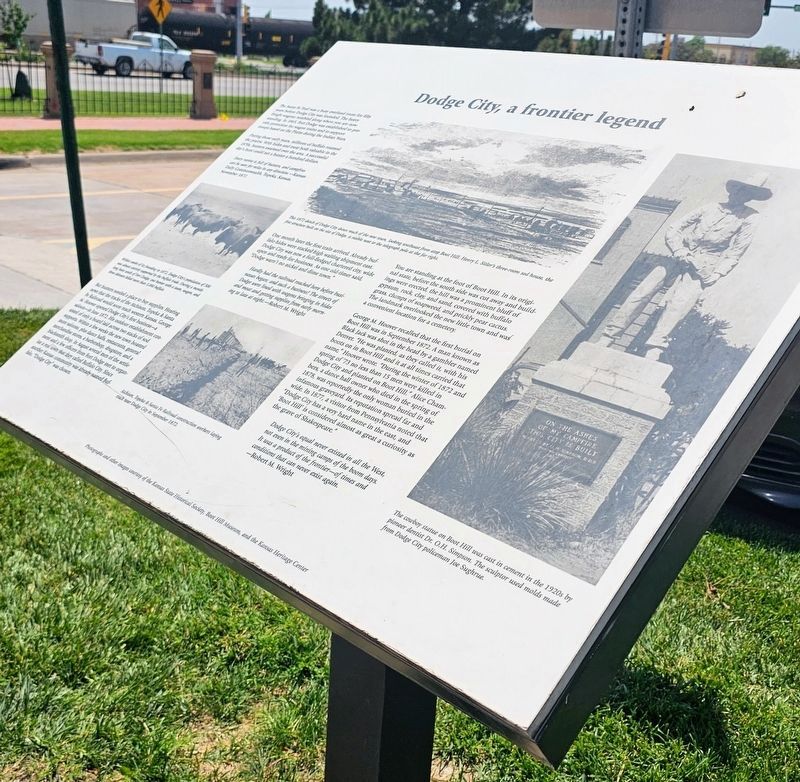
Photographed by Ian Lefkowitz, June 29, 2023
6. Dodge City, a frontier legend Marker
Credits. This page was last revised on April 8, 2025. It was originally submitted on May 11, 2013, by William Fischer, Jr. of Reynoldsburg, Ohio. This page has been viewed 1,166 times since then and 52 times this year. Photos: 1, 2, 3, 4, 5. submitted on May 11, 2013, by William Fischer, Jr. of Reynoldsburg, Ohio. 6. submitted on March 27, 2025, by Ian Lefkowitz of New York, New York.
