Dodge City in Ford County, Kansas — The American Midwest (Upper Plains)
Dodge City, full of excitement
Photographed by William Fischer, Jr., November 10, 2012
1. Dodge City, full of excitement Marker
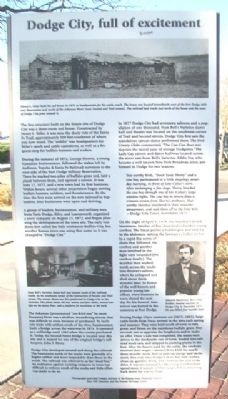
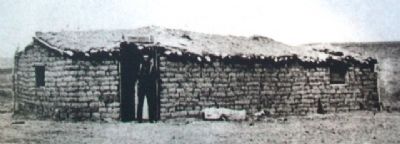
The first structure built on the future site of Dodge City was a three-room sod house. Constructed by Henry L. Sitler, it was near the dusty ruts of the Santa Fe Trail, approximately 500 feet southwest of where you now stand. The "soddie" was headquarters for Sitler's ranch and cattle operations, as well as a frequent stop for buffalo hunters and traders.
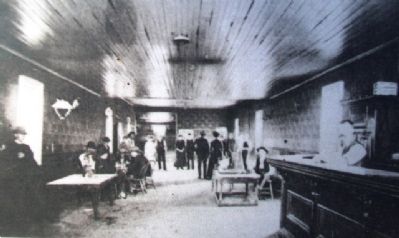
During the summer of 1872, George Hoover, a young Canadian businessman, followed the stakes left by Atchison, Topeka & Santa Fe Railroad surveyors to the west side of the Fort Dodge Military Reservation. There he stacked two piles of buffalo-grass sod, laid a plank between them, and opened a saloon. It was June 17, 1872, and a new town had its first business. Within hours, several other proprietors began serving buffalo hunters, soldiers, and frontiersmen. By the time the first train arrived on the new railroad in September, nine businesses were open and thriving.
A group of leaders, businessmen, and military men from Forts Dodge, Riley, and Leavenworth organized a town company on August 15, 1872, and began planning the development of the town site. The early residents first called the little settlement Buffalo City, but another Kansas town was using that name so it was changed to "Dodge City."
The Arkansas (pronounced "are-KAN-zus" by most Kansans) River was a shallow, meandering stream that was difficult to cross because of quicksand. To facilitate trade with settlers south of the river, businessmen built a bridge across the waterway in 1874. It operated as a tollbridge until 1885 when the county purchased it. Today, the Second Street bridge is located near this site and is named for one of the original bridge's tollkeepers, John T. Riney.
Dodge City developed around and along the railroad. The businesses north of the tracks were generally of a higher
this page online
In 1877 Dodge City had seventeen saloons and a population of one thousand. Ham Bell's Varieties dance hall and theater was located on the southwest corner of Trail and Second streets. Dodge City first saw the scandalous cancan dance performed there. The Ford County Globe commented, "The Can-Can does not deprave the moral taste of average Dodgeites." The Lady Gay saloon and dance hall was located across the street east from Bell's Varieties. Eddie Foy, who became a well-known New York Broadway actor, performed in Dodge for two seasons.
Two worthy birds, "Stock Yards Shorty" and a cow boy, participated in a little slugology yesterday morning, in front of Jake Collar's store. After exchanging a few slugs, Shorty knocked the cow boy through one of Mr. Collar's large window lights. The cow boy in return drew a crimson stream from Shorty's proboscis. Our worthy Marshal interfered in their innocent amusement, and took them off to the lime kiln.
-
Photographed by William Fischer, Jr., November 10, 2012
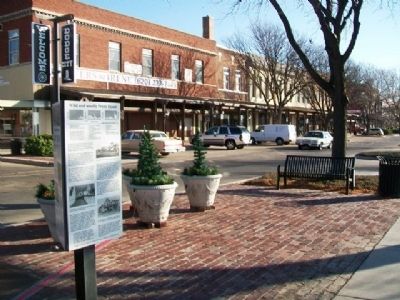
2. Dodge City, full of excitement Marker
On the night of April 9, 1878, city marshal Edward Masterson, brother of Bat, disarmed a drunken young cowboy. The Texan pulled a hidden gun and shot Ed in the abdomen, setting the lawman's clothes on fire. In a rapid-fire series of shots that followed, the cowboy and another man involved in the fight were wounded (the cowboy fatally). The marshal then walked north across the tracks into Hoover's saloon, where he collapsed and died about thirty minutes later. In honor of the well-known and popular young law officer, every business in town closed the next day for his funeral. Masterson was buried in the cemetery at Fort Dodge.
During Dodge City's cowtown era (1875-1885), large cattle herds from Texas arrived in the area each spring and summer. They were held south of town to rest, graze, and fatten on the nutritious buffalo grass. Buyers rode out to appraise the longhorns and to make an offer. Once a sale was completed, the steers were driven to the stockyards east of town, loaded into railroad stock cars, and shipped to packing plants in the East. After the buyers paid for the cattle, the cowboys received
Photographed by Unknown, circa 1870s
3. Image on Dodge City, full of excitement Marker
Photographs and other images courtesy of the Kansas State Historical Society, Boot Hill Museum, and the Kansas Heritage Center.
Topics. This historical marker is listed in these topic lists: Animals • Industry & Commerce • Roads & Vehicles • Settlements & Settlers. A significant historical date for this entry is April 9, 1875.
Location. 37° 45.178′ N, 100° 1.152′ W. Marker is in Dodge City, Kansas, in Ford County. It is at the intersection of Front Street and 2nd Avenue, on the left when traveling west on Front Street. Touch for map. Marker is in this post office area: Dodge City KS 67801, United States of America. Touch for directions.

Regionally, this marker is in the American Midwest, in the Corn Belt, on the prairies, on the Great Plains, on the Southern Plains, on the High Plains,
Photographed by Unknown, circa 1870s
4. Image on Dodge City, full of excitement Marker
Other nearby markers. At least 8 other markers are within walking distance of this marker: Wild and woolly Front Street (here, next to this marker); Longhorn cattle arrive (here, next to this marker); El Capitan (a few steps from this marker); Charles Rath (a few steps from this marker); Dennis Weaver (a few steps from this marker); Fidelity State Bank (within shouting distance of this marker); Milburn Stone (within shouting distance of this marker); James Arness (within shouting distance of this marker). Touch for a list and map of all markers in Dodge City.
Also see . . .
1. Dodge City Convention & Visitor’s Bureau. Website homepage (Submitted on December 27, 2021, by Larry Gertner of New York, New York.)
2. Kansas Cattle Towns. Website homepage (Submitted on May 11, 2013, by William Fischer, Jr. of Reynoldsburg, Ohio.)
3. A Cowboy in Dodge City, 1882.
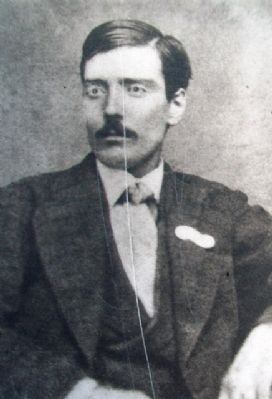
Photographed by Unknown, circa 1870s
5. Image on Dodge City, full of excitement Marker
4. Cowtowns. Kanssapeia website entry (Submitted on May 11, 2013, by William Fischer, Jr. of Reynoldsburg, Ohio.)
5. Cattle Towns. Encyclopedia of the Great Plains website entry (Submitted on May 11, 2013, by William Fischer, Jr. of Reynoldsburg, Ohio.)
6. Ed Masterson. Wikipedia entry (Submitted on May 12, 2013, by William Fischer, Jr. of Reynoldsburg, Ohio.)
Credits. This page was last revised on December 15, 2024. It was originally submitted on May 11, 2013, by William Fischer, Jr. of Reynoldsburg, Ohio. This page has been viewed 2,804 times since then and 189 times this year. Photos: 1, 2, 3, 4. submitted on May 11, 2013, by William Fischer, Jr. of Reynoldsburg, Ohio. 5. submitted on May 12, 2013, by William Fischer, Jr. of Reynoldsburg, Ohio.
