Tiberias in Kinneret, Northern District, Israel — West Asia (the Levant in the Middle East)
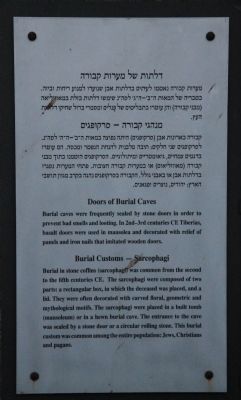
Doors of Burial Caves
⎯⎯⎯
Burial Customs - Sarcophagi
Photographed by Dale K. Benington, March 6, 2013
1. Doors of Burial Caves / Burial Customs - Sarcophagi Marker
Doors of Burial Caves
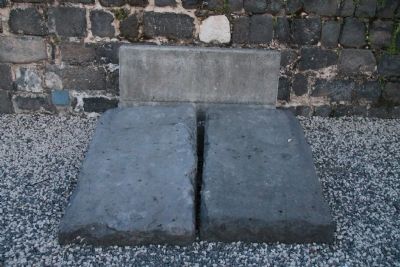
Burial caves were frequently sealed by stone doors in order to prevent bad smells and looting. In 2nd-3rd centuries CE Tiberias, basalt doors were used in mausolea and decorated with relief of panels and iron nails that imitated wooden doors.
Burial Customs - Sarcophagi
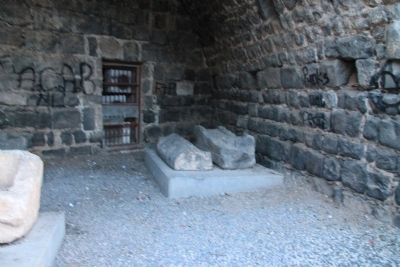
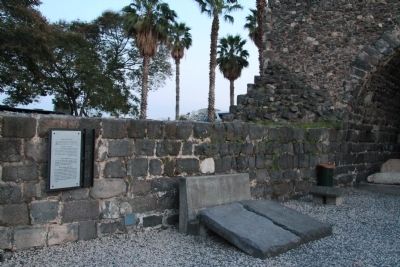
Burial in stone coffins (sarcophagi) was common from the second to the fifth centuries CE. The sarcophagi were composed of two parts: a rectangular box, in which the deceased was placed, and a lid. They were often decorated with carved floral, geometric and mythological motifs. The sarcophagi were placed in a built tomb (mausoleum) or in a hewn burial cave. The entrance to the cave was sealed by a stone door or a circular rolling stone. This burial custom was common among the entire population: Jews, Christians and pagans.
Erected by The municipality of Tiberias, Tourism Department.
Topics and series. This historical marker is listed in this topic list: Anthropology & Archaeology. In addition, it is included in the The Tiberias Archeological Park series list.
Location. 32° 47.141′ N, 35° 32.527′ E. Marker is in Tiberias, Northern District, in Kinneret. It is on Ha-Banim Street (National Route 90) close to HaGalil, on the right when traveling north. This historical marker is located on the south side of the downtown Tiberias business district, affixed to an ancient wall, that is inside a small archaeological park situated directly in front (to the west) of the Leonardo Plaza Hotel. Touch for map. Marker is at or near this postal address: Ha-Banim St 35, Tiberias, Northern District, Israel. Touch for directions.

Regionally, it is in Asia, specifically in West Asia, in the Middle East, in The Levant, on the Red Sea, in a coastal Mediterranean country, and
this page online
Other nearby markers. At least 8 other markers are within walking distance of this marker: The Synagogue (a few steps from this marker); The Architecture of Tiberias (within shouting distance of this marker); Domestic Building (within shouting distance of this marker); The Crusader-Ottoman Building / Millstones (within shouting distance of this marker); "Magic on the sea of galilee..." (within shouting distance of this marker); The Southern Wall (about 90 meters away, measured in a direct line); Remains of the Watch Tower (approx. 0.3 kilometers away); Liberation of Tiberias Memorial (approx. 0.4 kilometers away). Touch for a list and map of all markers in Tiberias.
Also see . . . Tiberias at Wikipedia. (Submitted on May 16, 2013, by Dale K. Benington of Toledo, Ohio.)
Photographed by Dale K. Benington, March 6, 2013
2. Doors of Burial Caves / Burial Customs - Sarcophagi Marker
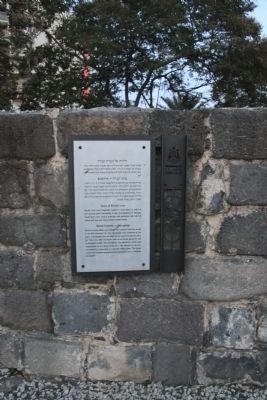
View of the historical marker affixed to an ancient wall.
Photographed by Dale K. Benington, March 6, 2013
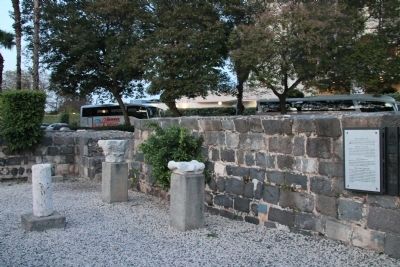
3. Doors of Burial Caves / Burial Customs - Sarcophagi Marker
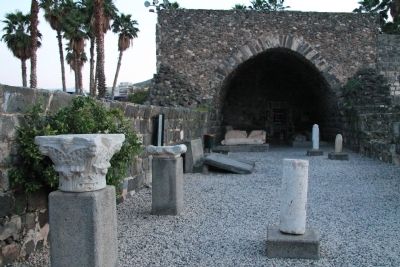
View of the archaeological park's courtyard where the historical marker is located. The historical marker is seen (barely) affixed to the left wall, midway between the ancient building and the column in the left foreground of the picture.
Photographed by Dale K. Benington, March 6, 2013
4. Burial Customs - Sarcophagi
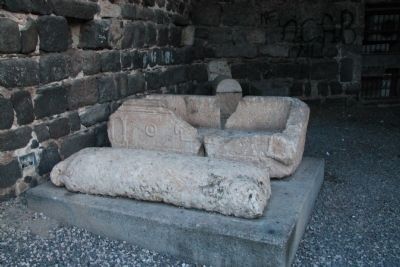
View of a sarcophagi, situated in the vaulted chamber of the ancient building, that is located at the southern end of the archaeological park courtyard, where the historical marker is located.
Photographed by Dale K. Benington, March 6, 2013
5. Burial Customs - Sarcophagi
View of a second sarcophagi, situated in the same vaulted chamber of the ancient building, that is located at the southern end of the archaeological park courtyard, where the historical marker is located.
Photographed by Dale K. Benington, March 6, 2013
6. Doors of Burial Caves / Burial Customs - Sarcophagi Marker
View of the historical marker situated just to the left of a pair of doors of burial caves.
Photographed by Dale K. Benington, March 6, 2013
7. Doors of Burial Caves
View of a pair of burial cave doors, located in the archaeological park courtyard.
Photographed by Dale K. Benington, March 6, 2013
8. Doors of Burial Caves / Burial Customs - Sarcophagi Marker
View, looking northeast, of the historical marker, affixed to an ancient wall in the Tiberias Archaeological Park.
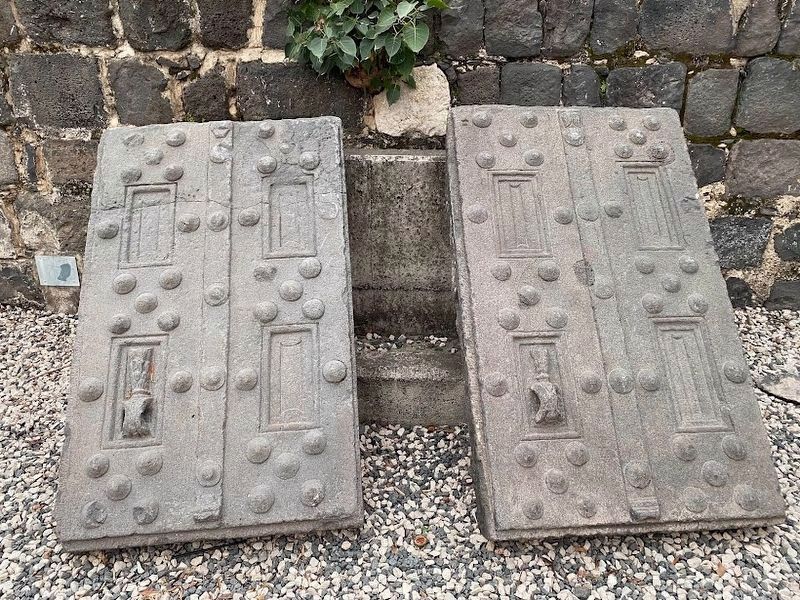
Photographed by Darren Jefferson Clay
9. Doors of Burial Caves
Credits. This page was last revised on May 7, 2023. It was originally submitted on May 15, 2013, by Dale K. Benington of Toledo, Ohio. This page has been viewed 821 times since then and 18 times this year. Photos: 1, 2, 3, 4, 5, 6, 7, 8. submitted on May 15, 2013, by Dale K. Benington of Toledo, Ohio. 9. submitted on April 28, 2023, by Darren Jefferson Clay of Duluth, Georgia.
