
Old Town in Alexandria, Virginia — The American South (Mid-Atlantic)
The Marshall House
Photographed by Ronald J. Baumgarten, Jr.
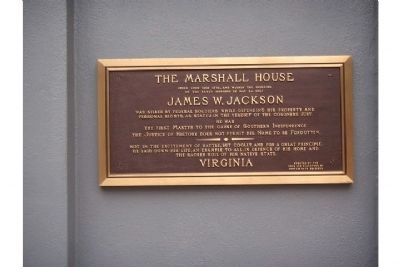
1. The Marshall House Marker on the Hotel Monaco
stood upon this site, and within the building
on the early morning of May 24, 1861
James W. Jackson
was killed by Federal soldiers while defending his property and
personal rights as stated in the verdict of the coroners jury.
He was
the first martyr to the cause of Southern Independence.
The justice of history does not permit his name to be forgotten.
Not in the excitement of battle, but coolly and for a great principle,
he laid down his life, an example to all, in defence of his home and
the sacred soil of his native state
Virginia
Erected by Sons and Daughters of Confederate Veterans.
Topics and series. This historical marker is listed in this topic list: War, US Civil. In addition, it is included in the Sons of Confederate Veterans/United Confederate Veterans series list. A significant historical date for this entry is May 24, 1999.
Location. Marker has been permanently removed. It was located near 38° 48.275′ N, 77° 2.643′ W. Marker was in Alexandria, Virginia. It was in Old Town. It was on King Street, on the right when traveling east. Touch for map. Marker was at or near this postal address: 480 King Street
this page online
We have been informed that this marker is no longer there and will not be replaced. This page is an archival view of what was.
Regionally, this marker was in the Washington Metropolitan Area and in Northern Virginia. It was also in the American South, specifically in the Upper South, in the Mid-Atlantic, and on the Eastern Seaboard. Globally, it was in the North Atlantic Region, North America, the Western Hemisphere, the Western World, and the Anglosphere. Historically, it found itself in what was once the territory of the Mississippian Culture, one of the original Thirteen Colonies, one of the Confederate States of America, and the Antebellum South.

Other nearby markers. At least 8 other markers are within walking distance of this location: Gadsby's Tavern Museum (within shouting distance of this marker); Electric Railway (within shouting distance of this marker); Market Square (within shouting distance of this marker); The Law Office of Cohen, Cohen, and Hirschkop (within shouting distance of this marker); Site of First Services of the Salvation Army
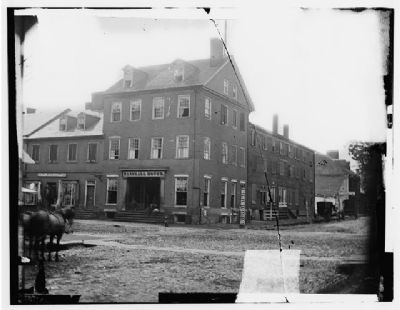
2. The Marshall House
Photo from the Library of Congress
More about this marker. The marker is affixed to a corner of the Hotel Monaco in Old Town Alexandria. It is located on the South Pitt Street and King Street corner of the building.
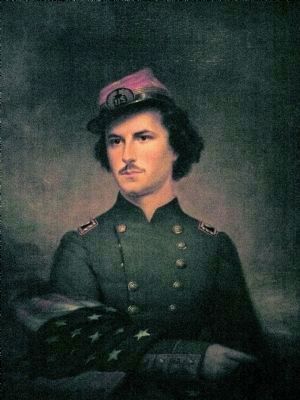
Regarding The Marshall House. On May 24, 1861 Union Col. Elmer E. Ellsworth of the 11th New York "Fire Zouaves" was shot to death by innkeeper James Jackson after having torn down the Stars and Bars flying from the roof of the hotel. Jackson in turn was killed on the spot by one of Ellsworth's men. In the immediate aftermath of Ellsworth's death, the young colonel and friend of President Lincoln became a martyr for the Northern cause. The South exalted Jackson as a defender of property rights in the face of Yankee aggression.
Also see . . .
1. Elmer Ellsworth. Biography of Ellsworth, who was killed by Jackson. (Submitted on August 1, 2010, by Ronald J. Baumgarten, Jr. of McLean, Virginia.)
2. Ft. Ward Museum Historic Site and Museum Collections.
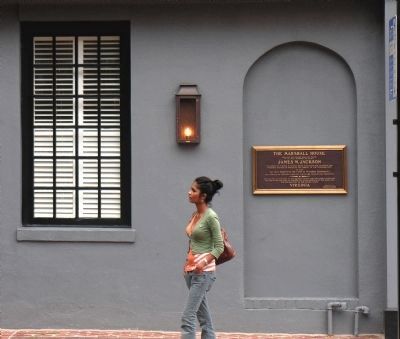
Photographed by Allen C. Browne, August 1, 2010
3. The Marshall House Marker
3. Life of James W. Jackson. the Alexandria hero, the slayer of Ellsworth, the first martyr in the cause of southern independence; containing a full account of the circumstances of his heroic death, and the many remarkable incidents in his eventful life, constituting a true history, more like romance than reality. Parrish & Willingham, 1862. (Submitted on February 21, 2015, by Allen C. Browne of Silver Spring, Maryland.)
4. Photo of the Marshall House flag on display in 2012. The flag is in the collections of the New York State Military Museum. The flag was conserved at the New York State Office of Parks, Recreation and Historic Preservation’s textile laboratory at Peebles Island in Waterford. (Submitted on April 22, 2020, by Mark Hilton of Montgomery, Alabama.)
Photographed by Allen C. Browne, August 1, 2010
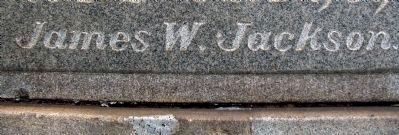
4. James W. Jackson's Name
on Alexandria's Confederate Monument
on Alexandria's Confederate Monument
Photographed by Allen C. Browne, April 13, 2014
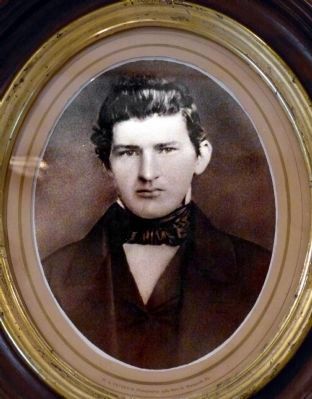
5. James W. Jackson
“In 1861 Jackson was 37 years old. His biographer described Jackson's face as “remarkable” in its expression…Grim, stern, obstinate determination was stamped emphatically on every feature. The forehead was low, and on it the hair, always slightly short, stood up defiantly.“ — Fort Ward Museum.
Photographed by Allen C. Browne, April 13, 2014
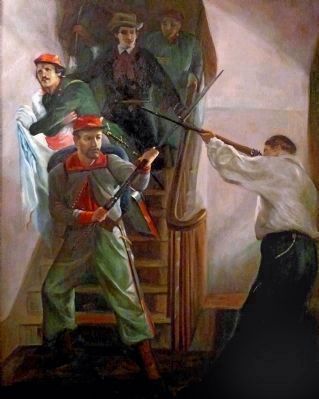
6. The Death of Colonel Ellsworth
In this ca. 1862 painting by Alonzo Chappel, James W. Jackson shoots Elmer Ellsworth at the Marshall House; Corporal Brownell in the center is about to shoot Jackson in turn. On the stair behind Ellsworth is NY Tribune reporter Edward H. House. On display at the Fort Ward Museum.
Photographed by Allen C. Browne, April 13, 2014
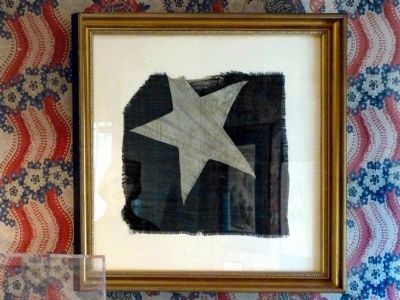
7. Section of the Marshall House Flag
“Alexandria innkeeper James Jackson raised the city's first Confederate flag over the Marshall House in April of 1861 after hearing news of the Virginia Convention's act to adopt a state ordinance of secession. Made by an Alexandria sailmaker and his family, the flag was patterned after the “Stars and Bars,” with red and white bars and a circle of seven stars on a blue field. An eighth star was added in the center for Virginia. Can you see the stain on a portion of the star? It is believed to be Elmer Ellsworth's blood. The largest section of the Marshall house flag is in the historical collections of the New York State Division of Military and Naval Affairs.” — Fort Ward Museum.
Photographed by Allen C. Browne, April 13, 2014
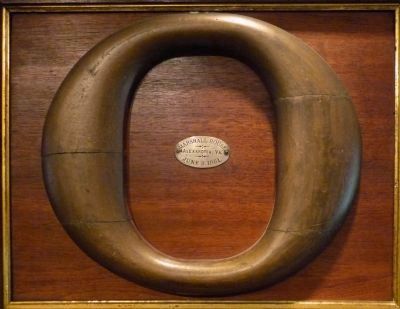
8. “O” from the Marshall House Sign
“The Marshall House became a mecca for souvenir hunters after the deaths of Ellsworth and Jackson. A Union soldier from Rhode Island documented in a letter how he had taken a portion of the building's exterior sign “…I got in Alexandria at the Marshall House where Ellsworth was killed (took) the letter “O” of the sign off the house. They are built of gilt letters…” The soldier also obtained pieces of the stairway and banister as mementos. This practice was so common that by 1862 when the American writer Nathaniel Hawthorne visited the Marshall house, he wrote “The memorial-hunters have completely cut away the original woodwork…thus it becomes something like a metaphysical question whether the place of the murder actually exists.” — Fort Ward Museum.
Photographed by Allen C. Browne, December 20, 2011
9. Colonel Elmer Ellsworth
Photographed by Allen C. Browne, April 13, 2014
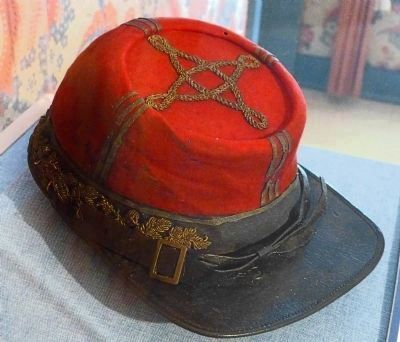
10. Kepi belonging to Colonel Elmer Ellsworth
“Col. Elmer Ellsworth was celebrated in the early days of the Civil War as a Union hero whose death in Alexandria, Virginia claimed him as the North's First Martyr. Ellsworth popularized the Zouave movement in America by organizing the Chicago Zouave Cadets in 1859. At the beginning of the Civil War, he raised the 11th New York “Fire” Zouaves, a regiment which participated in the Federal occupation of Alexandria on May 24, 1861. Zouave officers usually wore red kepis, a color typical of Zouave uniforms. Ellsworth's kepi reflects how officer' caps were often decorated with rows of gold braid, which indicated rank, and a Hungarian know design on the crown. The three vertical gold stripes on the sides of the cap's crown signified a field officer.” — Fort Ward Museum
Photographed by Allen C. Browne, August 1, 2010
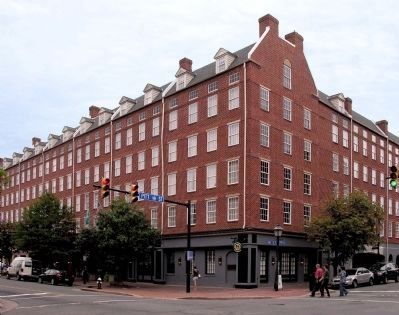
11. Hotel Monaco
Today the site of the Marshall House at King and Pitt Streets is occupied by the Hotel Monaco.
Photographed by Allen C. Browne, August 1, 2010
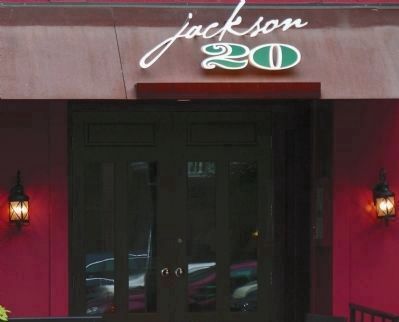
12. Jackson 20
Strangely, “Jackson 20”, the bar at the Hotel Monaco, is named for Andrew Jackson, not James W. Jackson.
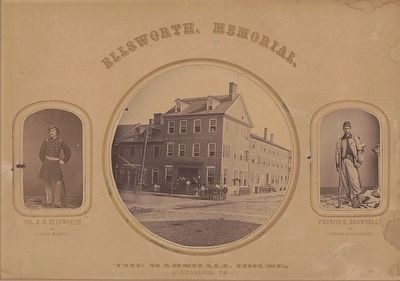
Photographed by Brady's National Photographic Portrait Galleries, 1861
13. Ellsworth. Memorial...
Full title:Ellsworth. Memorial Col. E.E. Ellsworth, the patriot martyr. The Marshall house, Alexandria, Va. Francis E. Brownell, the avenger of Ellsworth.
Photographs show Colonel Elmer Ellsworth of Field and Staff, 11th New York Infantry Regiment; Marshall House at the corner of King and Pitt Streets, Alexandria, Virginia, the scene of the assassination of Col. Ellsworth on May 24, 1861; and Lieutenant Francis Brownell of Co. A, 11th New York Infantry Regiment, who killed James Jackson after he murdered Col. Ellsworth. -- Library of Congress
(Click on image to enlarge)
Photographs show Colonel Elmer Ellsworth of Field and Staff, 11th New York Infantry Regiment; Marshall House at the corner of King and Pitt Streets, Alexandria, Virginia, the scene of the assassination of Col. Ellsworth on May 24, 1861; and Lieutenant Francis Brownell of Co. A, 11th New York Infantry Regiment, who killed James Jackson after he murdered Col. Ellsworth. -- Library of Congress
(Click on image to enlarge)
Credits. This page was last revised on January 28, 2023. It was originally submitted on July 31, 2010, by Ronald J. Baumgarten, Jr. of McLean, Virginia. This page has been viewed 5,458 times since then and 50 times this year. Last updated on May 24, 2013, by Ronald J. Baumgarten, Jr. of McLean, Virginia. Photos: 1, 2. submitted on July 31, 2010, by Ronald J. Baumgarten, Jr. of McLean, Virginia. 3, 4, 5, 6, 7, 8, 9, 10, 11, 12. submitted on February 21, 2015, by Allen C. Browne of Silver Spring, Maryland. 13. submitted on September 16, 2015. • Bill Pfingsten was the editor who published this page.
