Columbia Heights in Northwest Washington in Washington, District of Columbia — The American Northeast (Mid-Atlantic)
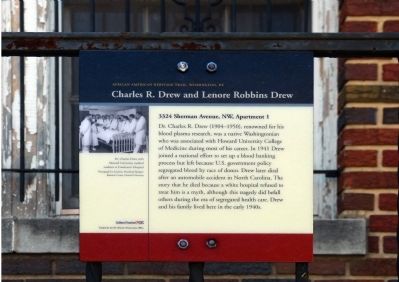
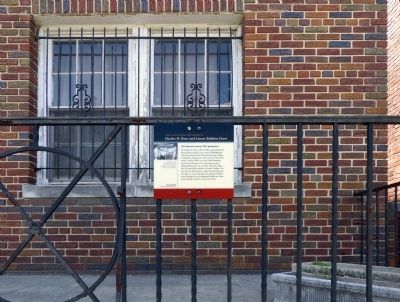
Charles R. Drew and Lenore Robbins Drew
3324 Sherman Avenue, NW, Apartment 1
| — | African American Heritage Trail, Washington DC | — |
Photographed by Allen C. Browne, May 25, 2013
1. Charles R. Drew and Lenore Robbins Drew Marker
Erected by Cultural Tourism DC.
Topics and series. This historical marker is listed in these topic lists: African Americans • Science & Medicine. In addition, it is included in the African American Heritage Trail, and the Historically Black Colleges and Universities series lists. A significant historical year for this entry is 1941.
Location. 38° 55.89′ N, 77° 1.605′ W. Marker is in Northwest Washington in Washington, District of Columbia. It is in Columbia Heights. It is on Sherman Avenue Northwest south of Morton Street Northwest, on the right.
this page online

Regionally, this marker is in the Washington Metropolitan Area. It is also in the American Northeast, in the Upper South, in the Mid-Atlantic, in the Tidewater, and in the Chesapeake Bay Region. Globally, it is in North America, the Western Hemisphere, the Western World, and the Anglosphere.
Other nearby markers. At least 8 other markers are within walking distance of this marker: Columbia Heights Green. (within shouting distance of this marker); Washington Parks & People (within shouting distance of this marker); Transformation. (about 300 feet away, measured in a direct line); Park Road Community Church (about 400 feet away); Nob Hill (about 600 feet away); A Changing Landscape (about 800 feet away); The Next Wave (approx. 0.2 miles away); Holmead Legacy (approx. 0.2 miles away). Touch for a list and map of all markers in Northwest Washington.
Also see . . . Patent For Preserving Blood Issued November 10, 1942.
Photographed by Allen C. Browne, May 25, 2013
2. Charles R. Drew and Lenore Robbins Drew Marker
Additional keywords. Medicine
Photographed by Allen C. Browne, May 25, 2013
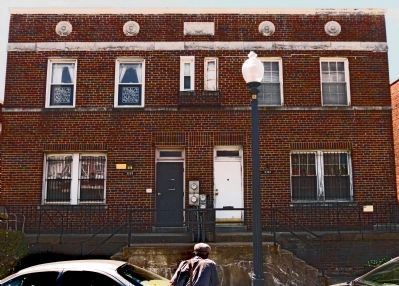
3. 3322 and 3324 Sherman Avenue
Photographed by Allen C. Browne, May 25, 2013
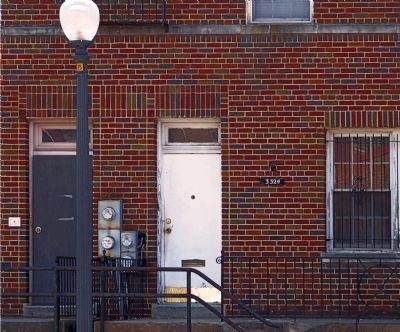
4. 3324 Sherman Avenue
Photographed by Wikipedia
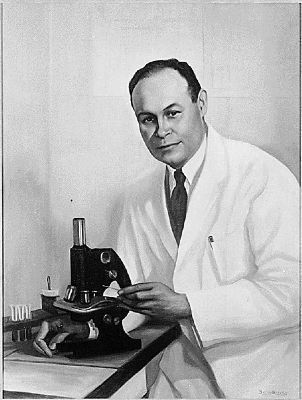
5. Charles R. Drew
Charles Richard Drew (June 3,1904 –April 1,1950) was an African-American physician, surgeon, and medical researcher. He researched in the field of blood transfusions, developing improved techniques for blood storage, and applied his expert knowledge to developing large-scale blood banks early in World War II. This allowed medics to save thousands of lives of the Allied forces. The research and development aspect of his blood storage work is disputed. As the most prominent African-American in the field, Drew protested against the practice of racial segregation in the donation of blood, as it lacked scientific foundation, an action which cost him his job. In 1943, Drew's distinction in his profession was recognized when he became the first black surgeon selected to serve as an examiner on the American Board of Surgery. -- Wikipedia (accessed 5/27/2013)
Credits. This page was last revised on January 30, 2023. It was originally submitted on May 27, 2013, by Allen C. Browne of Silver Spring, Maryland. This page has been viewed 1,110 times since then and 25 times this year. Photos: 1, 2, 3, 4, 5. submitted on May 27, 2013, by Allen C. Browne of Silver Spring, Maryland. • Bill Pfingsten was the editor who published this page.
