Le Sueur in Le Sueur County, Minnesota — The American Midwest (Upper Plains)
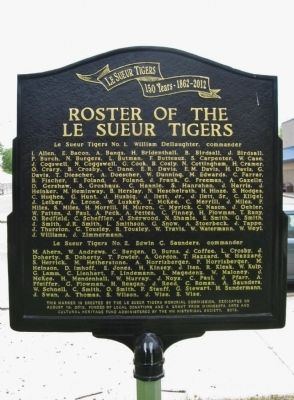
Roster of the Le Sueur Tigers
Le Sueur Tigers · 150 Years • 1862 – 2012
Photographed by K. Linzmeier, May 16, 2013
1. Roster of the Le Sueur Tigers Marker
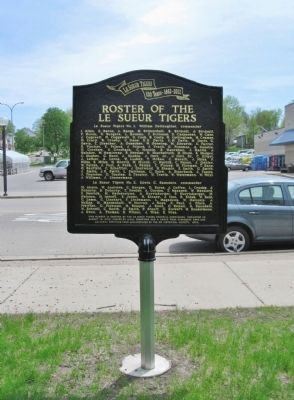
I. Allen, E. Bacon, A. Bangs, H. Bridenthall, B. Birdsall, J. Birdsall, P. Burch, N. Burgers, L. Butman, F. Butteauz, S. Carpenter, W. Case, J. Coggswell, G. Cook, B. Cosly, N. Cottingham, H. Cramer, O. Crary, B. Crosby, C. Dane, E.R. Davis, E.M. Davis, H. Davis, G. Davis, T. Diescher, A. Doescher, W. Dunning, M. Edwards, C. Farrar, B. Fischer, E. Foland, J. Foland, J. Frank, G. Freeman, A. Gazelle, D. Gershaw, S. Groshaus, C. Hannie, S. Hanrahan, J. Harris, J. Heinker, M. Heminway, B. Herslay, N. Heschelrath, H. Hinze, S. Hodges, C. Hughes, G. Hunt, J. Husbig, J. Ilett, Jr., J. Ilett, Sr., C. Kligel, J. Leiber, A. Leone, W. Luskey, T. McKee, C. Merrill, J. Miles, P. Miles, H. Morrill, H. Muron, C. Myrick, C. Nason, J. Oehler, W. Patten, J. Paul, A. Peck, A. Pettes, C. Pinney, H. Plowman, T. Rany, O. Redfield, C. Scheffler, J. Sherwood, N. Shamle, E. Smith, G. Smith, J. Smith, J.R. Smith, L. Smithson, G. Snow, A. Stoerbeck, J. Tappe,
this page online
M. Ahern, W. Andrews, C. Bergen, D. Burns, J. Coffee, L. Crosby, J. Doherty, S. Doherty, T. Fowler, A. Gordon, T. Hazzard, W. Hazzard, S. Herrick, M. Hetherstone, HMdb, A. Horrisberger, P. Horrisberger, M. Heinson, D. Imhoff, E. Jones, H. Kinsey, J. Iten, R. Kleak, W. Kulp, G. Lamm, C. Lienhart, F. Lindemann, L. Magedenz, W. Maloney, J. McKee, H. Mendenhall, W. Murray, J. Noys, C. Paul, J. Pfarr, A. Pfeiffer, G. Plowman, H. Reagan, J. Reed, C. Roman, A. Saunders, W. Schnell, C. Smith, O. Smith, P. Stauff, G. Stewart, H. Sundermann, J. Swan, A. Thomas, S. Wilson, J. Wise, S. Wise.
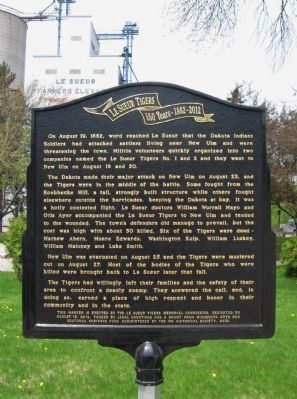
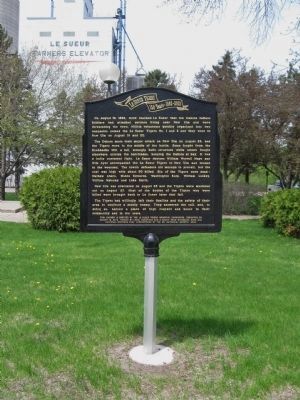
On August 19, 1862, word reached Le Sueur that the Dakota Indians Soldiers had attacked settlers living near New Ulm and were threatening the town. Militia volunteers quickly organized into two companies named the Le Sueur Tigers No. 1 and 2 and they went to New Ulm on August 19 and 20.
The Dakota made their major attack on New Ulm on August 23, and the Tigers were in the middle of the battle.
Photographed by K. Linzmeier, May 16, 2013
2. Le Sueur Tigers Marker
New Ulm was evacuated on August 25 and the Tigers were mustered out on August 27. Most of the bodies of the Tigers who were killed were brought back to Le Sueur later that fall.
The Tigers had willingly left their families and the safety of their area to confront a deadly enemy. They answered the call, and, in doing so, earned a place of high respect and honor in their community and in the state.
Erected 2012
Photographed by K. Linzmeier, May 16, 2013
3. Roster of the Le Sueur Tigers Marker
Topics and series. This memorial is listed in this topic list: Wars, US Indian. In addition, it is included in the Minnesota Historical Society series list. A significant historical year for this entry is 1862.
Location. 44° 27.738′ N, 93° 54.896′ W. Memorial is in Le Sueur, Minnesota, in Le Sueur County. It is on North Main Street (State Highway 112) south of Swan Street, on the right when traveling south. Marker is at Louise Park. Touch for map. Memorial is at or near this postal address: 118 North Main Street, Le Sueur MN 56058, United States of America. Touch for directions.

Regionally, this memorial is in the Minnesota River Valley. It is also in the American Midwest and in the Corn Belt. Globally, it is in North America, the Western Hemisphere, the Western World, and the Anglosphere. Historically, it finds itself in what was once Rupert’s Land, the territory of the Mississippian Culture, and the Louisiana Purchase.
Other nearby markers. At least 8 other markers are within 5 miles of this marker,
Photographed by K. Linzmeier, May 16, 2013
4. Le Sueur Tigers Marker
Also see . . .
1. Le Sueur Tigers Series. (Submitted on June 5, 2013.)
2. Minnesota in the Civil And Indian Wars 1861-1865. Google Books. (Submitted on June 5, 2013.)
3. Roster of the Le Sueur Tigers. (Submitted on June 5, 2013.)
4. Le Sueur Tigers. (Submitted on June 5, 2013.)
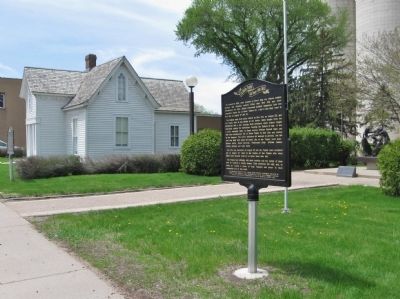
Photographed by K. Linzmeier, May 16, 2013
5. Le Sueur Tigers Marker
Credits. This page was last revised on June 16, 2016. It was originally submitted on June 5, 2013, by Keith L of Wisconsin Rapids, Wisconsin. This page has been viewed 1,226 times since then and 100 times this year. Photos: 1, 2, 3, 4, 5. submitted on June 5, 2013, by Keith L of Wisconsin Rapids, Wisconsin.
