
Clover in Halifax County, Virginia — The American South (Mid-Atlantic)
Henrietta Lacks
(1920-1951)
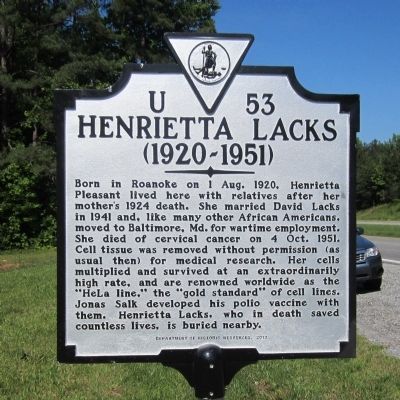
Photographed by Bernard Fisher, June 15, 2013
1. Henrietta Lacks Marker
Erected 2010 by Department of Historic Resources. (Marker Number U-53.)
Topics. This historical marker is listed in these topic lists: African Americans • Science & Medicine. A significant historical date for this entry is August 1, 1920.
Location. 36° 49.037′ N, 78° 44.143′ W. Marker is in Clover, Virginia, in Halifax County. It is at the intersection of James D Hagood Highway (U.S. 360) and Guill Town Road (Virginia Route 720), on the right when traveling east on James D Hagood Highway.
this page online

Regionally, this marker is in Virginia’s Piedmont, in Southside Virginia, and specifically in Central Virginia. It is also in the American South and specifically in the Upper South. Globally, it is in North America, the Western Hemisphere, the Western World, and the Anglosphere. Historically, it finds itself in what was once the territory of the Mississippian Culture, one of the original Thirteen Colonies, one of the Confederate States of America, and the Antebellum South.
Other nearby markers. At least 8 other markers are within 7 miles of this marker, measured as the crow flies: The Battle of Staunton River Bridge (approx. 4.9 miles away); Guarding A Lifeline (approx. 4.9 miles away); The Confederate Trail (approx. 4.9 miles away); Staunton River State Park (approx. 5 miles away); Wilson’s orders were to destroy the Richmond and Danville Railroad to the greatest extent possible (approx. 5.7 miles away); Roanoke Station (approx. 5.7 miles away); Wilson-Kautz Raid (approx. 5.7 miles away); Salem School
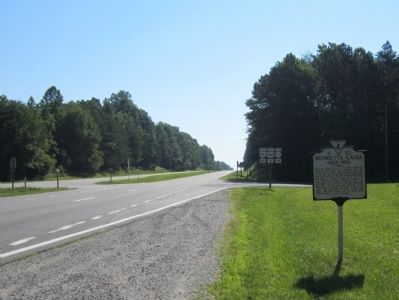
Photographed by Bernard Fisher, June 15, 2013
2. US 360 (facing east)
Another marker is no longer nearby. Staunton River State Park (was approx. 5 miles away but has been replaced with another marker now near it).
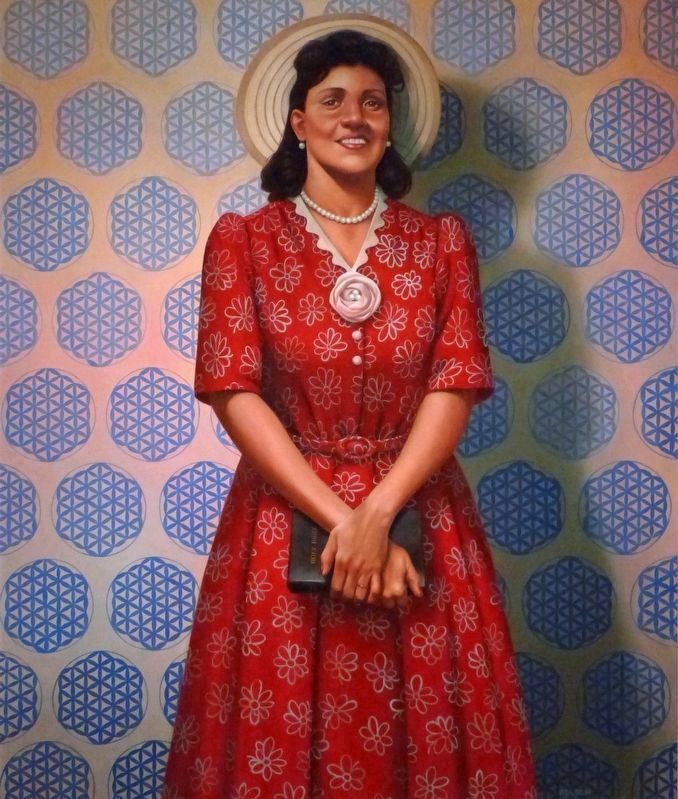
Photographed by Allen C. Browne, June 28, 2018
3. Henrietta Lacks (HeLa): The Mother of Modern Medicine
This 2017 portrait of Henrietta Lacks (1920-1951) by Kadir Nelson hangs in the National Portrait Gallery in Washington, DC.
“Henrietta Lacks, whose great-great-grandmother was enslaved, died of cervical cancer at age thirty-one. Upon her death, doctors discovered that cells from her body lived long lives and reproduced indefinitely in petri dishes. These ‘immortal’ HeLa cells have since contributed to over 10,000 medical patents relating to polio, AIDS, Parkinson's disease, and other conditions.
Considering the history of medical testing on African Americans without their consent, the fate of Lacks’s cells raises questions about ethics, privacy, and race. By addressing these issues forthrightly in The Immortal Life of Henrietta Lacks (2010), author Rebecca Skloot prompted Oprah Winfrey and HBO to make a film on the subject.
Kadir Nelson's portrait of Lacks uses visual elements to convey her legacy. The wallpaper features the ‘Flower of Life,’ a symbol of immortality. The pattern of her dress recalls cellular structures, and the garment's missing buttons signal the absence of those cells that were taken from her body, without permission.” – National Portrait Gallery
“Henrietta Lacks, whose great-great-grandmother was enslaved, died of cervical cancer at age thirty-one. Upon her death, doctors discovered that cells from her body lived long lives and reproduced indefinitely in petri dishes. These ‘immortal’ HeLa cells have since contributed to over 10,000 medical patents relating to polio, AIDS, Parkinson's disease, and other conditions.
Considering the history of medical testing on African Americans without their consent, the fate of Lacks’s cells raises questions about ethics, privacy, and race. By addressing these issues forthrightly in The Immortal Life of Henrietta Lacks (2010), author Rebecca Skloot prompted Oprah Winfrey and HBO to make a film on the subject.
Kadir Nelson's portrait of Lacks uses visual elements to convey her legacy. The wallpaper features the ‘Flower of Life,’ a symbol of immortality. The pattern of her dress recalls cellular structures, and the garment's missing buttons signal the absence of those cells that were taken from her body, without permission.” – National Portrait Gallery
Credits. This page was last revised on December 31, 2018. It was originally submitted on June 16, 2013, by Bernard Fisher of Richmond, Virginia. This page has been viewed 2,403 times since then and 234 times this year. Photos: 1, 2. submitted on June 16, 2013, by Bernard Fisher of Richmond, Virginia. 3. submitted on December 29, 2018, by Allen C. Browne of Silver Spring, Maryland.
