Bath in Beaufort County, North Carolina — The American South (South Atlantic)
James Adams Floating Theatre
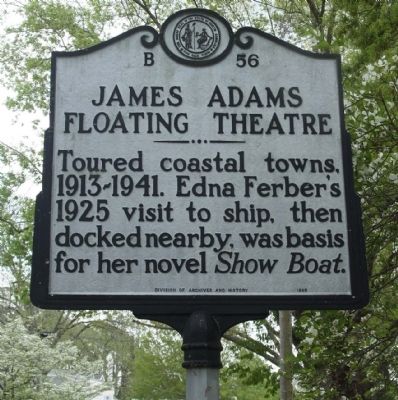
Photographed by Mike Stroud, April 19, 2013
1. James Adams Floating Theatre Marker
Erected 1989 by Division of Archives and History. (Marker Number B-56.)
Topics and series. This historical marker is listed in these topic lists: Arts, Letters, Music • Entertainment • Waterways & Vessels. In addition, it is included in the North Carolina Division of Archives and History series list. A significant historical year for this entry is 1925.
Location. 35° 28.613′ N, 76° 48.842′ W. Marker is in Bath, North Carolina, in Beaufort County. It is on South Main Street, on the right when traveling south. Touch for map. Marker is in this post office area: Bath NC 27808, United States of America. Touch for directions.

Regionally, this marker is in the Coastal Plain. It is also in the American South, specifically in the Upper South, in the Tidewater, and on the Eastern Seaboard. Globally, it is in the North Atlantic Region, North America, the Western Hemisphere, the Western World, and the Anglosphere. Historically, it finds itself in what was once the territory of the Mississippian
this page online
Other nearby markers. At least 8 other markers are within walking distance of this marker: Palmer-Marsh House (a few steps from this marker); First Public Library (within shouting distance of this marker); Matthew Rowan (within shouting distance of this marker); Colonial Bath (about 300 feet away, measured in a direct line); Port of Bath and Thomas Harding (about 400 feet away); First Post Road (about 400 feet away); a different marker also named Colonial Bath (about 600 feet away); Historic Bath (about 600 feet away). Touch for a list and map of all markers in Bath.
Regarding James Adams Floating Theatre. A bit of twentieth-century American cultural history had its origins in Bath, North Carolina’s oldest town. The scene was the James Adams Floating Theatre, a two-story scow measuring 132 feet long and thirty-four feet wide. Built in Washington, North Carolina, in 1913, the showboat was modeled on those that had plied the Mississippi, although it was never so ornate in appearance. The ship seated 700 and was
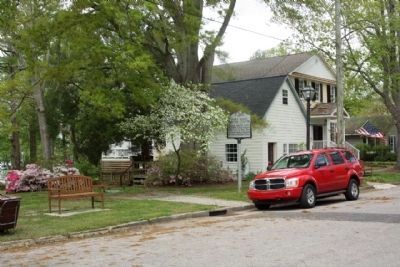
Photographed by Mike Stroud, April 19, 2013
2. James Adams Floating Theatre Marker, on South Main Street
Novelist Edna Ferber in 1924 won the Pulitzer Prize for her book So Big and hit upon the idea of using a showboat as the setting for her next work. Researching the subject, she learned of the James Adams and “dashed down to Carolina.” Arriving in Washington, she hired a driver to take her to the landing where the showboat rested. She got there just as they were putting up for the winter but determined to return the next spring. That she did, finding quarters for her four-day stay in Bath, which she described as a “decaying little hamlet.” She had little good to say of her
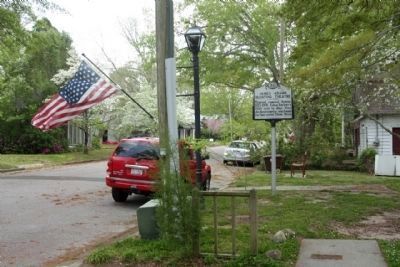
Photographed by Mike Stroud, April 19, 2013
3. James Adams Floating Theatre Marker, looking south along South Main Street
Edna Ferber was much more taken with the James Adams Floating Theatre than the town of Bath. She worked, played, rehearsed, and ate with the twenty-five-member company. “Those four days comprised the only show-boat experience I ever had,” she later wrote. Her novel, Show Boat, was published by Doubleday in 1926 and became an instant bestseller. In time it was adapted into a landmark musical by Jerome Kern and Oscar Hammerstein II. Three motion picture versions have been made, in 1929, 1936, and 1951. (North Carolina Office of Archives & History — Department of Cultural Resources)
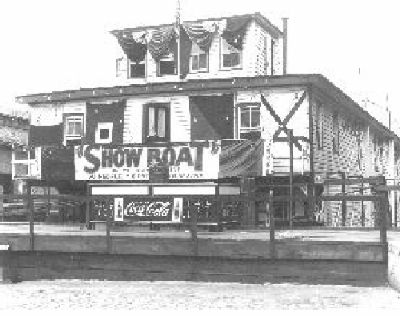
North Carolina Office of Archives & History — Department of Cultural Resources, `
4. James Adams Floating Theatre
Credits. This page was last revised on June 22, 2021. It was originally submitted on July 7, 2013, by Mike Stroud of Bluffton, South Carolina. This page has been viewed 1,342 times since then and 39 times this year. Photos: 1, 2, 3, 4. submitted on July 7, 2013, by Mike Stroud of Bluffton, South Carolina.
