Near Vienna in Dorchester County, Maryland — The American Northeast (Mid-Atlantic)
Handsell
The Steele Family Homestead
| — | A grand plantation home is destroyed and rebuilt. | — |
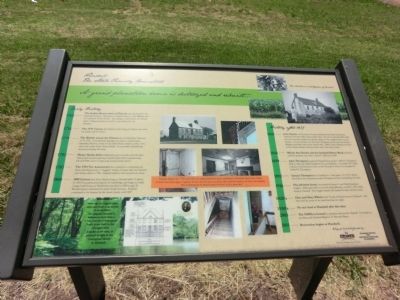
Photographed by Don Morfe, June 1, 2013
1. Handsell Marker
Early History
1768-The Indian Reservation at Chicone was dissolved by the Maryland Colony. 484 acres of Handsell went to Ann Billings and her husband, Henry Steele. According to oral history the Steeles built a “large pretentious home”, now believed to be Handsell.
1776-The 1776 Census lists Henry Steele living in Vienna area with this family and 91 slaves.
1779- The British attack the Vienna area several times between 1779-1781. Considerable damage was done to local homes including Weston, home of the John Henry family nearby. One slave was stolen from Henry Steele. It is possible Handsell was destroyed during that time.
1782-Henry Steele died in February, just 6 months after his dear friend and business partner Colonel John Henry passed away. He left 8000 acres of land and several dozen slaves.
1783-The 1783 Tax Assessment lists Handsell as containing one frame dwelling house, 5 “logged” home, 2 barns and one orchard. Ann Steele died in 1788. Handsell willed to her second son, Isaac.
1800-1800 Census lists Isaac Steele living at Handsell with 14 slaves. In 1803 he purchased property in Cambridge and began
this page online
History after 1837
1837-John Steele of Dorchester County purchased and built the present structure from the 18th century brick ruins.
1844-Mileah Ann Steele and her husband Robert Rook lived here until the property was sold to Jacob C. Wilson in 1849.
1859-John Thompson purchased Handsell from Jacob C. Wilson. Thompson died in 1862 and willed Handsell to his son Samuel E. An extant 1877 Map indicates Handsell, known then as the Thompson Farm was occupied by Samuel E. Thompson.
1916-The old brick house was rented by Harry E. and Della Bradshaw Hughes. Della gave birth to her first child, Blanche, on Feb. 9, 1916 while living at Handsell. The Hughes family left Handsell shortly after her birth.
1920’s-Glen and Mary Wilson lived “in the old brick home at Chicone”, and later told the story of the barn burning one night.
1930’s-No one lived at Handsell after this time.
2005-The NHPA is formed to purchase and restore Handsell. It is
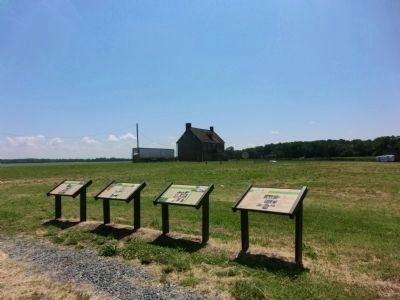
Photographed by Don Morfe, June 1, 2013
2. Handsell Marker
This marker is one of the four markers shown above.
2011-Restoration begins at Handsell
[Captions:]
Although no original plans exist, and there is no record of an architect, the original Handsell is believed to have been a 5-bay, two-story-with-garret brick home built in the Georgian style popular at the time, as pictured at right in the in the Conceptual Sketch of Handsell.
Sometime between 1770’s and 1803, the original plantation house experienced a devastation and partial collapse. Research and archaeology is ongoing, but it is clear the house was left in ruins with three walls of the house still standing. Was it destroyed by the British during the War or by a house fire?
Erected by Maryland Heritage Area Authority.
Topics. This historical marker is listed in these topic lists: Colonial Era • War, US Revolutionary. A significant historical month for this entry is February 1854.
Location. 38° 30.544′ N, 75° 48.769′ W. Marker is near Vienna, Maryland, in Dorchester County. It is on Indiantown Road. Touch for map. Marker is at or near this postal address: 4837 Indiantown Rd, Vienna MD 21869, United States of America.
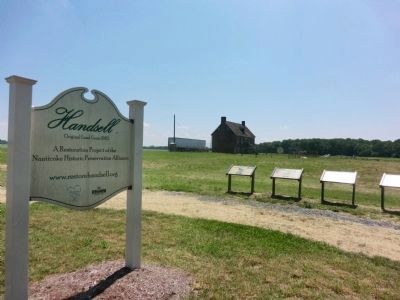
Photographed by Don Morfe, June 1, 2013
3. Handsell Marker
Handsell-Original Land Grant 1665-A Restoration Project of the Nanticoke Historic Preservation Alliance-www.restorehandsell.org

Regionally, this marker is on the Eastern Shore. It is also in the American Mid-Atlantic, on the Delmarva Peninsula, in the Tidewater, in the Chesapeake Bay Region, and on the Eastern Seaboard. Globally, it is in the North Atlantic Region, North America, the Western Hemisphere, the Western World, and the Anglosphere. Historically, it finds itself in what was once one of the original Thirteen Colonies and also the Antebellum South.
Other nearby markers. At least 8 other markers are within 2 miles of this marker, measured as the crow flies: The Nanticoke Historic Preservation Alliance (here, next to this marker); The native people of the Chicacone Village…the Nanticokes (here, next to this marker); The African American Story in the Indian Town… (here, next to this marker); The Nature Trail at Handsell…walk the footsteps of the Native People of Chicone and find these trees (within shouting distance of this marker); The Chicone Lodge, Garden and Work Shelter… (within shouting distance of this marker); Unnacokossimmon (approx. 1.7 miles away); John Smith Explores the Chesapeake (approx. 1.7 miles away);
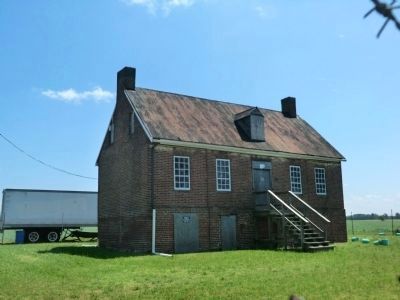
Photographed by Don Morfe, June 1, 2013
4. Handsell Marker
A photo of the Handsell Homestead
Also see . . . National Register Nomination Form. This form was prepared by Jaquelyn K. Bateman with the Nanticoke Historic Preservation Alliance, Inc. on August 3, 2007. The statement of historical significance is on page 5:
Handsell, also known as the Webb House, is located on Vienna Rhodesdale Road (formerly Indiantown Road), north of the town of Vienna in Dorchester County, Maryland. The late 18th century brick house is located in a rural agricultural area and sits on a two acre parcel surrounded by 1400 acres of farmland which has been placed under an agricultural conservation easement. The property bears the historic name of a 1665 land grant; the original 484 acre land grant has been in the Webb family since 1892. The current owners of the house, David and Carol Lewis, purchased Handsell and the two acres with the intention of preserving it and to study the history of the house and the land.(Submitted on October 11, 2026, by Devry Becker Jones of Washington, District of Columbia.)
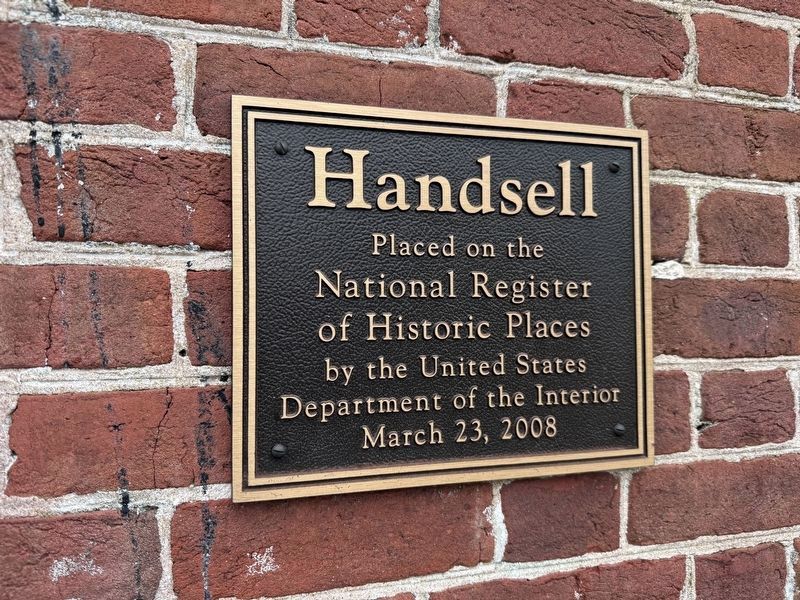
The house is a fine example of a late 18th century Georgian style manor house. It is a brick structure, one and ahalf stories over an English basement. The south fa9ade is laid in Flemish bond above a quarter-round molded water table. Handsell is five bays wide and has a central entrance holding a double door flanked by windows; the brickwork in this area projects from the wall surface by about four inches to suggest a pavilion. The windows on the south fa9ade have been reduced in width by about four inches and the original jack arches have been replaced with crude flat arches, the brickwork of which is not as fine as the original. The secondary elevations are laid in common bond, the east gable having a string course. There is an interior chimney in both gables and a single dormer on each side of the "A" roof. The interior retains a fair amount of original fabric including an early fireplace surround which has been removed to a protected site for restoration. The west side of the basement originally housed the kitchen, as evidenced by a cooking fireplace and the remains of a beehive oven, reputedly the only surviving oven of its kind on the Eastern Shore (Stump, 2005). The remainder of the basement was divided into two smaller rooms. A fire inPhotographed by Devry Becker Jones (CC0), October 11, 20265. National Register of Historic Places plaque for HandsellHandsell
Placed on the
National Register
of Historic Places
by the United States
Department of the Interior
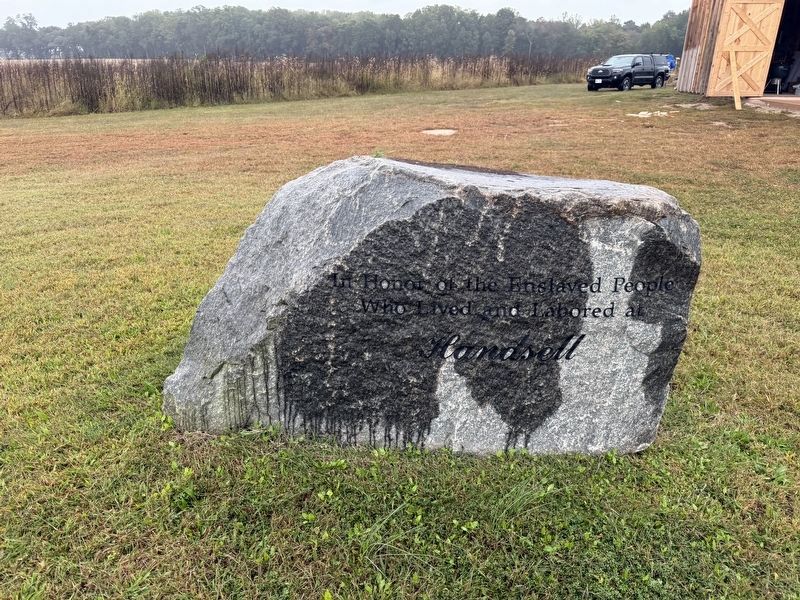
March 23, 2008the early 19th century required some exterior rebuilding to the rear and end walls, and the interior woodwork appears to date from the period 1810-20. The house has remained vacant for some seventy years, but despite deterioration and vandalism retains sufficient integrity to inform a comprehensive and accurate restoration.Photographed by Devry Becker Jones (CC0), October 11, 20266. Slavery acknowledgement rock on the grounds of HandsellIn honor of the enslaved people
who lived and labored at
Handsell
Credits. This page was last revised on October 11, 2026. It was originally submitted on July 10, 2013, by Don Morfe of Baltimore, Maryland. This page has been viewed 741 times since then and 55 times this year. Photos: 1, 2, 3, 4. submitted on July 10, 2013, by Don Morfe of Baltimore, Maryland. 5, 6. submitted on October 11, 2026, by Devry Becker Jones of Washington, District of Columbia. • Bill Pfingsten was the editor who published this page.
