Near Buellton in Santa Barbara County, California — The American West (Pacific Coastal)
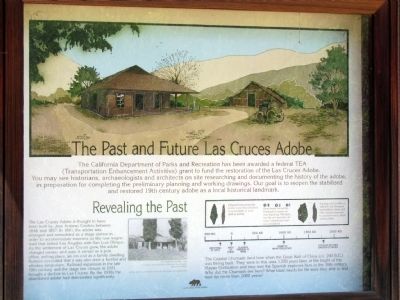
The Past and Future Las Cruces Adobe
Photographed by Duane Hall, June 30, 2013
1. The Past and Future Las Cruces Adobe Marker
Revealing the Past
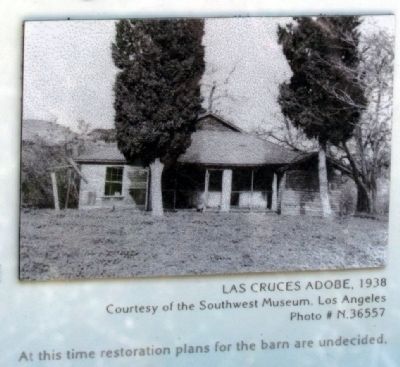
The Las Cruces Adobe is thought to have been built by Jose Antonio Cordero between 1846 and 1857. In 1861, the adobe was enlarged and remodeled as a stage station in order to accommodate travelers on the new wagon road that linked Los Angeles with San Luis Obispo. As the settlement of Las Cruces grew, the adobe changed owners and uses. It served as a post office, polling place, an inn and as a family dwelling. Rumors circulated that it was also once a brothel and whiskey emporium. Railroad expansion in the late 19th century and the stage line closure in 1901 brought a decline to Las Cruces. By the 1930s the abandoned adobe had deteriorated
this page online
Graphics Text
Chipped stone projectile points were often attached to arrowshafts or were used as knives.
Stone beads served the Chumash as money in their bartering. The more rare the raw material, the more valuable the bead was considered.
Lacking steel needles or drill bits, the Chumash used antlers, stones and other natural materials to puncture wood, shells and buckskin.
The Coastal Chumash lived here when the Great Wall of China (cir. 240 B.C.) was being built. They were in this area 1,200 years later, at the height of the Mayan Civilization and they met the Spanish explorers here in the 18th century. Why did the Chumash live here? What basic needs for life were they able to find here for more than 2,000 years?
Erected by California State Parks.
Topics. This historical marker is listed in these topic lists: Roads & Vehicles • Settlements & Settlers. A significant historical year for this entry is 1846.
Location. 34° 30.524′ N, 120° 13.691′ W. Marker is near Buellton, California, in Santa Barbara County. It can be reached from San Julian Road half a mile south of California Route 1. Marker may be
Photographed by Duane Hall, June 30, 2013
2. Las Cruces Adobe, 1938

Regionally, this marker is on the Central Coast, specifically on the Coast Ranges, and specifically in the Transverse Ranges. It is also on the American Pacific Coast. Globally, it is in North America, on the Ring of Fire, on the Pacific Rim, in the Western Hemisphere, in the Western World, and in the Anglosphere. Historically, it finds itself in what was once New Spain and also Mexico’s Alta California.
Other nearby markers. At least 8 other markers are within 2 miles of this marker, measured as the crow flies: Las Cruces • The Crosses (here, next to this marker); El Camino Real Bell (approx. 1.6 miles away); Gaviota Pass (approx. 1.6 miles away); Gaviota Timeline: 8) Gaviota Grows (approx. 1.6 miles away); Gaviota Timeline: 7) Highways and Byways (approx. 1.6 miles away); Gaviota Timeline: 6) America Expands (approx. 1.6 miles away); Gaviota Timeline: 5) California Ranchos (approx. 1.6 miles away); Gaviota Timeline: 4) Missions and Trade (approx. 1.6 miles
Photographed by Duane Hall, June 30, 2013
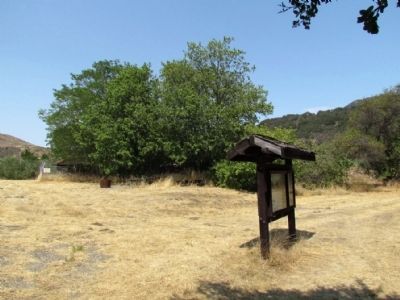
3. The Past and Future Las Cruces Adobe Marker
Photographed by Duane Hall, June 30, 2013
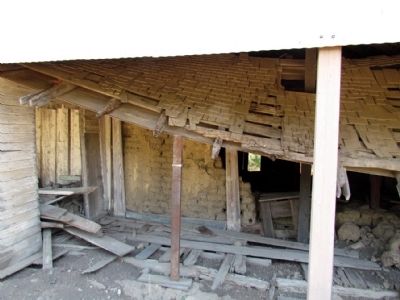
4. Las Cruces Adobe under Protective Roof
Credits. This page was last revised on June 16, 2016. It was originally submitted on July 31, 2013, by Duane Hall of Abilene, Texas. This page has been viewed 1,210 times since then and 65 times this year. Photos: 1, 2, 3, 4. submitted on July 31, 2013, by Duane Hall of Abilene, Texas.
