Canton in Stark County, Ohio — The American Midwest (Great Lakes)
The McKinley National Memorial
Photographed by Don Morfe, July 17, 2013
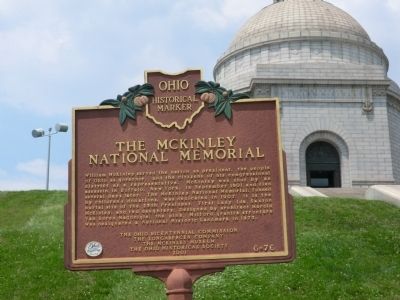
1. The McKinley National Memorial Marker
William McKinley served the nation as president, the people of Ohio as governor, and the citizens of his congressional district as a representative. McKinley was shot by an assassin in Buffalo, New York, in September 1901 and died several days later. The McKinley National Memorial, funded by children’s donations, was dedicated in 1907. It is the burial site of the 25th President, First Lady Ida Saxton McKinley, and two daughters. Designed by architect Harold Van Buren Magonigle, the pink Milford granite structure was designed a National Historic Landmark in 1975.
Erected 2001 by The Ohio Bicentennial Commission-The Longaberger Company, The McKinley Museum-The Ohio Historical Society. (Marker Number 6-76.)
Topics and series. This historical marker and memorial is listed in these topic lists: Cemeteries & Burial Sites • Government & Politics. In addition, it is included in the Former U.S. Presidents: #25 William McKinley, the National Historic Landmarks, and the Ohio Historical Society / The Ohio History Connection series lists. A significant historical month for this entry is September 1901.
Location. 40° 48.383′ N, 81° 23.55′ W.
this page online

Regionally, this marker and memorial is in Amish Country and in Greater Cleveland. It is also in the American Midwest. Globally, it is in North America, the Western Hemisphere, the Western World, and the Anglosphere. Historically, it finds itself in what was once the Haudenosaunee (Iroquois) Confederacy, the territory of the Mississippian Culture, and the Northwest Territory.
Other nearby markers. At least 8 other markers are within walking distance of this marker: A different marker also named McKinley National Memorial (a few steps from this marker); William McKinley (within shouting distance of this marker); a different marker also named William McKinley (within shouting distance of this marker); Ohio War Memorial (within shouting distance of this marker); Symbolism of the McKinley National Memorial (about 300 feet away, measured in a direct line); Building the McKinley National Memorial (about 300
Photographed by Don Morfe, July 17, 2013
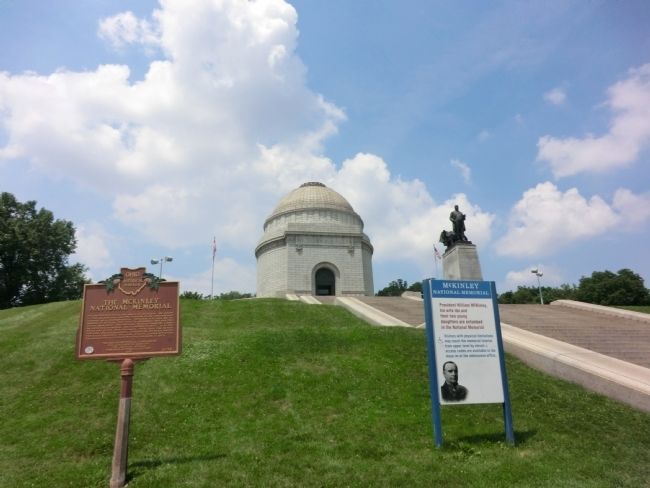
2. The McKinley National Memorial Marker
Also see . . . William McKinley Memorial. McKinley Presidential Library and Museum website entry (Submitted on August 9, 2013.)
Photographed by Don Morfe, July 17, 2013
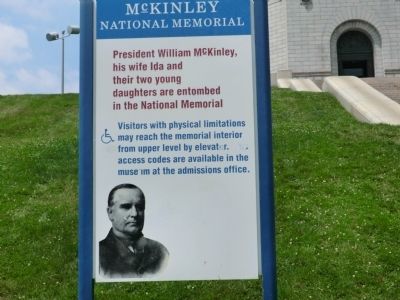
3. The McKinley National Memorial Marker
Photographed by Don Morfe, July 17, 2013
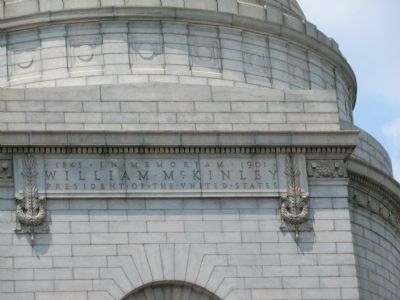
4. The McKinley National Memorial Marker
Photographed by Allen C. Browne, August 9, 2015
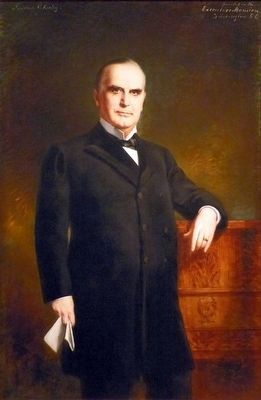
5. William McKinley
This 1897 portrait of William McKinley by August Benziger hangs in the National Portrait Gallery in Washington, DC.
“William McKinley's ‘front porch‘ campaign for the White House in 1896 consisted mainly of speeches delivered to well-wishers flocking by train to his Canton, Ohio, home. As president, the main focus of his administration lay in responding to calls for aid in Cuba's struggle against Spanish rule. Although reluctant to meddle, McKinley felt obliged to act when the American battleship Maine blew up in Havana harbor, and interventionists blamed it on the Spanish. The result was the Spanish-American War, which led to Cuba's independence and Spain's surrender of the Philippines, Puerto Rico, and Guam to the United States. Despite his own doubts about this turn of events, McKinley made the traditionally isolationist United States more visible in international politics.
One of several portraits derived from 1897-98 sittings at the White House, August Benziger's likeness testifies to McKinley's blandly funereal appearance. But housed in that uninteresting exterior was an unusual supply of warmth and charm that, as one observer put it, made McKinley ‘a marvelous manager of men.’” — National Portrait Gallery
“William McKinley's ‘front porch‘ campaign for the White House in 1896 consisted mainly of speeches delivered to well-wishers flocking by train to his Canton, Ohio, home. As president, the main focus of his administration lay in responding to calls for aid in Cuba's struggle against Spanish rule. Although reluctant to meddle, McKinley felt obliged to act when the American battleship Maine blew up in Havana harbor, and interventionists blamed it on the Spanish. The result was the Spanish-American War, which led to Cuba's independence and Spain's surrender of the Philippines, Puerto Rico, and Guam to the United States. Despite his own doubts about this turn of events, McKinley made the traditionally isolationist United States more visible in international politics.
One of several portraits derived from 1897-98 sittings at the White House, August Benziger's likeness testifies to McKinley's blandly funereal appearance. But housed in that uninteresting exterior was an unusual supply of warmth and charm that, as one observer put it, made McKinley ‘a marvelous manager of men.’” — National Portrait Gallery
Photographed by Bill Coughlin, August 6, 2015
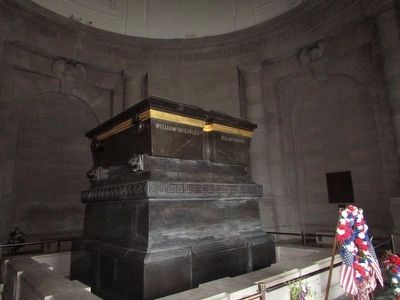
6. McKinkey Sarcophagus
The bodies of President and Mrs. McKinley were laid to rest inside the memorial.
Photographed by Ian Lefkowitz, May 23, 2025
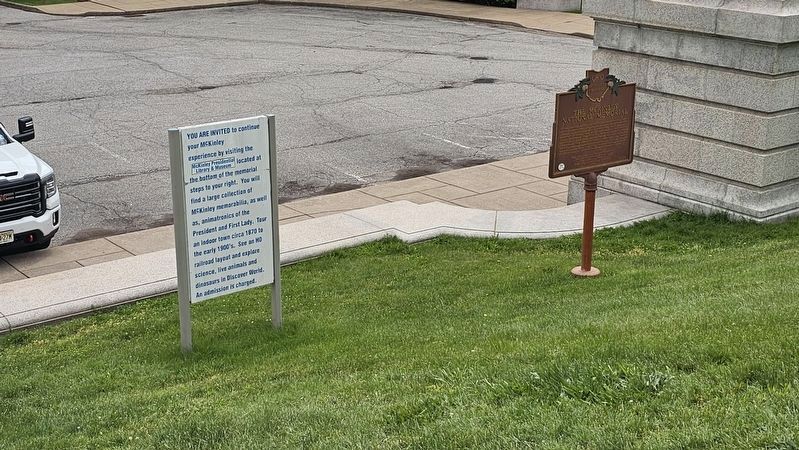
7. The McKinley National Memorial
The reverse side of the historical marker, located next to a sign that encourages visitors to enjoy the museums located within the McKinley Presidential Library complex.

Photographed by Ian Lefkowitz, May 23, 2025
8. The McKinley National Memorial
Inside the memorial, a detailed marker discusses many of the architectural features of the McKinley Monument.
Credits. This page was last revised on June 16, 2025. It was originally submitted on August 8, 2013, by Don Morfe of Baltimore, Maryland. This page has been viewed 1,078 times since then and 57 times this year. Photos: 1, 2, 3, 4. submitted on August 8, 2013, by Don Morfe of Baltimore, Maryland. 5. submitted on September 9, 2015, by Allen C. Browne of Silver Spring, Maryland. 6. submitted on August 6, 2015, by Bill Coughlin of Woodland Park, New Jersey. 7, 8. submitted on June 11, 2025, by Ian Lefkowitz of New York, New York. • Al Wolf was the editor who published this page.
