Tupelo in Lee County, Mississippi — The American South (East South Central)
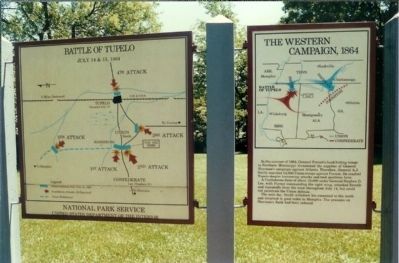
Battle of Tupelo
The Western Campaign, 1864
Photographed by Mike Stroud
1. Battle of Tupelo • The Western Campaign , 1864
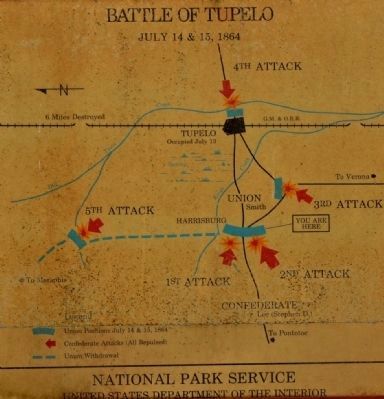
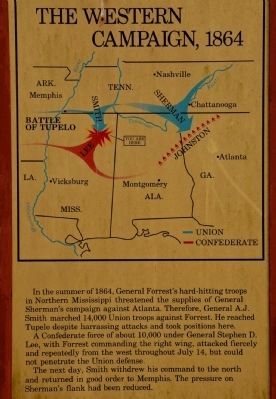
In the summer of 1864, General Forrest's hard hitting troops in Northern Mississippi threatened the supplies of General Sherman's campaign against Atlanta. Therefore, General A. J. Smith marched 14,000 Union troops against Forrest. He reached Tupelo despite harassing attacks and took positions here. A Confederate force of about 10,000 under General Stephen D. Lee, with Forrest commanding the right wing, attacked fiercely and repeatedly from the west throughout July 14, but could not penetrate the Union defense. The next day, Smith withdrew his command to the north and returned in good order to Memphis. The pressure on Sherman's flank had been reduced.
Erected by National Park Service, U.S. Department of the Interior.
Topics. This historical marker is listed in this topic list: War, US Civil. A significant historical date for this entry is July 14, 1862.
Location. 34° 15.336′ N, 88° 44.207′ W. Marker is in Tupelo, Mississippi, in Lee County. It is at the intersection of West Main Street (U.S. 278) and Monument Drive, on the right when traveling east on West Main Street. Touch for map. Marker is in this post office area: Tupelo
this page online

Regionally, this marker is in andspecifically ast Mississippi in the North Mississippi Hills. It is also in the American South and specifically in the Deep South. Globally, it is in North America, a Gulf of Mexico state, the Western Hemisphere, the Western World, and the Anglosphere. Historically, it finds itself in what was once the territory of the Mississippian Culture, one of the Confederate States of America, and the Antebellum South.
Other nearby markers. At least 8 other markers are within 2 miles of this marker, measured as the crow flies: A different marker also named Battle of Tupelo (within shouting distance of this marker); Battle of Ackia (approx. 0.9 miles away); Milam Junior High (approx. 1.3 miles away); Lee County Library (approx. 1½ miles away); Home of Private John Allen (approx. 1½ miles away); John E. Rankin (approx. 1½ miles away); Robins Field / High School Football During Segregation (approx. 1.6 miles away); Chickasaw Village Site (approx. 1.6 miles away). Touch for a list and map of all markers in Tupelo.
Regarding Battle of Tupelo. Tupelo
Photographed by Karl Stelly, June 30, 2015
2. Battle of Tupelo Map
This is displayed in a wayside exhibit at the Tupelo National Battlefield.
Related markers. Click here for a list of markers that are related to this marker. Battle of Tupelo by Markers.
Also see . . .
1. Tupelo Battlefield. National Park Service website entry (Submitted on March 31, 2008, by Mike Stroud of Bluffton, South Carolina.)
2. The Battle of Tupelo. Explore Southern history website entry:
Fought within the limits of the modern city of Tupelo, the critical engagement helped assure the success of Sherman's Atlanta Campaign by diverting the attention of the Confederacy's "Wizard of the Saddle," Nathan Bedford Forrest. (Submitted on January 21, 2013, by Mike Stroud of Bluffton, South Carolina.)
Additional keywords. USCT,
Photographed by Karl Stelly, June 30, 2015
3. The Western Campaign, 1864
A map and text explaining the campaign
Photographed by Brandon Fletcher, November 29, 2008
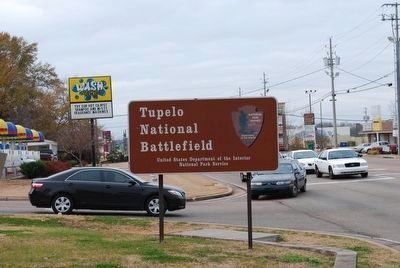
4. Tupelo National Battlefield
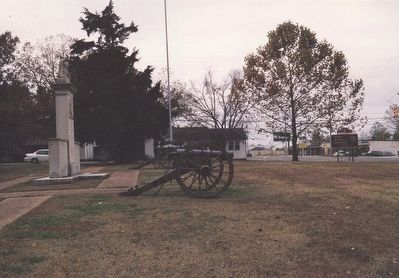
Photographed by Richard E. Miller, January 99
5. Tupelo National Battlefield
Credits. This page was last revised on June 22, 2022. It was originally submitted on March 31, 2008, by Mike Stroud of Bluffton, South Carolina. This page has been viewed 2,842 times since then and 71 times this year. Photos: 1. submitted on March 30, 2008, by Mike Stroud of Bluffton, South Carolina. 2, 3. submitted on July 24, 2015, by Karl Stelly of Gettysburg, Pennsylvania. 4. submitted on September 27, 2015, by Brandon Fletcher of Chattanooga, Tennessee. 5. submitted on June 18, 2008, by Richard E. Miller of Oxon Hill, Maryland. • Craig Swain was the editor who published this page.
