West Ashley in Charleston in Charleston County, South Carolina — The American South (South Atlantic)
Mixed Results
Photographed by Bill Coughlin, August 6, 2013
1. Mixed Results Marker
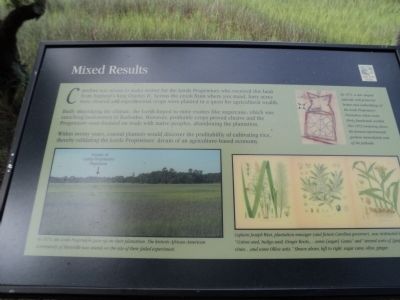
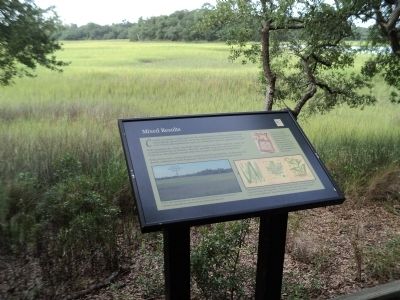
Carolina was meant to make money for the Lords Proprietors who received this land from England’s King Charles II. Across the creek from where you stand, forty acres were cleared and experimental crops were planted in a quest for agricultural wealth.
Badly misjudging the climate, the Lords hoped to raise exotics like sugarcane, which was enriching landowners in Barbados. However, profitable crops proved elusive and the Proprietors soon focused on trade with native peoples, abandoning the plantation.
Within twenty years, coastal planters would discover the profitability of cultivating rice, thereby validating the Lords Proprietors’ dream of an agriculture-based economy.
( Sidebar : )
Next to a diagram of the plantation and palisade wall: By 1671, a star-shape palisade wall protected homes and outbuildings of the Lords Proprietors’ Plantation where some thirty farmhands worked. This 1673 rendering shows the formal experimental gardens immediately east of the palisade.
Topics. This historical marker is listed in these topic lists: Colonial Era • Settlements & Settlers. A significant historical year for this entry is 1671.
Location. 32° 48.101′ N,
this page online

Regionally, this marker is in the Lowcountry. It is also in the American South, specifically in the Deep South, and on the Eastern Seaboard. Globally, it is in the North Atlantic Region, North America, the Western Hemisphere, the Western World, and the Anglosphere. Historically, it finds itself in what was once the territory of the Mississippian Culture, one of the original Thirteen Colonies, one of the Confederate States of America, and the Antebellum South.
Other nearby markers. At least 8 other markers are within walking distance of this marker: Ship Shaping (about 400 feet away, measured in a direct line); Seized! (about 400 feet away); Harnessing the Wind (about 400 feet away); The Adventure, Trading Ketch (about 400 feet away); Seeking Wealth, Sowing Servitude
Photographed by Bill Coughlin, August 6, 2013
2. Mixed Results Marker
More about this marker. A photo at the lower left of the marker indicates the “Vicinity of Lords Proprietors’ Plantation” and has a caption of “In 1675, the Lords Proprietors gave up on their plantation. The historic African-American community of Maryville now stands on the site of their failed experiment.”
The lower right of the marker contains a picture of several crops that were intended to be grown at the settlement. It includes the caption “Captain Joseph West, plantation manager (and future Carolina governor), was instructed to plant ‘Cotton seed, Indigo seed, Ginger Roots, . . . some [sugar] cane and several sorts of [grape] vines . . . and Ollive setts.’ Shown above, left to right: sugar cane, olive, ginger.”
Photographed by Bill Coughlin, August 6, 2013
3. Marker at Charles Towne Landing
Photographed by Bill Coughlin, August 6, 2013
4. View from the Marker
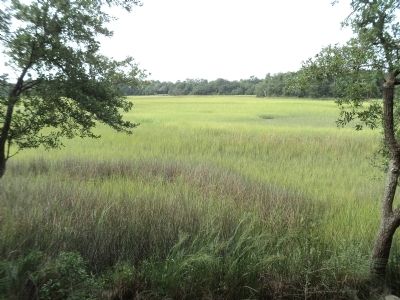
This view looks towards the location of the Lords Proprietors’ failed plantation.
Credits. This page was last revised on February 16, 2023. It was originally submitted on August 19, 2013, by Bill Coughlin of Woodland Park, New Jersey. This page has been viewed 567 times since then and 18 times this year. Photos: 1, 2, 3, 4. submitted on August 19, 2013, by Bill Coughlin of Woodland Park, New Jersey.
