Pawcatuck in Stonington in Southeastern Region, Connecticut — The American Northeast (New England)
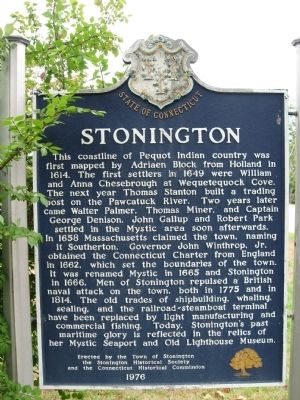
Stonington
Photographed by Michael Herrick, August 26, 2013
1. Stonington Marker
the Stonington Historical Society
and the Connecticut Historical Commission
1978
Erected 1978
this page online
Topics and series. This historical marker is listed in these topic lists: Colonial Era • Settlements & Settlers. In addition, it is included in the Lighthouses series list. A significant historical year for this entry is 1614.
Location. 41° 21.369′ N, 71° 52.986′ W. Marker is in Stonington in Southeastern Region, Connecticut. It is in Pawcatuck. It is on Stonington Road (U.S. 1) half a mile north of Elm Street, on the left when traveling north. Touch for map. Marker is in this post office area: Pawcatuck CT 06379, United States of America. Touch for directions.

Regionally, this marker is on the Connecticut Shoreline, in Greater New London, in Mystic and the Eastern Shore, and in the Thames River Valley. It is also in the American Northeast, in New England, and on the Eastern Seaboard. Globally, it is in the North Atlantic Region, North America, the Western Hemisphere, the Western World, and the Anglosphere. Historically, it finds itself in what was once New London County and also one of the original Thirteen Colonies.
Photographed by Michael Herrick, August 26, 2013
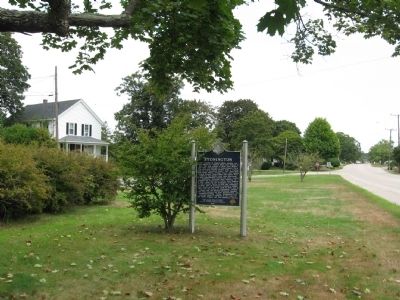
2. Stonington Marker
Other nearby markers. At least 8 other markers are within 2 miles of this marker, measured as the crow flies: Stonington Founders Monument (approx. 0.4 miles away); Wequetequock Burial Ground (approx. 0.4 miles away); Veterans Memorial (approx. 1.4 miles away); World War I Memorial (approx. 1.4 miles away); Stonington Community Garden (approx. 1½ miles away); John W. Richmond (approx. 1½ miles away); Captain Nathaniel B. Palmer House (approx. 1.6 miles away); Stonington Land Battery (approx. 1.8 miles away). Touch for a list and map of all markers in Stonington.
Also see . . . Stonington, Connecticut on Wikipedia. (Submitted on September 1, 2013, by Michael Herrick of Southbury, Connecticut.)
Photographed by Michael Herrick, August 27, 2013
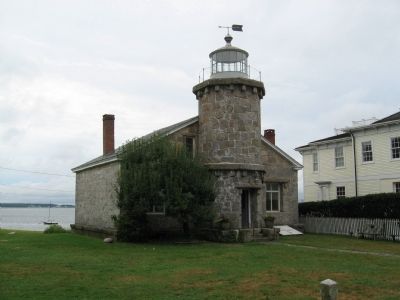
3. Old Lighthouse Museum
Listed on the National Register of Historic Places in 1976
(this building does not have a marker)
Credits. This page was last revised on May 19, 2026. It was originally submitted on September 1, 2013, by Michael Herrick of Southbury, Connecticut. This page has been viewed 1,470 times since then and 126 times this year. Photos: 1, 2, 3. submitted on September 1, 2013, by Michael Herrick of Southbury, Connecticut.
