Hackensack in Bergen County, New Jersey — The American Northeast (Mid-Atlantic)
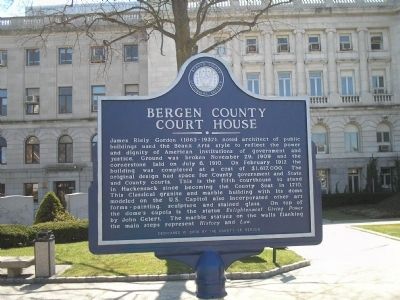
Bergen County Court House
⎯⎯⎯
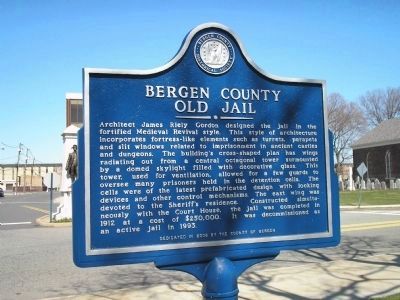
Bergen County Old Jail
Photographed by Bill Coughlin, March 30, 2008
1. Bergen County Court House Marker
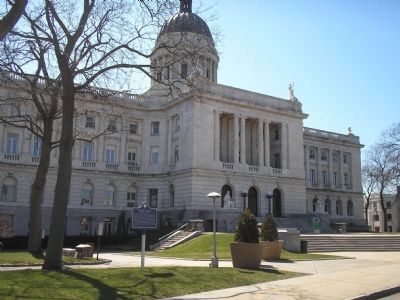
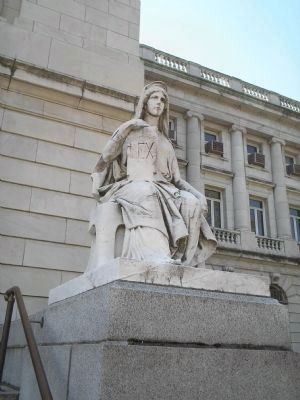
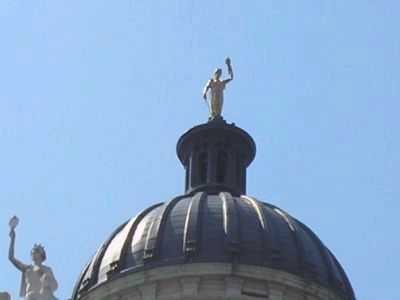
Bergen County Court House. James Riely Gordon (1863–1937), noted architect of public buildings used the Beaux Arts style to reflect the power and dignity of American institutions of government and justice. Ground was broken November 29, 1909 and the cornerstone laid on July 6, 1910. On February 1912 the building was completed at a cost of $1,617,000. The original design had space for County government and State and County courts. This is the fifth courthouse to stand in Hackensack since becoming the County Seat in 1710. This Classical granite and marble building with its dome modeled on the U.S. Capitol also incorporated other art forms—painting, sculpture and stained glass. On top of the dome’s cupola is the statue Enlightenment Giving Power by John Gelert. The marble statues on the walls flanking the main steps represent History and Law.
Bergen County Old Jail. Architect James Riely Gordon designed the jail in the fortified Medieval Revival style. This style of architecture incorporates fortress-like elements such as turrets, parapets and slit windows related to imprisonment in ancient castles and dungeons. The building’s
this page online
Erected 2006 by the County of Bergen.
Topics and series. This historical marker is listed in these topic lists: Architecture • Government & Politics • Law Enforcement. In addition, it is included in the New Jersey, Bergen County Historical Society series list. A significant historical date for this entry is July 6, 1910.
Location. 40° 52.735′ N, 74° 2.602′ W. Marker is in Hackensack, New Jersey, in Bergen County. It is at the intersection of Court Street and Moore Street, on the right when traveling east on Court Street. Touch for map. Marker is in this post office area: Hackensack NJ
Photographed by Bill Coughlin
2. Bergen County Old Jail Marker

Regionally, this marker is in New Jersey’s North Jersey, in Greater Newark, and in the New York City Metropolitan Area. It is also in the American Northeast, in the Mid-Atlantic, and on the Eastern Seaboard. Globally, it is in the North Atlantic Region, North America, the Western Hemisphere, the Western World, and the Anglosphere. Historically, it finds itself in what was once New Netherland and also one of the original Thirteen Colonies.
Other nearby markers. At least 8 other markers are within walking distance of this marker: Brigadier General Enoch Poor (a few steps from this marker); Gen. Enoch Poor (a few steps from this marker); The Huguenots (within shouting distance of this marker); Historic First Reformed Church (within shouting distance of this marker); Hackensack Soldier and Sailor Memorial (within shouting distance of this marker); Grave of Gen. Enoch Poor (within shouting distance of this marker); The Green (within shouting distance of this marker); Site of the Court-House & Jail (within shouting distance of this marker). Touch for a list and map
Photographed by Bill Coughlin, March 31, 2008
3. Bergen County Court House and Marker
Photographed by Bill Coughlin
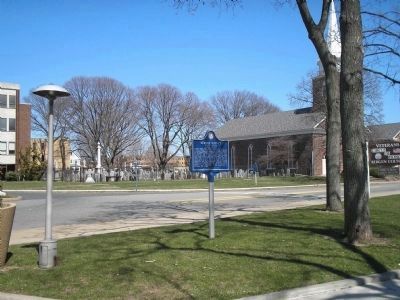
4. Old Jail Marker
The marker for the Bergen County Old Jail is near the Historic First Reformed Church.
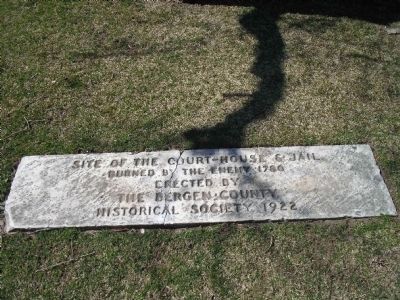
Photographed by Bill Coughlin, March 30, 2008
5. Site of the Original Court House and Jail
On the Green across from the present Court House is the site of the original Court House, which was burned by the British in 1780. The original Jail was located near the original Court House.
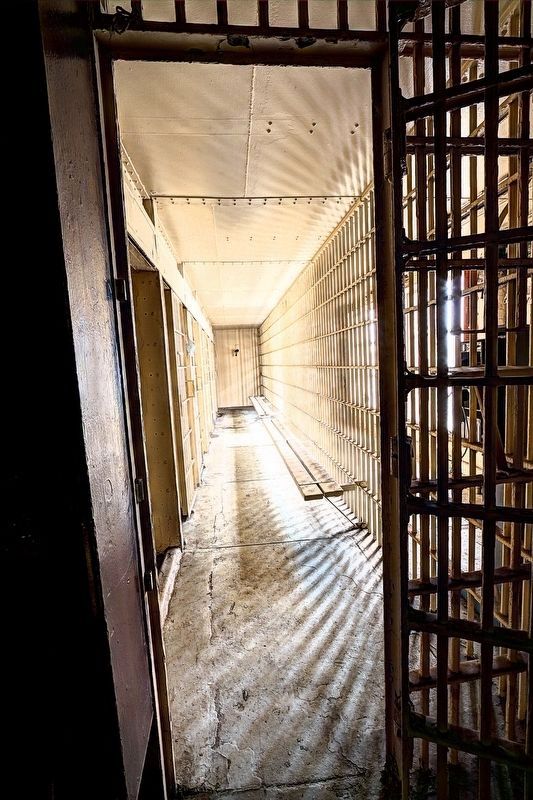
Photographed by Chip Renner, circa 2016
6. Bergen County Court House / Bergen County Old Jail Marker
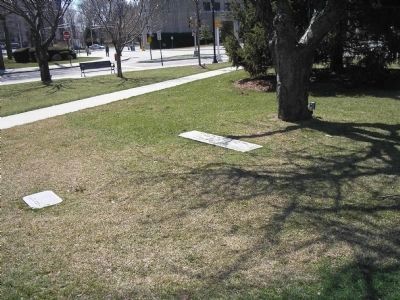
Photographed by Bill Coughlin, March 30, 2008
7. Site of the Original Court House and Jail
The original Court House and Jail were located on what today is the Hackensack Green.
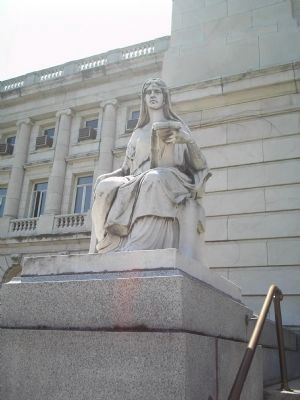
Photographed by Bill Coughlin, April 19, 2008
8. Statue on Court House Steps
This statue on the east side of the Bergen County Court House steps represents History.
Photographed by Bill Coughlin, April 19, 2008
9. Statue on Court House Steps
This statue on the west side of the Bergen County Court House steps represents Law.
Photographed by Bill Coughlin, April 19, 2008
10. Dome Statue
The statue of Enlightenment Giving Power, by John Gelert, sits on the top of the Bergen County Court House dome.
Credits. This page was last revised on March 11, 2026. It was originally submitted on April 3, 2008, by Bill Coughlin of Woodland Park, New Jersey. This page has been viewed 5,535 times since then and 127 times this year. Photos: 1, 2, 3, 4, 5. submitted on April 3, 2008, by Bill Coughlin of Woodland Park, New Jersey. 6. submitted on March 21, 2017, by Chip Renner of Rochelle Park, N.j.. 7. submitted on April 3, 2008, by Bill Coughlin of Woodland Park, New Jersey. 8, 9, 10. submitted on April 20, 2008, by Bill Coughlin of Woodland Park, New Jersey. • J. J. Prats was the editor who published this page.
