Gulf Shores in Baldwin County, Alabama — The American South (East South Central)
The Battle of Mobile Bay
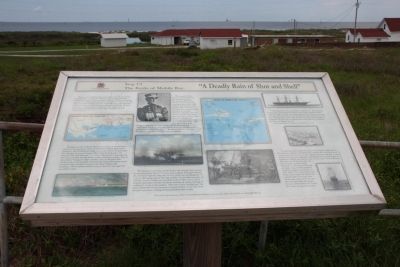
“A Deadly Rain of Shot and Shell”
| — | Civil War Trail, Battle for Mobile Bay | — |
Photographed by Timothy Carr, June 19, 2013
1. Stop C1 - The Battle of Mobile Bay Marker
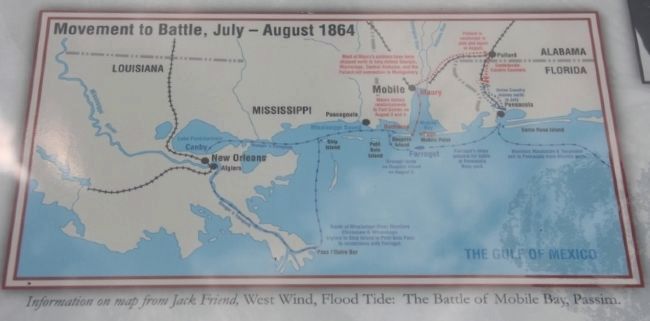
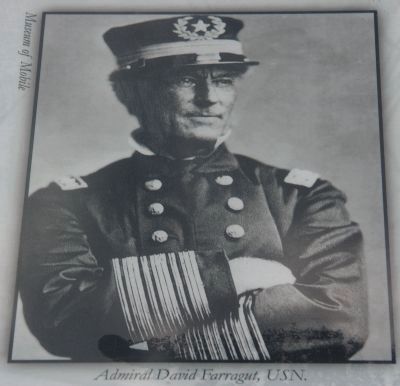
Eager to attack Mobile Bay since 1862, U. S. Admiral David Farragut knew he could not capture control of the lower bay without the support of the army and without a flotilla of ironclad monitors to confront the Confederate ironclad CSS Tennessee. In July 1864, U. S. General Edward Canby sent 1,500 men under General Gordon Granger on army transports from New Orleans. Granger landed on Dauphin Island on August 3. By August 4 all of Farragut’s monitors had joined the fleet. Farragut was ready to attack.
Farragut would confront three forts, a series of obstructions, a triple row of torpedoes, and C. S. Admiral Franklin Buchanan’s squadron. The Confederate ships mounted a total of 22 guns and Fort Morgan mounted 46 guns, 38 of them bearing upon the channel. The ironclad ram, CSS Tennessee, Buchanan’s flagship and the most powerful warship in the world, mounted ten guns, four of them rifled. Farragut’s ships carried a total of 199 guns. His wooden ships were partially armored with improvised chain armor and sand bags, intended to protect the ship’s boilers and machinery. His monitors carried a total of four 15” and eight
this page online
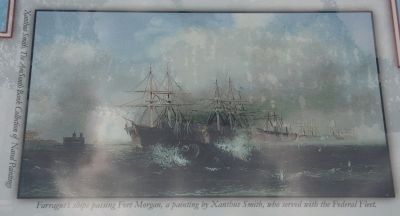
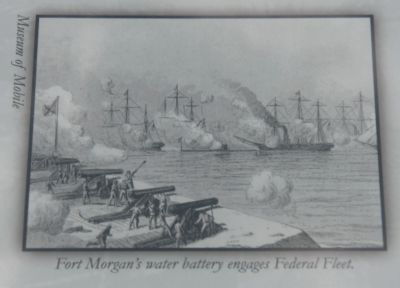
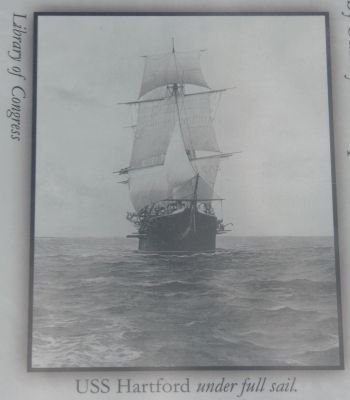
On August 5, 1864, Farragut attempted to run past Forts Gaines and Morgan into Mobile Bay. The USS Tecumseh, the lead monitor, when within 2,000 yards of Fort Morgan, fired the first shot of the day at 6:47 a.m. A few minutes later the fort returned fire. Farragut’s flagship, the USS Hartford, fired her first shot about 25 minutes later. Soon after, the engagement became general and a light west wind blew black smoke into the faces of Fort Morgan’s gunners. A soldier in the fort remembered that “everything was so enveloped in smoke that little could be seen except their brilliant banners…” But the smoke also obscured Farragut’s view and forced him into the rigging.
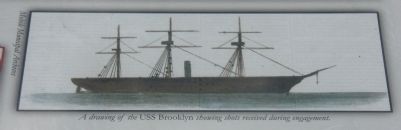
At 7:25 the USS Brooklyn, in the lead of the wooden fleet, found its way blocked by the USS Tecumseh and stopped. Farragut ordered the Brooklyn to “go on,” but, the Tecumseh, intent on attacking the CSS Tennessee, did not get out of the way and the Brooklyn did not move. At 7:40 the Tecumseh, within two hundred yards of the Tennessee, hit a torpedo and sank, causing “immense bubbles of steam, as large as cauldrons”
Photographed by Timothy Carr, June 19, 2013
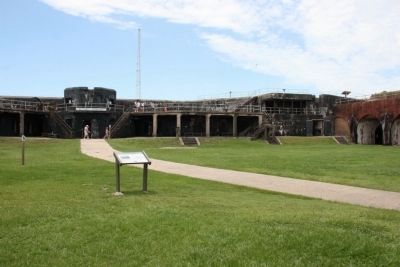
2. This Marker along with a group of markers located on the top right side of Battery Duportail
“…A deadly rain of shot and shell was falling on… [the Hartford], and her men were being cut down by the scores, unable to make reply. The sight on deck was sickening beyond the power of words to portray. Shot after shot came through the side, mowing down the men, deluging the decks with blood, and scattering mangled fragments of humanity so thickly that it was difficult to stand on the deck, so slippery was it.”
Lieutenant John C. Kinney, aboard the Hartford
Conditions were similar on many of Farragut’s ships. At 7:50, the admiral, taking a calculated risk, ordered the Hartford and her consort, the Metacomet, across the torpedo field into the Bay at full speed. He knew that torpedoes submerged for too long might be ineffective. Within ten minutes, the Brooklyn and Octorora followed. Over the next 30 minutes the rest of Farragut’s wooden ships followed. As they passed through the field, many heard torpedoes knocking against the bottom of
Photographed by Timothy Carr, June 19, 2013
3. Top Left Image: Movement to Battle, July - August 1864
Information on map from Jack Friend, West Wind, Flood Tide: The Battle of Mobile Bay, Passim.
Erected by Mobile Bay Convention and Visitors Bureau. (Marker Number Stop C1.)
Topics. This historical marker is listed in these topic lists: Forts and Castles • War, US Civil. A significant historical month for this entry is July 1864.
Location. 30° 13.684′ N, 88° 1.405′ W. Marker is in Gulf Shores, Alabama, in Baldwin County. It can be reached from Fort Morgan Road (State Highway 180) 1.7 miles west of Dune Drive. Located in Fort Morgan State Historic Park. Touch for map. Marker is at or near this postal address: 51 Highway 180 West, Gulf Shores AL 36542, United States of America. Touch for directions.

Regionally, this marker is on the Gulf Coast and in the Mobile Bay area. It is also in the American South, specifically in the Deep South, and on the Gulf Coast. Globally, it is in North America, a Gulf of Mexico state, the Western Hemisphere, the Western World, and the Anglosphere. Historically, it
Photographed by Timothy Carr, June 19, 2013
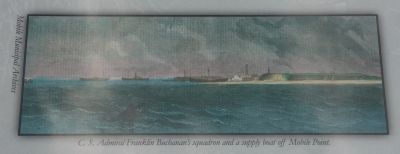
4. Bottom Left Image
C. S. Admiral Franklin Buchanan's squadron and a supply boat off Mobile Point. (Mobile Municipal Archives)
Other nearby markers. At least 8 other markers are within walking distance of this marker: Panama Mount (here, next to this marker); a different marker also named The Battle of Mobile Bay (here, next to this marker); a different marker also named The Battle of Mobile Bay (a few steps from this marker); Citadel (1825-1865) (within shouting distance of this marker); The Citadel (within shouting distance of this marker); The Battery Bailey (within shouting distance of this marker); Battery Thomas (1898-1917) (about 300 feet away, measured in a direct line); 6.4” (100 pounder) Parrott Rifle / 7” Brooke Rifle (about 500 feet away). Touch for a list and map of all markers in Gulf Shores.
More about this marker. This marker is within the walls of historic Fort Morgan. The marker is located on the top level, west side of Battery Duportail.
Also see . . . Civil War Trail, Battle For Mobile Bay. (Submitted on September 25, 2013, by Timothy Carr of Birmingham, Alabama.)
Photographed by Timothy Carr, June 19, 2013
5. Center, Top Left Image: Admiral David Farragut, USN. (Museum of Mobile)
Photographed by Timothy Carr, June 19, 2013
6. Center, Bottom Left Image:
Farragut's ships passing Fort Morgan, a painting by Xanthus Smith, who served with the Federal Fleet. (Xanthus Smith, The AmSouth Bank Collection of Naval Painting)
Photographed by Timothy Carr, June 19, 2013
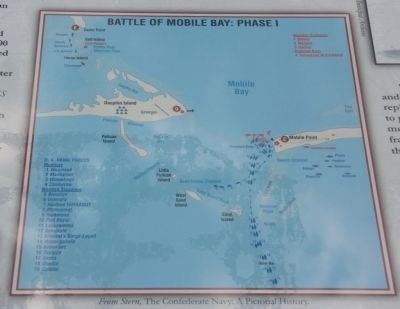
7. Center, Top Right Image: Battle Of Mobile Bay: Phase I
From Stern, The Confederate Navy: A Pictorial History.
Photographed by Timothy Carr, June 19, 2013
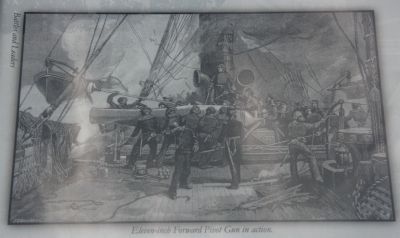
8. Center, Bottom Right Image: Eleven-inch Forward Pivot Gun in action. (Battles and Leaders)
Photographed by Timothy Carr, June 19, 2013
9. Top Right Image: A drawing of the USS Brooklyn showing shots received during engagement.
(Mobile Municipal Archives)
Photographed by Timothy Carr, June 19, 2013
10. Center Right Image: Fort Morgan's water battery engages Federal Fleet. (Museum of Mobile)
Photographed by Timothy Carr, June 19, 2013
11. Bottom Right Image: USS Hartford under full sail. (Library of Congress)
Photographed by Timothy Carr, June 19, 2013
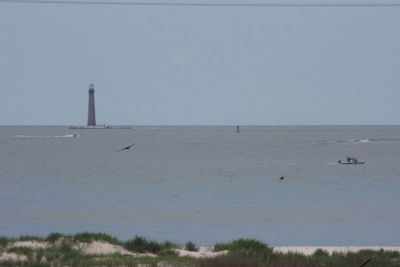
12. Sand Island Lighthouse and The Aprroach Channel To Mobile Bay.
45 miles east of Mobile Point, Farragut's ships prepared for battle at Pensacola Navy Yard. His ships passed Sand Island as they made their way toward the channel into Mobile Bay. The previous Sand Island Lighthouse that stood on Sand Island was destroyed by Confederate soldiers after Union spies were discovered in the tower.
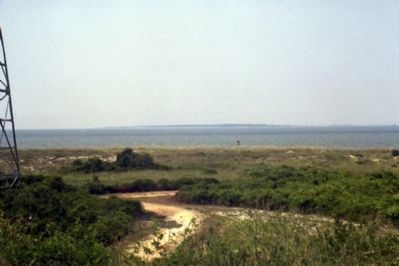
Photographed by Timothy Carr, 2000
13. The Channel Into Mobile Bay Viewed From Fort Morgan.
In the distance across the channel stands Fort Gaines on Dauphin Island.
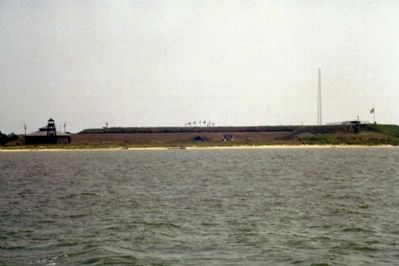
Photographed by Timothy Carr, 2000
14. Fort Morgan Seen From The Channel Into Mobile Bay.
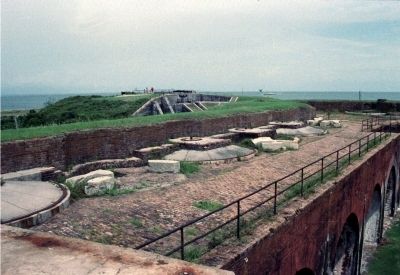
Photographed by Timothy Carr, 1988
15. Gun Mounts Atop of the Fort's West Casemates Facing the Channel.
Credits. This page was last revised on July 25, 2018. It was originally submitted on September 25, 2013, by Timothy Carr of Birmingham, Alabama. This page has been viewed 3,166 times since then and 159 times this year. Photos: 1, 2, 3, 4, 5, 6, 7, 8, 9, 10, 11, 12, 13, 14, 15. submitted on September 25, 2013, by Timothy Carr of Birmingham, Alabama. • Bernard Fisher was the editor who published this page.
