Wissahickon Valley Park in Philadelphia in Philadelphia County, Pennsylvania — The American Northeast (Mid-Atlantic)
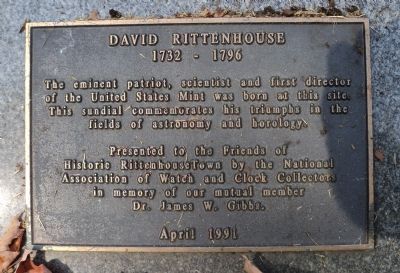
David Rittenhouse
1732 - 1796
Photographed by Bill Coughlin, October 5, 2013
1. David Rittenhouse Marker
Presented to the Friends of
Historic RittenhouseTown by the National
Association of Watch and Clock Collectors
in memory of our mutual member
Dr. James W. Gibbs.
April 1991
Erected 1991.
Topics. This historical marker is listed in these topic lists: Air & Space • Industry & Commerce • Science & Medicine. A significant historical month for this entry is April 1991.
Location. 40° 1.762′ N, 75° 11.385′ W. Marker is in Philadelphia, Pennsylvania, in Philadelphia County. It is in Wissahickon Valley Park. It can be reached from Lincoln Drive, on the right when traveling south. Marker is accessible from the parking area for Rittenhouse Town off Lincoln Drive. Touch for map. Marker is at or near this postal address: 1690 Lincoln Dr, Philadelphia PA 19144, United States of America. Touch for directions.

Regionally, this marker is in Southeast Pennsylvania. It is also in the American Northeast and in the Mid-Atlantic. Globally, it is in North America,
this page online
Other nearby markers. At least 8 other markers are within walking distance of this marker: Rittenhouse Homestead (here, next to this marker); Colonial Herb Garden (a few steps from this marker); Homestead (a few steps from this marker); Rittenhouse Town (within shouting distance of this marker); Rittenhousetown Historic District (within shouting distance of this marker); Battle of Germantown (about 400 feet away); Sailor Grove Stormwater Wetland (about 700 feet away); Dr. Mary Davis Ridgway (about 800 feet away). Touch for a list and map of all markers in Philadelphia.
Another marker is no longer nearby. The Jacob Rittenhouse Home at RittenhouseTown (was about 300 feet away, measured in a direct line but has been permanently removed).
Photographed by Bill Coughlin, October 5, 2013
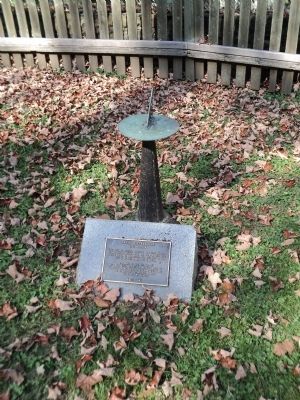
2. David Rittenhouse Marker and Sundial
Photographed by Bill Coughlin, October 5, 2013
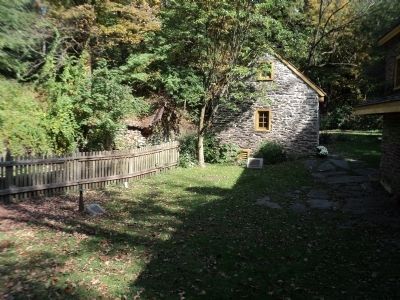
3. Marker at the Rittenhouse Homestead
The David Rittenhouse marker and sundial can be seen here on the left.
Photographed by Bill Coughlin, October 5, 2013
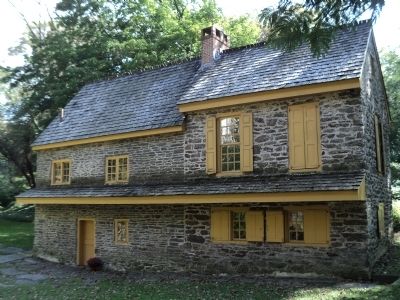
4. Rittenhouse Homestead - Established 1690
David Rittenhouse was born in this house in 1732.
Photographed by Allen C. Browne, February 16, 2015
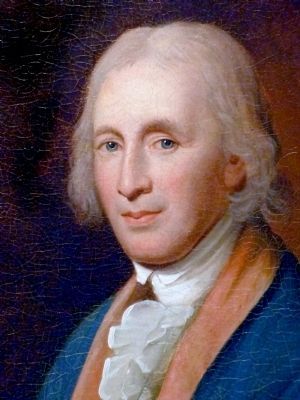
5. David Rittenhouse
This 1796 portrait of David Rittenhouse by Charles Willson Peale hangs in the National Portrait Gallery in Washington DC.
“A child prodigy who received no formal education, David Rittenhouse became one of early America's most respected scientists and is depicted here as president of the American Philosophical Society. Rittenhouse made his living as a clock-and instrument-maker; his mathematical skills earned him service on commissions determining the boundaries of several states. He constructed two orreries, instruments that accurately depict the motions of the solar system for 5,000 years, backwards and forwards. Rittenhouse achieved international fame when, acting on John Ewing's proposal, he organized the Philosophical Society's participation in an international effort to measure the transit of Venus. This allowed astronomers to more accurately measure distances to celestial objects. Rittenhouse's published observations, along with those of other American scientists, attracted favorable reactions in Europe, bringing a new recognition of American scientific achievement.” — National Portrait Gallery
“A child prodigy who received no formal education, David Rittenhouse became one of early America's most respected scientists and is depicted here as president of the American Philosophical Society. Rittenhouse made his living as a clock-and instrument-maker; his mathematical skills earned him service on commissions determining the boundaries of several states. He constructed two orreries, instruments that accurately depict the motions of the solar system for 5,000 years, backwards and forwards. Rittenhouse achieved international fame when, acting on John Ewing's proposal, he organized the Philosophical Society's participation in an international effort to measure the transit of Venus. This allowed astronomers to more accurately measure distances to celestial objects. Rittenhouse's published observations, along with those of other American scientists, attracted favorable reactions in Europe, bringing a new recognition of American scientific achievement.” — National Portrait Gallery
Credits. This page was last revised on February 2, 2024. It was originally submitted on October 6, 2013, by Bill Coughlin of Woodland Park, New Jersey. This page has been viewed 856 times since then and 30 times this year. Photos: 1, 2, 3, 4. submitted on October 6, 2013, by Bill Coughlin of Woodland Park, New Jersey. 5. submitted on May 25, 2015, by Allen C. Browne of Silver Spring, Maryland.
