Green Valley in Arlington in Arlington County, Virginia — The American South (Mid-Atlantic)
Drew School
Photographed by Kevin Vincent, October 7, 2013
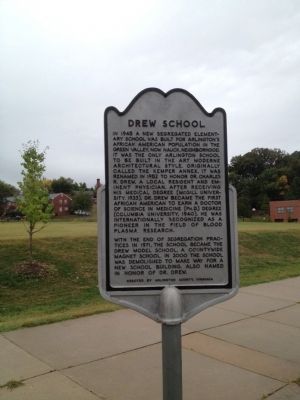
1. Drew School Marker
In 1945 a new segregated elementary school was built for Arlington’s African American population in the Green Valley, now Nauck, neighborhood. It was the only Arlington school to be built in the Art Moderne architectural style. Originally called the Kemper Annex, it was renamed in 1952 to honor Dr. Charles R. Drew, a local resident and eminent physician. After receiving his medical degree (McGill University, 1933), Dr. Drew became the first African American to earn a Doctor of Science in Medicine (Ph.D.) degree (Columbia University, 1940). He was internationally recognized as a pioneer in the field of blood plasma research.
With the end of segregation practices in 1971, the school became the Drew Model School, a countywide magnet school. In 2000 the school was demolished to make way for a new school building, also to be named in honor of Dr. Drew.
Erected by Arlington County.
Topics. This historical marker is listed in these topic lists: African Americans • Education • Science & Medicine. A significant historical year for this entry is 1945.
Location. 38° 50.918′ N, 77° 5.132′ W. Marker is in Arlington,
this page online

Regionally, this marker is in the Washington Metropolitan Area and in Northern Virginia. It is also in the American South, specifically in the Upper South, in the Mid-Atlantic, and on the Eastern Seaboard. Globally, it is in the North Atlantic Region, North America, the Western Hemisphere, the Western World, and the Anglosphere. Historically, it finds itself in what was once the territory of the Mississippian Culture, one of the original Thirteen Colonies, one of the Confederate States of America, and the Antebellum South.
Other nearby markers. At least 8 other markers are within walking distance of this marker: Origins of Green Valley (a few steps from this marker); Community Businesses (a few steps from this
Photographed by Kevin Vincent, October 7, 2013
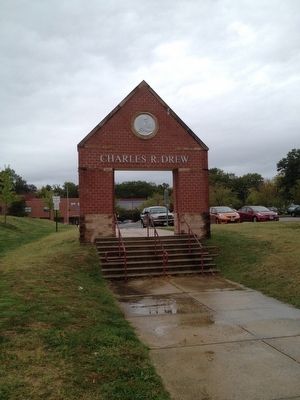
2. Drew School Marker
I believe this is the entrance to the original Drew School. The historic marker can be seen in the background through the arch.
Another marker is no longer nearby. Origins (was about 400 feet away but has been replaced with another marker now near it).
Also see . . . Arlington to tweak name of Drew Model School. Inside NOVA website entry (Submitted on August 28, 2023, by Larry Gertner of New York, New York.)
Photographed by Kevin Vincent, October 7, 2013
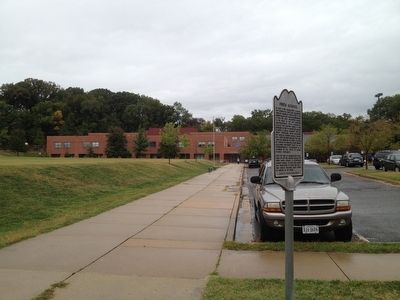
3. modern Drew School
The modern Drew School is in the distance past the marker.
Photographed by Allen C. Browne, November 29, 2015
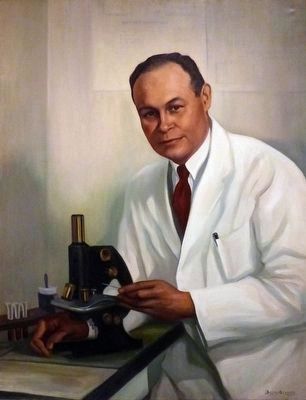
4. Charles R. Drew
This 1953 portrait of Charles R. Drew by Betsy Graves Reyneau hangs in the National Portrait Gallery in Washington, DC.
“In 1940 with German bombers dropping their deadly cargoes daily on British cities, England stood in desperate need of blood supplies for its thousands of wounded civilians. To fill this shortage, the British turned to the African American physician Charles Drew, America's recognized pioneer in the preservation and storage of blood. Drew expeditiously organized the Blood Transfusion Association, and the crisis in war-torn England's hospitals was met. A year later, Drew became the medical director of the American Red Cross's blood-donor project, and it was largely because of his expertise that this enterprise saved many American lives during the war. Yet when the Red Cross ordered that all non-Caucasian blood be stored separately, Drew resigned, stating that there were no scientific or medical reasons for classifying blood by race. Today Drew is universally deemed the ‘Father of the Blood Bank.’” — National Portrait Gallery
“In 1940 with German bombers dropping their deadly cargoes daily on British cities, England stood in desperate need of blood supplies for its thousands of wounded civilians. To fill this shortage, the British turned to the African American physician Charles Drew, America's recognized pioneer in the preservation and storage of blood. Drew expeditiously organized the Blood Transfusion Association, and the crisis in war-torn England's hospitals was met. A year later, Drew became the medical director of the American Red Cross's blood-donor project, and it was largely because of his expertise that this enterprise saved many American lives during the war. Yet when the Red Cross ordered that all non-Caucasian blood be stored separately, Drew resigned, stating that there were no scientific or medical reasons for classifying blood by race. Today Drew is universally deemed the ‘Father of the Blood Bank.’” — National Portrait Gallery
Credits. This page was last revised on August 28, 2023. It was originally submitted on October 10, 2013, by Kevin Vincent of Arlington, Virginia. This page has been viewed 1,603 times since then and 101 times this year. Photos: 1, 2, 3. submitted on October 10, 2013, by Kevin Vincent of Arlington, Virginia. 4. submitted on November 30, 2015, by Allen C. Browne of Silver Spring, Maryland. • Bernard Fisher was the editor who published this page.
