Dandridge in Jefferson County, Tennessee — The American South (East South Central)
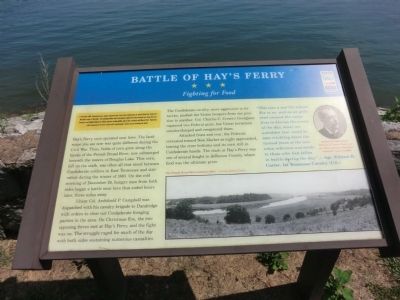
Battle of Hay's Ferry
Fighting for Food
Photographed by Don Morfe, July 29, 2013
1. Battle of Hay's Ferry Marker
In November 1863, Confederate Gen. James Longstreet led a force from Chattanooga to attack Union Gen. Ambrose E. Burnside’ s army at Knoxville. The campaign failed, and in December Longstreet’s men marched east along the East Tennessee and Virginia Railroad to winter quarters at Russellville, where they remained until March 1864. Numerous small engagements between Longstreet’s and Burnside’s armies occurred during the winter.
(main text)
Hay’s Ferry once operated near here. The landscape you see now was quite different during the Civil War. Then, fields of corn grew along the banks of the French Broad River, now submerged beneath the waters of Douglas Lake. This corn, left on the stalk, was often all that stood between Confederate soldiers in East Tennessee and starvation during the winter of 1863. On the cold morning of December 24, hungry men from both sides began a battle near here that ended hours later, three miles away.
The Confederate cavalry, more aggressive in its tactics, pushed the Union troopers from one position to another. Col. Charles C. Crew’s Georgians captured two Federal guns, but Union
this page online
Attacked front and rear, the Federals retreated toward New Market as night approached, leaving the river bottoms and its corn still in Confederate hands. The Clash at Hay’s Ferry was one of several fought in Jefferson County, where food was the ultimate prize.
“This was a sad Christmas Eve to us, and as we gathered around the campfires to discuss the events of the day, many an unbidden tear could be seen trickling down the tanned faces of the men when reference was made to those who had fallen in battle during the day.” — Sgt. William R. Carter, 1st Tennessee Cavalry (U.S.)
(captions)
The French Broad River bottoms (1941) - Courtesy Richard Taylor
William R. Carter from William R. Carter, History of the First Regiment Tennessee Volunteer Cavalry (1902)
Erected by Tennessee Civil War Trails.
Topics and series. This historical marker is listed in this topic list: War, US Civil. In addition, it is included in the Tennessee Civil War Trails series list. A significant historical year for this entry is 1863.
Location. 36° 2.232′ N, 83° 20.952′ W. Marker is in Dandridge,
Photographed by Don Morfe, July 29, 2013
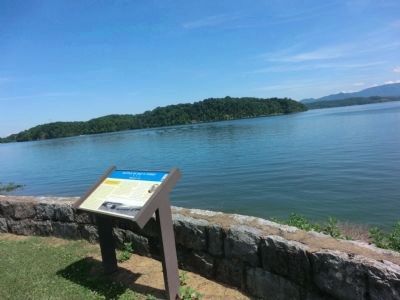
2. Battle of Hay's Ferry Marker

Regionally, this marker is in East Tennessee. It is also in the American South, specifically in the Upper South, in Appalachia, and specifically in Southern Appalachia. Globally, it is in North America, the Western Hemisphere, the Western World, and the Anglosphere. Historically, it finds itself in what was once the original Cherokee Nation, the territory of the Mississippian Culture, one of the Confederate States of America, the State of Franklin, and the Antebellum South.
Other nearby markers. At least 8 other markers are within 4 miles of this marker, measured as the crow flies: Tennessee Civil War Trails (approx. 1½ miles away); Stokely-Van Camp, Inc. (approx. 2.6 miles away); Pine Chapel (approx. 2.6 miles away); a different marker also named Tennessee Civil War Trails
Photographed by Don Morfe, July 29, 2013
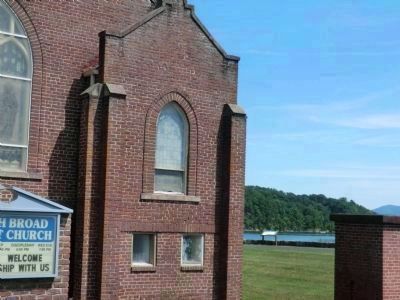
3. Marker in rear of the church
Other markers no longer nearby. Fighting at Dandridge (was approx. 1½ miles away but has been permanently removed); a different marker also named Fighting at Dandridge (was approx. 3.6 miles away but has been replaced with another marker now near it).
Photographed by Don Morfe, July 29, 2013
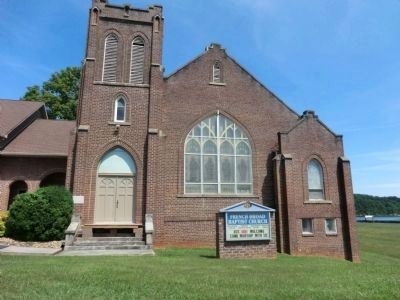
4. French Broad Baptist Church
Credits. This page was last revised on March 16, 2017. It was originally submitted on October 20, 2013, by Don Morfe of Baltimore, Maryland. This page has been viewed 2,204 times since then and 107 times this year. Photos: 1, 2, 3, 4. submitted on October 20, 2013, by Don Morfe of Baltimore, Maryland. • Bernard Fisher was the editor who published this page.
