Shiloh in Hardin County, Tennessee — The American South (East South Central)
General Albert Sidney Johnston
Photographed by Nick Kurtz
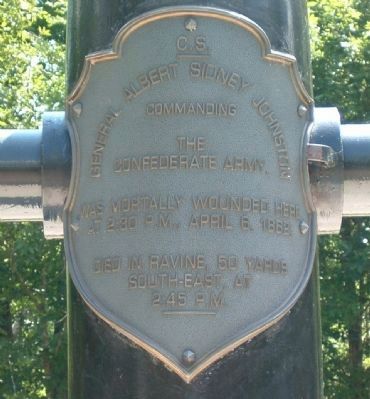
1. Johnston Mortuary Monument Marker
General Albert Sidney Johnston
Commanding
the Confederate Army,
Was mortally wounded
at 2.30 P.M.,April 6, 1862,
Died in ravine, 50 yards
south-east, at
2:45 P.M.
Topics. This historical marker is listed in this topic list: War, US Civil. A significant historical date for this entry is April 6, 1862.
Location. 35° 7.812′ N, 88° 19.772′ W. Marker is in Shiloh, Tennessee, in Hardin County. It is on Hamburg-Savannah Road. Located near Spain's Field at stop 12, "the Death of Johnston," on the tour road in Shiloh National Military Park. Touch for map. Marker is in this post office area: Shiloh TN 38376, United States of America. Touch for directions.

Regionally, this marker is in West Tennessee. It is also in the American South and specifically in the Upper South. Globally, it is in North America, the Western Hemisphere, the Western World, and the Anglosphere. Historically, it finds itself in what was once the territory of the Mississippian Culture, one of the Confederate States of America, and the Antebellum South.
Other nearby markers. At least 8 other markers are within walking distance of this marker: Conquer or Perish
this page online
Also see . . .
1. National Park Service. In all of American history, he is the highest-ranking American military officer ever to be killed in action. (Submitted on April 8, 2008, by Mike Stroud of Bluffton, South Carolina.)
2. A.S. Johnston. At the outbreak of the Civil War, Johnston was the commander of the U.S. Army Department of the Pacific in California. (Submitted on April 8, 2008, by Mike Stroud of Bluffton, South Carolina.)
3. CSA Ranks. "General" is a rank above "Lt.General". CSA still all grades of general had the insignia of three
Photographed by Craig Swain, March 16, 2009
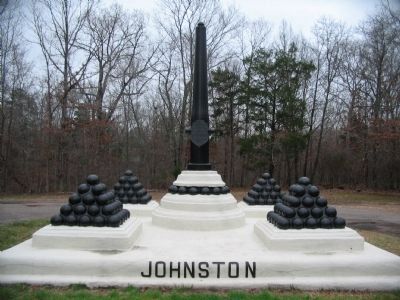
2. General Albert Sidney Johnston Monument
The monument features an upright 4.2-inch (or 30-pdr) Parrott Rifle. Visible on the right rimbase is the foundry number 666, matching to registry number 183. The rifle was produced in 1863 by West Point Foundry, and weighed 4,240 pounds.
Additional commentary.
1. Johnson's Mortal Wounding and Death
Senator Isham G. Harris, who was Governor of Tennessee in 1862 and was serving as Volunteer Aid on the staff of General Johnston at Shiloh, visited this field in April, 1896 for the express purpose of fixing the place where General Johnston fell. After a careful examination of the ground over which the advance was made, he came to the place now marked by the monument and said: "General Johnston was following the advance of Bowen's brigade; he had sent all the members of his staff to other parts of the field with orders. I was the last to leave him, with an order to put Statham's brigade in motion across the Peach Orchard. When I returned General Johnston was alone, sitting on his horse near a large oak tree (where the monument now stands). I saw him reel in the saddle and rode to his side and asked: 'General, are you hurt?' He replied: 'Yes, I fear seriously.' I supported him in the saddle and guided the two horses to
Photographed by Mike Stroud, 1991
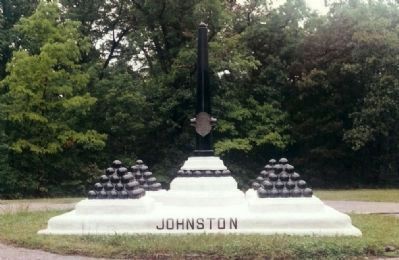
3. Johnston Marker ( Killed here )
— Submitted April 9, 2008, by Mike Stroud of Bluffton, South Carolina.
Photographed by Mike Stroud, 1991
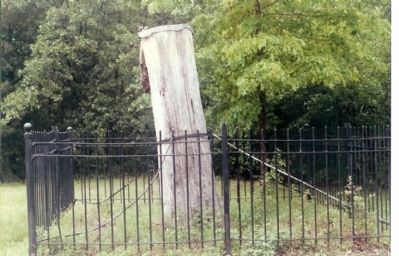
4. Gen. A.S.Johnston Tree
This tree stump, which is no longer standing, is commonly known as the "Johnston Tree." The oft told story is Johnston died under the tree. In reality, he died in the ravine behind the tree. In the early days of the park, a sign was nailed to the tree indicating the place of Johnston's death. From there, some implied the tree itself was the site of the General's last moments.

Photographed by Jim Fredlund, August 3, 2023
5. General Albert Sidney Johnston Marker
Credits. This page was last revised on June 10, 2025. It was originally submitted on April 8, 2008, by Mike Stroud of Bluffton, South Carolina. This page has been viewed 2,623 times since then and 148 times this year. Photos: 1. submitted on October 22, 2008, by Nick Kurtz of Littleton, Colorado. 2. submitted on August 2, 2009, by Craig Swain of Leesburg, Virginia. 3, 4. submitted on April 8, 2008, by Mike Stroud of Bluffton, South Carolina. 5. submitted on June 9, 2025, by Jim Fredlund of Olney, Maryland. • Craig Swain was the editor who published this page.
