
Eastern Neck National Wildlife Refuge in Rock Hall in Kent County, Maryland — The American Northeast (Mid-Atlantic)
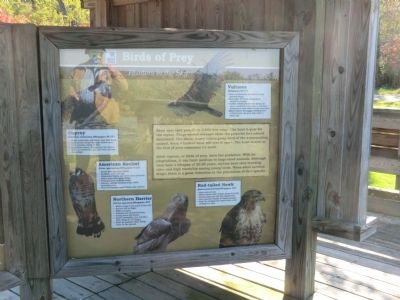
Birds of Prey-Hunters in the Sky
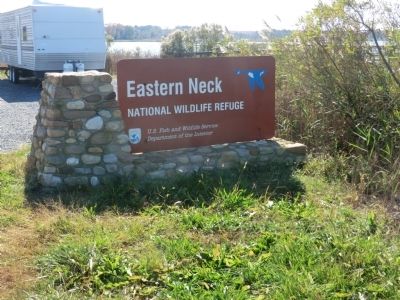
Eastern Neck National Wildlife Refuge
Photographed by Don Morfe, October 27, 2013
1. Birds of Prey-Hunters in the Sky Marker
Keen eyes spot prey from 3,000 feet away. The hunt begins for the raptor. Wings spread outward while the powerful feet extend downward. The sharp, heavy talons grasp hold of the unsuspecting animal. Soon a hooked beak will tear it apart. The hunt is over as the bird of prey consumes its meal.
Adult raptors, or birds of prey, have few predators. With its adaptations, it can hunt medium to large-sized animals. Although they have a lifespan of 20-30 years, raptors have slow breeding rates and high mortality among young birds. When adult survival drops, there is a great reduction in the population of that species.
Osprey
(Pandion haliaetus) (Wingspan 54-72”)
• White underside and head, and dark back.
• Dark brown stripe through yellow eyes.
• Diet consists solely of fish.
• Hunt from above, diving into the water.
• Nests on platform and tall trees around the refuge.
American Kestrel
(Falco sparverius) (Wingspan 9-12”)
• Small Blue-jay sized Hawk.
• Reddish back and tail.
• Mustached black and white face patterns.
• Males have blue/gray wings.
• Females have reddish wings.
• Hovers, rapidlybeating wings while pursuing prey.
Click or scan to see
this page online
• Feed on insects, small birds, and rodents.
Northern Harrier
(Circus cyaneus) (Wingspan 42”)
• White rump at the base of the tail.
• Narrow tail in flight.
• Males are gray.
• Females are streaked brown.
• Young have red breast.
• Soars unsteadily over marshes with wings in a V-shape.
• Hunt by ambush while flying close to the ground.
Red-tailed Hawk
(Buteo jamaicensis) (Wingspan 48”)
• Rust colored tail.
• White breast with stripes along the belly.
• Round wing tips and fan-shaped tail.
• Diet consists mainly of small rodents.
• Hunt by soaring over open fields or by sitting in a tree.
Vultures
(Wingspan 55-71”)
• Soar continuously in circles, rarely beating wings.
• Scavenges for food, eating dead animal carcasses.
• Turkey vulture (Catharies auraj), the most commonly seen, have a red head. (immature have black heads and legs.)
• Black vulture (Coragyps atratus) have a black head and gray legs under a short tail.
Erected by Fish & Wildlife Service, U.S. Department of the Interior.
Topics. This historical marker is listed in these topic lists:
Photographed by Don Morfe, October 27, 2013
2. Birds of Prey-Hunters in the Sky Marker
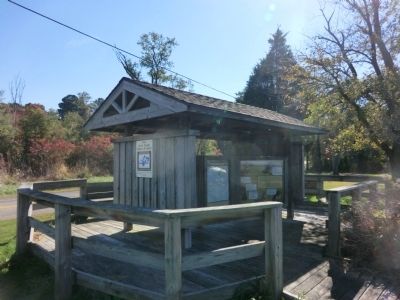
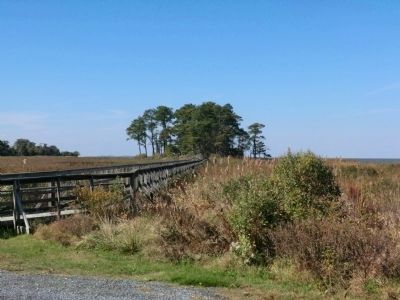
Location. Marker has been permanently removed. It was located near 39° 2.683′ N, 76° 13.283′ W. Marker was in Rock Hall, Maryland, in Kent County. It was in Eastern Neck National Wildlife Refuge. It was at the intersection of Eastern Neck Island Road and Tubby Cove, on the right when traveling south on Eastern Neck Island Road. The marker is located at the entrance to the refuge. Touch for map. Marker was at or near this postal address: 1634 Eastern Neck Island Rd, Rock Hall MD 21661, United States of America.
We have been informed that this marker is no longer there and will not be replaced. This page is an archival view of what was.
Regionally, this marker was on the Eastern Shore. It was also in the American Mid-Atlantic, on the Delmarva Peninsula, in the Tidewater, in the Chesapeake Bay Region, and on the Eastern Seaboard. Globally, it was in the North Atlantic Region, North America, the Western Hemisphere, the Western World, and the Anglosphere. Historically, it found itself in what was once one of the original Thirteen Colonies and also the

Photographed by Don Morfe, October 27, 2013
3. Birds of Prey-Hunters in the Sky Marker
Other nearby markers. At least 8 other markers are within 2 miles of this location, measured as the crow flies: In Recognition of Howard E. McIntyre (within shouting distance of this marker); Tundra Swan Range (approx. 0.6 miles away); Living Shorelines at Eastern Neck National Wildlife Refuge (approx. 1.1 miles away); History of Bogles Wharf (approx. 1.1 miles away); New Yarmouth (approx. 1.6 miles away); Hunting Waterfowl in the Chesapeake (approx. 1.7 miles away); Chesapeake Waterfowl Hunting / Hunting Skiff (approx. 1.7 miles away); Wickliffe (approx. 1.8 miles away). Touch for a list and map of all markers in Rock Hall.
Other markers no longer nearby. Long Distance Travelers (was here, next to this marker but has been permanently removed); Clever Ruse (was approx. 0.6 miles away but has been permanently removed).
Additional commentary.
1. About the signage
At the time this profile was published, nature markers were included on the database. New profiles that exclusively share natural history are not published.
— Submitted May 25, 2025, by Devry Becker Jones of Washington, District of Columbia.
Photographed by Don Morfe, October 27, 2013
4. Birds of Prey-Hunters in the Sky Marker
Credits. This page was last revised on May 25, 2025. It was originally submitted on November 2, 2013, by Don Morfe of Baltimore, Maryland. This page has been viewed 529 times since then and 24 times this year. Photos: 1, 2, 3, 4. submitted on November 2, 2013, by Don Morfe of Baltimore, Maryland. • Bill Pfingsten was the editor who published this page.
