Near Lowesville in Lincoln County, North Carolina — The American South (South Atlantic)
Stonewall Jackson
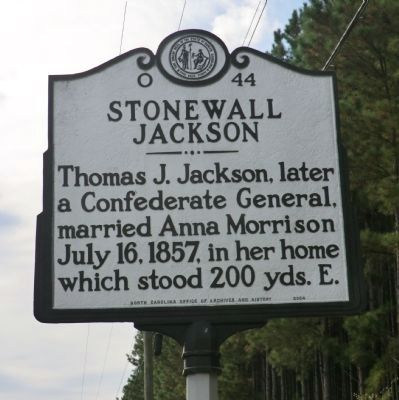
Photographed by Don Morfe, September 17, 2013
1. Stonewall Jackson Marker
Erected 2004 by North Carolina Office of Archives and History. (Marker Number O-44.)
Topics and series. This historical marker is listed in this topic list: War, US Civil. In addition, it is included in the North Carolina Division of Archives and History series list. A significant historical date for this entry is July 16, 1857.
Location. 35° 25.567′ N, 81° 2.717′ W. Marker is near Lowesville, North Carolina, in Lincoln County. It is on Old Plank Road 0.2 miles east of Hines Circle Road, on the right when traveling west. Touch for map. Marker is in this post office area: Stanley NC 28164, United States of America. Touch for directions.

Regionally, this marker is in the Piedmont and in Greater Charlotte. It is also in the American South and specifically in the Upper South. Globally, it is in North America, the Western Hemisphere, the Western World, and the Anglosphere. Historically, it finds itself in what was once the territory of the Mississippian Culture, one of the original Thirteen Colonies,
this page online
Other nearby markers. At least 8 other markers are within 5 miles of this marker, measured as the crow flies: Cottage Home (a few steps from this marker); Peter Forney (approx. half a mile away); Ingleside (approx. 2 miles away); Andrew Carpenter House (approx. 2.6 miles away); Oak Grove (approx. 3.2 miles away); Catawba Springs (approx. 3.6 miles away); Machpelah Cemetery (approx. 3.7 miles away); Stroupe Forest Preserve (approx. 4.7 miles away). Touch for a list and map of all markers in Lowesville.
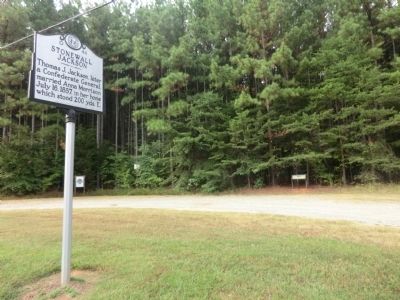
Photographed by Don Morfe, September 17, 2013
2. Stonewall Jackson Marker
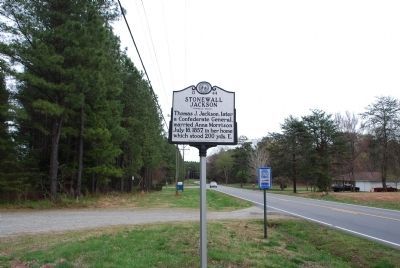
Photographed by Brandon Fletcher, April 4, 2014
3. Stonewall Jackson Marker
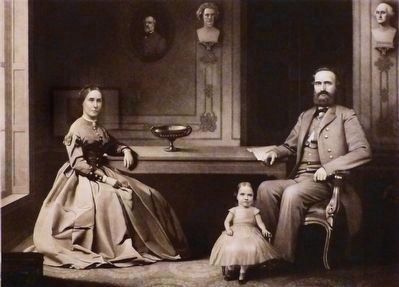
Photographed by Allen C. Browne, February 16, 2015
4. Liet. Gen. Thomas J. Jackson and His Family
This engraving of Stonewall Jackson and family hangs in the National Portrait Gallery in Washington, DC.
“Southern nationalism is symbolically infused in this engraving of General ‘Stonewall’ Jackson seated with his wife, Anna, and their daughter, Julia. Prominently displayed on the back wall is a portrait of Robert E. Lee and sculpture busts of John C. Calhoun and George Washington. Lee emerged from the war as the South's premier icon; he relied heavily on Jackson's military prowess and leadership up until his lieutenant's death in 1863. Calhoun was perhaps the South's foremost pillar of states' rights and the doctrine of secession, while Washington was held in the highest esteem by both sides as a revolutionary patriot and defender of the Constitution.” — National Portrait Gallery
“Southern nationalism is symbolically infused in this engraving of General ‘Stonewall’ Jackson seated with his wife, Anna, and their daughter, Julia. Prominently displayed on the back wall is a portrait of Robert E. Lee and sculpture busts of John C. Calhoun and George Washington. Lee emerged from the war as the South's premier icon; he relied heavily on Jackson's military prowess and leadership up until his lieutenant's death in 1863. Calhoun was perhaps the South's foremost pillar of states' rights and the doctrine of secession, while Washington was held in the highest esteem by both sides as a revolutionary patriot and defender of the Constitution.” — National Portrait Gallery
Credits. This page was last revised on June 30, 2021. It was originally submitted on November 6, 2013, by Don Morfe of Baltimore, Maryland. This page has been viewed 2,210 times since then and 115 times this year. Photos: 1, 2. submitted on November 6, 2013, by Don Morfe of Baltimore, Maryland. 3. submitted on April 7, 2014, by Brandon Fletcher of Chattanooga, Tennessee. 4. submitted on September 1, 2015, by Allen C. Browne of Silver Spring, Maryland. • Bernard Fisher was the editor who published this page.
