Petersburg, Virginia — The American South (Mid-Atlantic)
The Crater
Photographed by Bill Coughlin, April 23, 2007
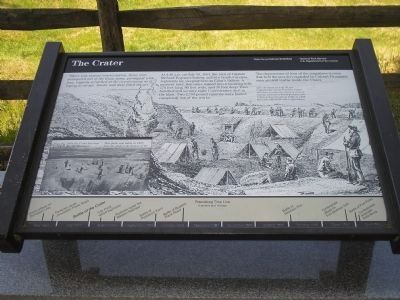
1. The Crater Marker
This marker is located on the walking trail at "The Crater" Tour Stop.
- Col. William McMaster, 17th South Carolina Infantry
At 4:40 a.m. on July 30, 1864, the men of Captain Richard Pegram’s battery and two South Carolina regiments lay sleeping here at Elliot’s Salient. A moment later, this place turned into a smoking hole 170 feet long, 80 feet wide, and 30 feet deep. Two hundred and seventy-eight Confederates died in the blast. Two 1,700-pound cannons were hurled completely out of the works.
The depressions of four of the magazines (rooms that held the powder) exploded by Colonel Pleasants’s men are still visible inside the Crater.
Erected by Petersburg National Battlefield - National Park Service - Dept. of the Interior.
Topics. This historical marker is listed in this topic list: War, US Civil. A significant historical month for this entry is July 1862.
Location. 37° 13.115′ N, 77° 22.65′ W. Marker is in Petersburg, Virginia. It can be reached from Siege Road, on the right when traveling
this page online

Regionally, this marker is in Central Virginia. It is also in the American South and specifically in the Upper South. Globally, it is in North America, the Western Hemisphere, the Western World, and the Anglosphere. Historically, it finds itself in what was once the territory of the Mississippian Culture, one of the original Thirteen Colonies, one of the Confederate States of America, and the Antebellum South.
Other nearby markers. At least 8 other markers are within walking distance of this marker: “A Stupendous Failure” (here, next to this marker); Confederate Counterattack (here, next to this marker); Crater of Mine (here, next to this marker); Confederate Countermine (a few steps from this marker); South Carolina (within shouting distance of this marker); Mahone (within shouting distance of this marker); Mahone’s Brigade (within shouting distance of this marker); Union High Tide (within
Photographed by Bill Coughlin, April 23, 2007
2. Site of the Crater
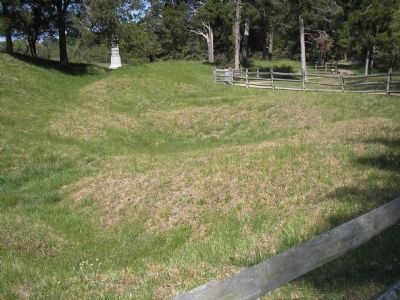
On July 30, 1864, a Union mine blew up under the Confederate Lines here. The explosion resulted in an enormous Crater, the remains of which are still visible today.
More about this marker. The background of the marker is a picture of soldiers camping in the vicinity of the Crater. It has a caption of After the battle on July 30, the Confederates incorporated the Crater into their earthworks. Years of erosion and the removal of 669 bodies from the Crater and surrounding fields in 1866 have altered the site’s appearance.
The lower left of the marker features a post-war photograph of the Crater with the caption Since the 1860s the Crater has been a popular spot for tourists. This photo was taken in 1867. Note the skull at the bottom of the picture.
Like many other markers in Petersburg National Battlefield, this one has a Petersburg Time Line at the bottom. The Battle of the Crater is indicated on it.
Related markers. Click here for a list of markers that are related to this marker. Battle of the Crater by markers.
Also see . . .
1. Crater. CWSAC Battle Summaries. (Submitted on April 12, 2008, by Bill Coughlin of Woodland Park, New Jersey.)
2. Petersburg National Battlefield.
Photographed by Bill Coughlin, April 23, 2007
3. Union Tunnel
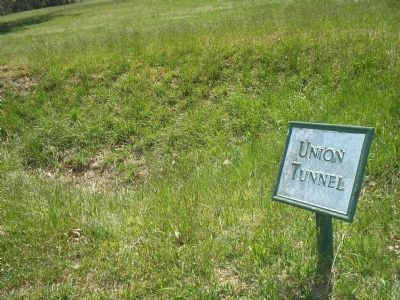
Union soldiers dug a tunnel from their lines to a point under the Confederate position, in which the mine was exploded. The remains of the tunnel are also still visible today.
3. Battle of the Crater. The Civil War Siege of Petersburg (Submitted on April 12, 2008, by Bill Coughlin of Woodland Park, New Jersey.)
Library of Congress
4. The Battle of the Petersburg Crater:
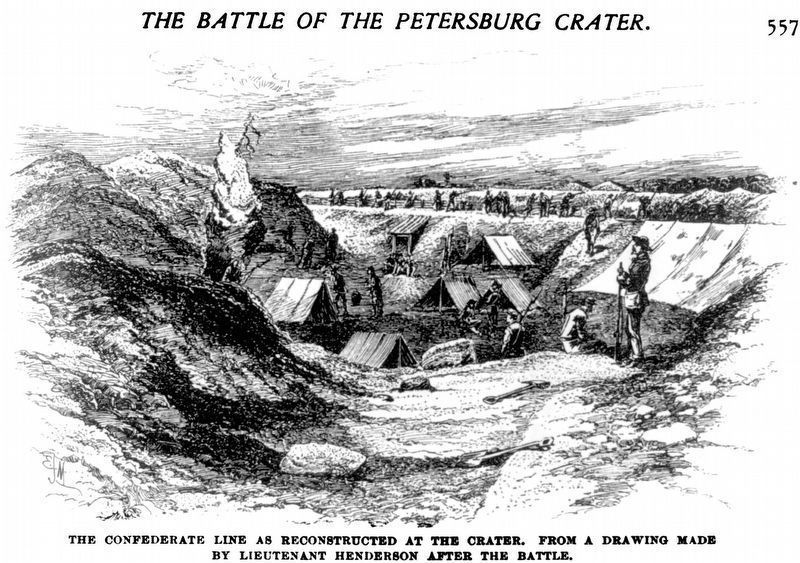
The Confederate Line as Reconstructed at the Crater
The Confederate Line as Reconstructed at the Crater
After the battle on July 30, the Confederates incorporated the Crater into their earthworks. Years of erosion and the removal of 669 bodies from the Crater and surrounding fields in 1866 have altered the site’s appearance.
From a drawing made by Lieutenant Henderson after the battle - Battles and Leaders of the Civil War, 1st ed., v. 4, p. 557.
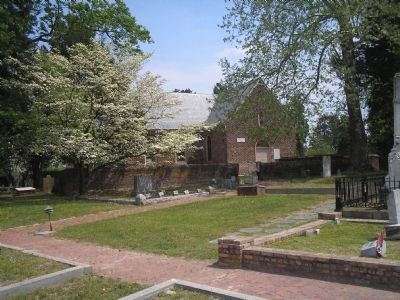
Photographed by Bill Coughlin, April 24, 2007
5. Blandford Church and Cemetery
The Blandford Church is on the high ground just beyond the Confederate works. It was the objective of the Union breakthrough at the Battle of the Crater.
Credits. This page was last revised on February 2, 2023. It was originally submitted on April 12, 2008, by Bill Coughlin of Woodland Park, New Jersey. This page has been viewed 3,693 times since then and 44 times this year. Photos: 1, 2, 3. submitted on April 12, 2008, by Bill Coughlin of Woodland Park, New Jersey. 4. submitted on November 6, 2020, by Allen C. Browne of Silver Spring, Maryland. 5. submitted on April 13, 2008, by Bill Coughlin of Woodland Park, New Jersey. • Craig Swain was the editor who published this page.
