Montgomery in Montgomery County, Alabama — The American South (East South Central)
The Montgomery Slave Trade
⎯⎯⎯
Warehouses Used in the Slave Trade
Photographed by Mark Hilton, December 11, 2013
1. The Montgomery Slave Trade
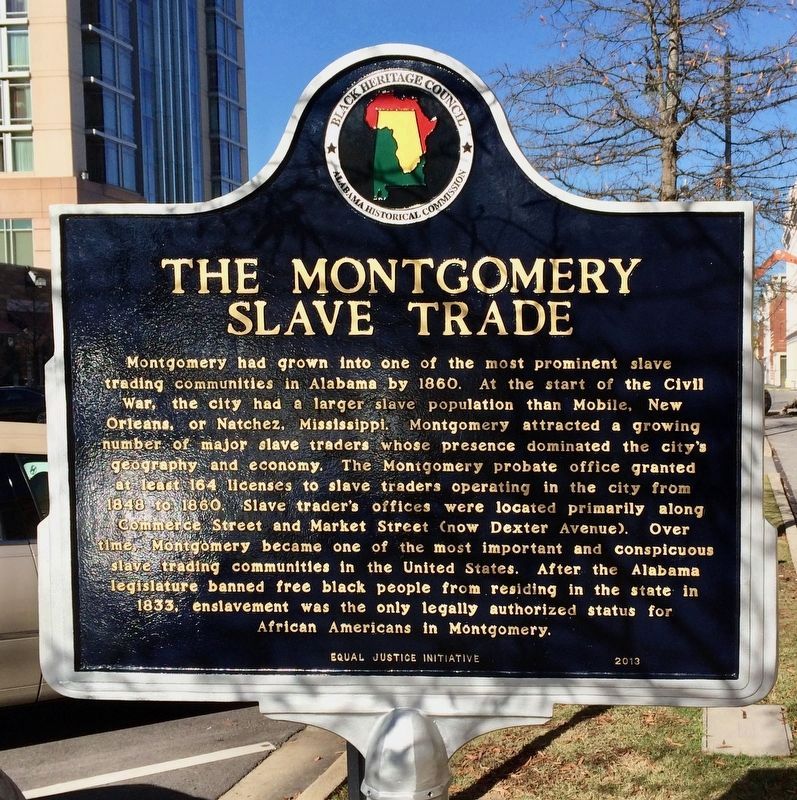
The Montgomery Slave Trade. Montgomery had grown into one of the most prominent slave trading communities in Alabama by 1860. At the start of the Civil War, the city had a larger slave population than Mobile, New Orleans, or Natchez, Mississippi. Montgomery attracted a growing number of major slave traders whose presence dominated the city’s geography and economy. The Montgomery probate office granted at least 164 licenses to slave traders operating in the city from 1848 to 1860. Slave trader’s offices were located primarily along Commerce Street and Market Street (now Dexter Avenue). Over time, Montgomery became one of the most important and conspicuous slave trading communities in the United States. After the Alabama legislature banned free black people from residing in the state in 1833, enslavement was the only legally authorized status for African Americans in Montgomery.
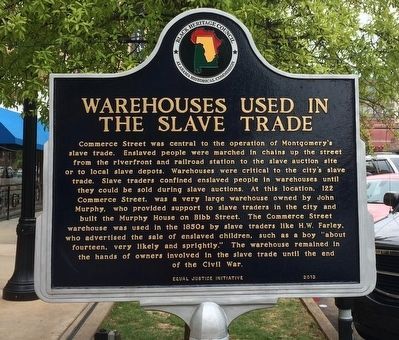
Warehouses Used in the Slave Trade. Commerce Street was central to the operation of Montgomery’s slave trade. Enslaved people were marched in chains up the street from the riverfront and railroad station to the slave auction site or to local
this page online
Erected 2013 by Black Heritage Council, Equal Justice Initiative and the Alabama Historical Commission.
Topics and series. This historical marker is listed in these topic lists: African Americans • Industry & Commerce. In addition, it is included in the Alabama Historical Commission series list. A significant historical year for this entry is 1860.
Location. 32° 22.766′ N, 86° 18.659′ W. Marker is in Montgomery, Alabama, in Montgomery County. It is on Commerce Street 0.1 miles north of Bibb Street (Alabama
Photographed by Mark Hilton, May 28, 2016
2. Warehouses Used in the Slave Trade Marker

Regionally, this marker is in Alabama’s Tri-Counties River Region. It is also in the American South, specifically in the Deep South, and in the Black Belt. Globally, it is in North America, a Gulf of Mexico state, the Western Hemisphere, the Western World, and the Anglosphere. Historically, it finds itself in what was once the territory of the Mississippian Culture, one of the Confederate States of America, and the Antebellum South.
Other nearby markers. At least 8 other markers are within walking distance of this marker: Montgomery Freemasonry (a few steps from this marker); The First Offices of the Confederate Government (within shouting distance of this marker); Great Seal of the Confederacy (within shouting distance of this marker); The Southern Courier. (about 300 feet away, measured in a direct line); Marquis de Lafayette (about 300 feet away); Murphy House (about 500 feet away); Montgomery Area Chamber of Commerce / The Forefront of Montgomery's Future
2014
3. The Montgomery Slave Trade / Warehouses Used in the Slave Trade Marker
Related markers. Click here for a list of markers that are related to this marker.
Additional keywords. human trafficking
Credits. This page was last revised on July 30, 2025. It was originally submitted on December 11, 2013, by Mark Hilton of Montgomery, Alabama. This page has been viewed 12,584 times since then and 546 times this year. Photos: 1. submitted on September 12, 2023, by Mark Hilton of Montgomery, Alabama. 2. submitted on May 28, 2016, by Mark Hilton of Montgomery, Alabama. 3. submitted on September 12, 2023, by Mark Hilton of Montgomery, Alabama. • Bernard Fisher was the editor who published this page.
