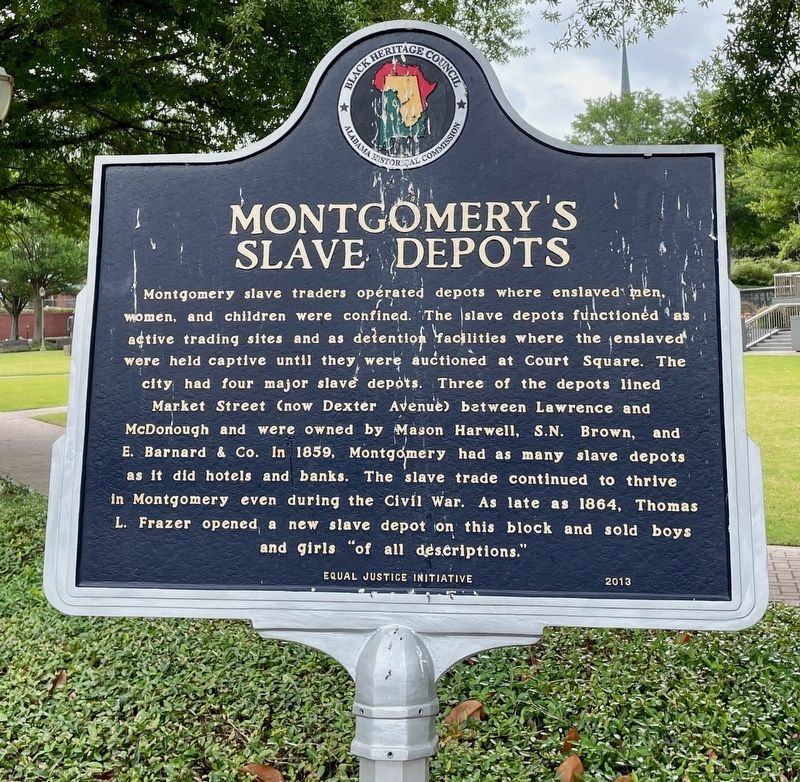
Montgomery's Slave Depots. Montgomery slave traders operated depots where enslaved men, women, and children were confined. The slave depots functioned as active trading sites and as detention facilities where the enslaved were held captive until they were auctioned at Court Square. The city had four major slave depots. Three of the depots lined Market Street (now Dexter Avenue) between Lawrence and McDonough and were owned by Mason Harwell, S.N. Brown, and E. Barnard and Co. In 1859, Montgomery had as many slave depots as it did hotels and banks. The slave trade continued to thrive in Montgomery even during the Civil War. As late as 1864, Thomas L. Frazer opened a new slave depot on this block and sold boys and girls "of all descriptions.",
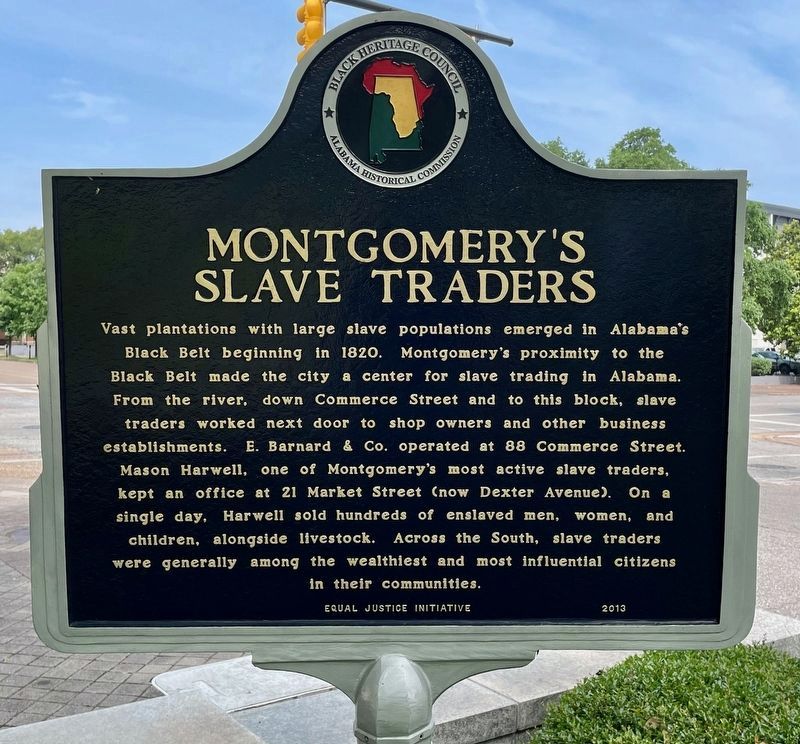
Montgomery's Slave Traders. Vast plantations with large slave populations emerged in Alabama's Black Belt beginning in 1820. Montgomery's proximity to the Black Belt made the city a center for slave trading in Alabama. From the river, down Commerce Street and to this block, slave traders worked next door to shop owners and other business establishments. E. Barnard and Co. operated at 88 Commerce Street. Mason Harwell, one of Montgomery's most active slave traders, kept an office at 21 Market Street (now Dexter Avenue). On a single day, Harwell sold hundreds of enslaved men, women, and children, alongside livestock. Across the South, slave traders were generally among the wealthiest and most influential citizens in their communities.
Montgomery's Slave Depots
Montgomery slave traders operated depots where enslaved men, women, and children were confined. The slave depots functioned as active trading sites and as detention facilities where the enslaved were held captive until they were auctioned at Court Square. The city had four major slave depots. Three of the depots lined Market Street (now Dexter Avenue) between Lawrence and McDonough and were owned by Mason Harwell, S.N. Brown, and E. Barnard & Co. In 1859, Montgomery had as many slave depots as it did hotels and banks. The slave trade continued to thrive in Montgomery even during the Civil War. As late as 1864, Thomas L. Frazer opened a new slave depot on this block and sold boys and girls "of all descriptions."
Montgomery's Slave Traders
Vast plantations with large slave populations emerged in Alabama's Black Belt beginning in 1820. Montgomery's proximity to the Black Belt made the city a center for slave trading in Alabama. From the river, down Commerce Street and to this block, slave traders worked next door to shop owners and other business establishments. E. Barnard & Co. operated
Click or scan to see this page online
at 88 Commerce Street. Mason Harwell, one of Montgomery's most active slave traders, kept an office at 21 Market Street (now Dexter Avenue). On a single day, Harwell sold hundreds of enslaved men, women, and children, alongside livestock. Across the South, slave traders were generally among the wealthiest and most influential citizens in their communities.
Erected 2013 by the Black Heritage Council, Equal Justice Initiative and the Alabama Historical Commission.
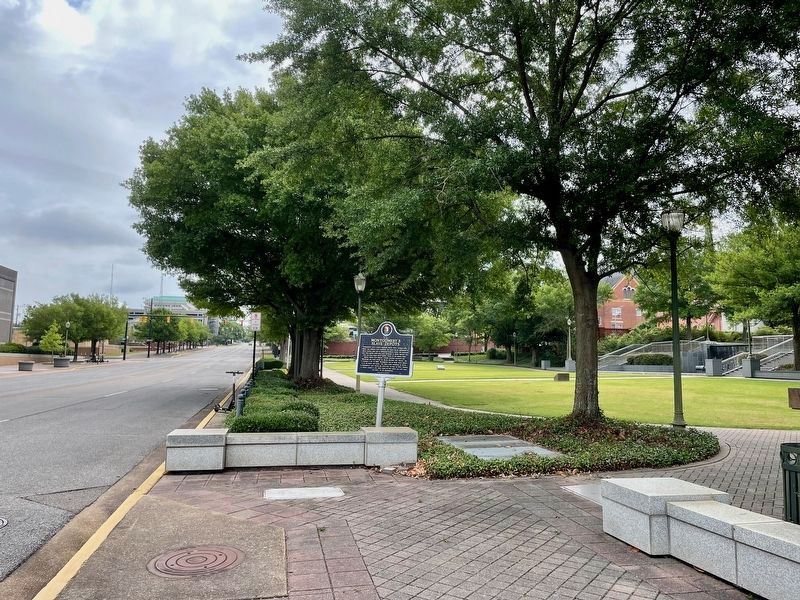
Location. 32° 22.717′ N, 86° 18.367′ W. Marker is in Montgomery, Alabama, in Montgomery County. It is at the intersection of Monroe Street and North Lawrence Street, on the right when traveling east on Monroe Street. Touch for map. Marker is at or near this postal address: 248 Monroe St, Montgomery AL 36104, United States of America. Touch for directions.
Regionally, this marker is in Alabama’s Tri-Counties River Region.
Photographed by Mark Hilton, May 20, 2023
2. Montgomery's Slave Traders Marker
It is also in the American South, specifically in the Deep South, and in the Black Belt. Globally, it is in North America, a Gulf of Mexico state, the Western Hemisphere, the Western World, and the Anglosphere. Historically, it finds itself in what was once the territory of the Mississippian Culture, one of the Confederate States of America, and the Antebellum South.
(was about 500 feet away but has been confirmed missing).
Related markers. Click here for a list of markers that are related to this marker.
Credits. This page was last revised on May 20, 2023. It was originally submitted on January 12, 2014, by Mark Hilton of Montgomery, Alabama. This page has been viewed 3,178 times since then and 108 times this year. Photos:1, 2, 3. submitted on May 20, 2023, by Mark Hilton of Montgomery, Alabama. • Bernard Fisher was the editor who published this page.