Near South Fork in Mineral County, Colorado — The American Mountains (Southwest)
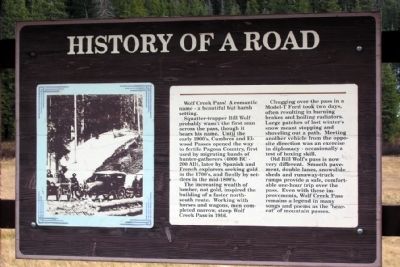
History of a Road
Photographed by Duane Hall, October 9, 2010
1. History of a Road Marker
Wolf Creek Pass! A romantic name - a beautiful but harsh setting.
Squatter-trapper Bill Wolf probably wasn't the first man across the pass, though it bears his name. Until the early 1900's, Cumbres and Elwood Passes opened the way to fertile Pagosa Country, first used by migrating bands of hunter-gatherers (4000 BC - 200 AD), later by Spanish and French explorers seeking gold in the 1700's, and finally by settlers int he mid-1800's.
The increasing wealth of lumber, not gold, inspired the building of a faster north-south route. Working with horses and wagons, men completed narrow, steep Wolf Creek Pass in 1916.
Chugging over the pass in a Model-T Ford took two days, often resulting in burning brakes and boiling radiators. Large patches of last winter’s snow meant stopping and shoveling out a path. Meeting another vehicle from the opposite direction was an exercise in diplomacy - occasionally a test of boxing skill.
Old Bill Wolf’s pass is now very different. Smooth pavement, double-lanes, snowslide sheds and runaway-truck ramps provide a safe, comfortable one-hour trip over the pass. Even with these improvements,
this page online
Topics. This historical marker is listed in this topic list: Roads & Vehicles. A significant historical year for this entry is 1916.
Location. 37° 28.975′ N, 106° 48.137′ W. Marker is near South Fork, Colorado, in Mineral County. It is on U.S. 160 0.2 miles west of County Road 402, on the left when traveling west. Touch for map. Marker is at or near this postal address: Wolf Creek Pass Summit, South Fork CO 81154, United States of America. Touch for directions.

Regionally, this marker is in the Colorado High Rockies, on the Continental Divide, in the San Juan Mountains, and in the San Luis Valley. It is also in the American Mountain West. Globally, it is in North America, the Rocky Mountains, the Western Hemisphere, the Western World, and the Anglosphere. Historically, it finds itself in what was once New Spain and also the Republic of Texas.
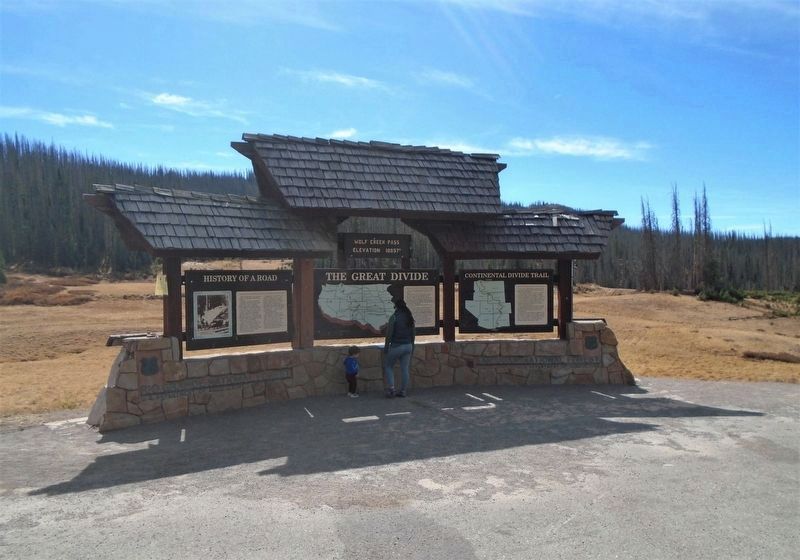
Other nearby markers. At least 6 other markers are within 16 miles of this marker, measured as the crow flies: The Great Divide (here, next to this marker); Continental Divide Trail (here,
Photographed by William Fischer, Jr., October 15, 2020
2. History of a Road Marker
Photographed by Duane Hall, October 9, 2010
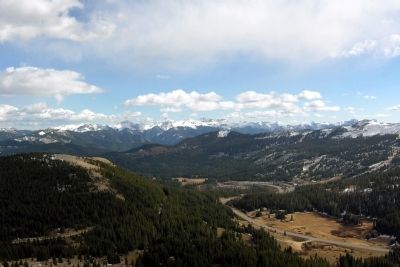
3. View to the southeast from Lobo Overlook
Photographed by Duane Hall, October 9, 2010
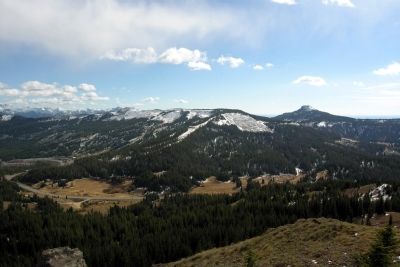
4. View to the south from Lobo Overlook
The US 160 pullout with the markers is at the bottom of the mountain hidden by trees
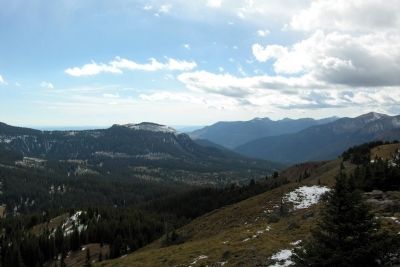
Photographed by Duane Hall, October 9, 2010
5. View to the southwest from Lobo Overlook
Credits. This page was last revised on December 24, 2024. It was originally submitted on February 10, 2014, by Duane Hall of Abilene, Texas. This page has been viewed 1,209 times since then and 62 times this year. Photos: 1. submitted on February 10, 2014, by Duane Hall of Abilene, Texas. 2. submitted on November 21, 2020, by William Fischer, Jr. of Reynoldsburg, Ohio. 3, 4, 5. submitted on February 10, 2014, by Duane Hall of Abilene, Texas.
