Parkers Crossroads in Henderson County, Tennessee — The American South (East South Central)
Morton's Battery
Forrest's Artillery
Photographed by David Graff, April 24, 2012
1. Morton's Battery Monument
Front view
Inscription.
Morton's Battery. Forrest's Artillery. Front
Dedicated to Morton's Battery Forrest's Artillery and Captain John W. Morton, Jr. The Confederacy's Youngest Captain of Artillery, Morton's Battery fought near here December 31, 1862 in the Battle of Parker's Crossroads, TN. with Two Mountain Howitzers and Two 3" Steel Rifled Cannon.. , Rear
Morton's Battery December 27, 1862 , May 9, 1865 . Porter's Battery was captured at Fort Donelson, TN and imprisoned at Johnson Island., Ohio. After being exchanged, Lieutenant John Watson Morton, Jr. and ten of his men were assigned to General Nathan Bedford Forrest's Artillery. Captain Samuel L. Freeman commanded Forrest's Artillery and was acquainted with Lieutenant Morton, who was a personal friend of long standing. Freeman loaned Morton two cannon and sufficient men to man the pieces so Morton could accompany Forrest on his West Tennessee Raid, in December of 1862. On December 18, 1862, Forrest's command captured two three-inch steel-rifled Rodman guns made by Singer-Nimick Company of Pittsburgh, PA, fully equipped from the 14th Indiana Battery. These pieces were given into Morton's possession, enabling him to return to Captain Freeman the two which had been loaned. These two captured cannon became the famous "bull pups," of Forrest's Artillery. Three other cannon were also captured during the raid of 1862. Napier's Battalion, which had joined General Forrest shortly after the Battle of Trenton, TN, contained two mountain howitzers, commanded by Lieutenant A.W. Gould. These were consolidated with Morton's guns at Dresden, TN, December 27, 1862, forming the battery known thereafter as Morton's Battery, with John W. Morton Jr., Captain; A.W. Gould, 1st Lieutenant, and T. Sanders Sale, 2nd Lieutenant. The battery numbered sixty-three non-commissioned officers and men., Morton's Battery served at Parker's Crossroads on December 31, 1862. The artillery was placed at close range and ordered by Forrest to "Give 'em Hell." During the battle, one of the Confederate guns exploded. While the U.S. forces were surrendering, Forrest's was surprised by the brigade of Colonel John W. Fuller under the command of Brigadier General Jeremiah Sullivan. What looked like victory began to resemble a defeat. Forrest was able to extract most of his command. With the exception of the exploded gun, all the Confederate artillery, including the "bull pups," was safely removed. The three captured pieces were left behind, as their horses had been killed and there was not time to substitute others. Eighteen members of Morton's Battery were captured along with three hundred cavalrymen. Freeman and Morton were conspicuous for their coolness, their intelligent, intrepid management of their guns, and General Forrest attributed the larger part of the loss inflicted that day on the enemy to this and the bravery of their companies. In his official report General Forrest commended the action of his artillery. "Captain Freeman and Lieutenant Morton, of our batteries, with all of their men, deserve especial mention, keeping up, as they did, a constant fire from their pieces, notwithstanding the enemy made every effort at silencing them by shooting down the artillerist at their guns.", After Captain Freeman's death, April 10, 1863, Captain Morton later became General Forrest's Chief of Artillery.,
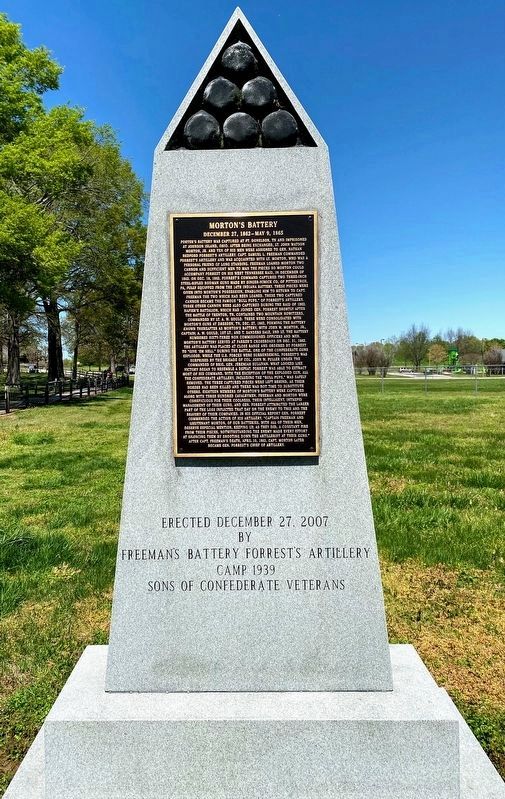
Erected December 27, 2007 by Freeman's Battery Forrest's Artillery Camp 1939 Sons of Confederate Veterans.
Front
Dedicated to Morton's Battery Forrest's Artillery and Captain John W. Morton, Jr. The Confederacy's Youngest Captain of Artillery
Morton's Battery fought near here December 31, 1862 in the Battle of Parker's Crossroads, TN. with Two Mountain Howitzers and Two 3" Steel Rifled Cannon.
Rear
Morton's Battery December 27, 1862 — May 9, 1865
Porter's Battery was captured at Fort Donelson, TN and imprisoned at Johnson Island., Ohio. After being exchanged, Lieutenant John Watson Morton, Jr. and ten of his men were assigned to General Nathan Bedford Forrest's Artillery. Captain Samuel L. Freeman commanded Forrest's Artillery and was acquainted with Lieutenant Morton, who was a personal friend of long standing. Freeman loaned Morton two cannon and sufficient men to man the pieces so Morton could accompany Forrest on his West Tennessee Raid, in December of 1862. On December 18, 1862, Forrest's command captured two three-inch steel-rifled Rodman guns made by Singer-Nimick Company of Pittsburgh, PA, fully equipped from the 14th Indiana Battery. These pieces were given into Morton's possession, enabling him to return to Captain Freeman the two which had been loaned. These two captured cannon became the famous "bull pups,"
Click or scan to see this page online
of Forrest's Artillery. Three other cannon were also captured during the raid of 1862. Napier's Battalion, which had joined General Forrest shortly after the Battle of Trenton, TN, contained two mountain howitzers, commanded by Lieutenant A.W. Gould. These were consolidated with Morton's guns at Dresden, TN, December 27, 1862, forming the battery known thereafter as Morton's Battery, with John W. Morton Jr., Captain; A.W. Gould, 1st Lieutenant, and T. Sanders Sale, 2nd Lieutenant. The battery numbered sixty-three non-commissioned officers and men.
Morton's Battery served at Parker's Crossroads on December 31, 1862. The artillery was placed at close range and ordered by Forrest to "Give 'em Hell." During the battle, one of the Confederate guns exploded. While the U.S. forces were surrendering, Forrest's was surprised by the brigade of Colonel John W. Fuller under the command of Brigadier General Jeremiah Sullivan. What looked like victory began to resemble a defeat. Forrest was able to extract most of his command. With the exception of the exploded gun, all the Confederate artillery, including the "bull pups," was safely removed. The three captured pieces were left behind, as their horses had been killed and there was not time to substitute others. Eighteen members of Morton's Battery were captured along with three hundred cavalrymen. Freeman and Morton were conspicuous for
Photographed by Shane Oliver, April 11, 2021
2. Morton's Battery Marker
their coolness, their intelligent, intrepid management of their guns, and General Forrest attributed the larger part of the loss inflicted that day on the enemy to this and the bravery of their companies. In his official report General Forrest commended the action of his artillery. "Captain Freeman and Lieutenant Morton, of our batteries, with all of their men, deserve especial mention, keeping up, as they did, a constant fire from their pieces, notwithstanding the enemy made every effort at silencing them by shooting down the artillerist at their guns."
After Captain Freeman's death, April 10, 1863, Captain Morton later became General Forrest's Chief of Artillery.
Erected December 27, 2007 by Freeman's Battery Forrest's Artillery Camp 1939 Sons of Confederate Veterans
Erected 2007 by Sons of Confederate Veterans (See end of text).
Location. 35° 47.78′ N, 88° 23.418′ W. Memorial is in Parkers Crossroads, Tennessee, in Henderson County. It can be reached from Tennessee Route 22 0.6 miles north of Interstate 40, on the right
Photographed by David Graff, April 24, 2012
3. Morton's Battery Monument
Bronze plaque on rear.
when traveling north. Marker is on the North Loop Walking Trail 340 feet from the start of the trail near where the trail splits. The North Loop Walking Trail is at Tour Stop #1 (Parkers Crossroads City Park) of the Parkers Crossroads Driving Tour. Touch for map. Memorial is in this post office area: Wildersville TN 38388, United States of America. Touch for directions.
Regionally, this memorial is in West Tennessee. It is also in the American South and specifically in the Upper South. Globally, it is in North America, the Western Hemisphere, the Western World, and the Anglosphere. Historically, it finds itself in what was once the territory of the Mississippian Culture, one of the Confederate States of America, and the Antebellum South.
More about this memorial. The marker has an engraved Confederate States artillery symbol on the front and is topped by a stylized pyramid of cannonballs.
Photographed by Brandon Fletcher, October 8, 2010
4. Morton's Battery Marker
Marker to left of 3 sided Kiosk
Photographed by David Graff, April 24, 2012
5. View North from Morton's Battery Monument
The monument is near the start of the North Loop Walking Trail (at left) and Parkers Crossroads City Park.
Credits. This page was last revised on June 3, 2021. It was originally submitted on March 10, 2014, by David Graff of Halifax, Nova Scotia. This page has been viewed 1,935 times since then and 58 times this year. Photos:1. submitted on March 10, 2014, by David Graff of Halifax, Nova Scotia. 2. submitted on May 30, 2021, by Shane Oliver of Richmond, Virginia. 3. submitted on March 10, 2014, by David Graff of Halifax, Nova Scotia. 4. submitted on August 22, 2015, by Brandon Fletcher of Chattanooga, Tennessee. 5. submitted on March 10, 2014, by David Graff of Halifax, Nova Scotia. • Bill Pfingsten was the editor who published this page.

