South Beach in San Francisco City and County, California — The American West (Pacific Coastal)
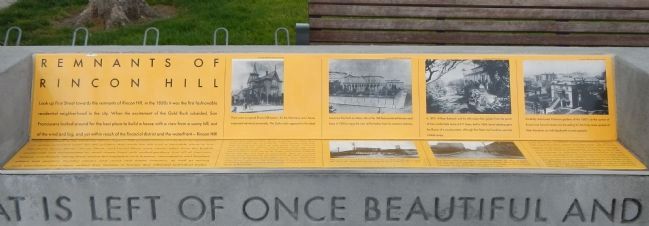
Remnants of Rincon Hill
Photographed by Barry Swackhamer, March 20, 2014
1. Remnants of Rincon Hill Marker
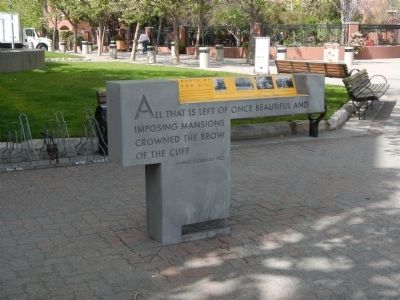
Rincon Hill was first assaulted in 1869 when the notorious Second Street Cut dug a trench
this page online
On the front of the podia
All that is left of once beautiful and imposing mansions crowned the brow of the cliff – Harles Stoddard, 1903
On the back of the podia
To each the city of his dreams – George Sterling, 1901
Erected by San Francisco Art Commission for the Waterfront Transportation Projects.
Topics. This historical marker
Photographed by Barry Swackhamer, March 20, 2014
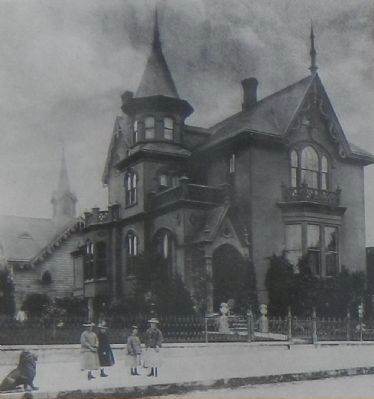
2. Photograph detail from Remnants of Rincon Hill Marker
Photograph:
Top row, left
There were no typical Rincon Hill estates – for the Victorians, one’s house expressed individual personality. The Gothic style appealed to this ideal. A next door neighbor, Evelyn Breeze, remembers this Gothic home when she played there , a little girl: “When Jerome Lincoln lived there the estate had a black and white marble sidewalk, flanked at each end with two cast-iron lions couchant, which were great favorites with the young... In front was a fountain which played on festive occasions, and in the garden proper were statues of Apollo, Diana, two deer and dogs of varied kinds. There was a round summer house covered with ivy and honeysuckle where lunch was occasionally served. Near the stables, was an aviary where quail called to each other morning and evening. A large green parrot shrieked on his perch and gave military orders in French, much to the delight of the young.”
There were no typical Rincon Hill estates – for the Victorians, one’s house expressed individual personality. The Gothic style appealed to this ideal. A next door neighbor, Evelyn Breeze, remembers this Gothic home when she played there , a little girl: “When Jerome Lincoln lived there the estate had a black and white marble sidewalk, flanked at each end with two cast-iron lions couchant, which were great favorites with the young... In front was a fountain which played on festive occasions, and in the garden proper were statues of Apollo, Diana, two deer and dogs of varied kinds. There was a round summer house covered with ivy and honeysuckle where lunch was occasionally served. Near the stables, was an aviary where quail called to each other morning and evening. A large green parrot shrieked on his perch and gave military orders in French, much to the delight of the young.”
Location. 37° 46.951′ N, 122° 23.309′ W. Marker is in San Francisco, California, in San Francisco City and County. It is in South Beach. It is on The Embarcadero near Townsend Street, on the right when traveling south. Touch for map. Marker is at or near this postal address: 684 The Embarcadero, San Francisco CA 94107, United States of America. Touch for directions.

Regionally, this marker is on the Coast Ranges. It is also on the American Pacific Coast. Globally, it is in North America, on the Ring of Fire, on the Pacific Rim, in the Western Hemisphere, in the Western World, and in the Anglosphere. Historically, it finds itself in what was once New Spain and also Mexico’s Alta California.
Other nearby markers. At least 8 other markers are within walking distance of this marker: Building the Seawall (within shouting distance of this marker); Townsend Street (about 300 feet away, measured in a direct line); The Alaska Packers (about 300 feet away); The Oriental Warehouse (about 300 feet away); Whaling Out of San Francisco (about
Photographed by Barry Swackhamer, March 20, 2014
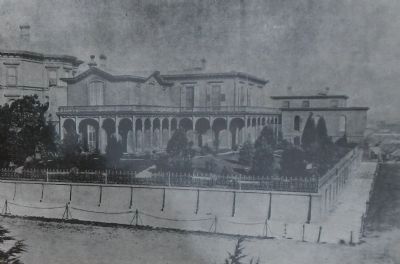
3. Photograph detail from Remnants of Rincon Hill Marker
Photograph: Top row, center left
Lawrence Coe built an Italian villa at the 100 foot summit at Harrison and Essex in 1861 to enjoy the view of the harbor from his extensive balcony.
Lawrence Coe built an Italian villa at the 100 foot summit at Harrison and Essex in 1861 to enjoy the view of the harbor from his extensive balcony.
Also see . . . A History of Ever-changing Rincon Hill - SPUR. By 1852, San Francisco's overgrown mining camp era was rapidly disappearing. Many Forty-Niners asked their wives or sweethearts back home to join them... Many of these families lived in three- and four-room cottages in today's downtown area and nearby South of Market blocks. Well-to-do San Franciscans, of course, wanted substantial houses and stylish neighborhoods which, for a few, recalled their previous way of life back East and, for most others, showed off the money they had just won in the West. (Submitted on March 31, 2014, by Barry Swackhamer of Brentwood, California.)
Photographed by Barry Swackhamer, March 20, 2014
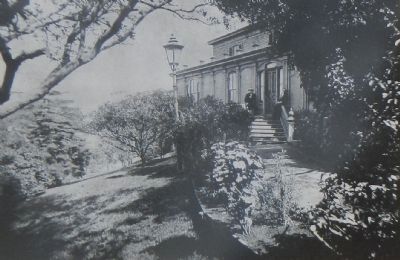
4. Photograph detail from Remnants of Rincon Hill Marker
Photograph: Top row, center right
In 1879, William Babcock and his wife enjoy their garden from the porch of their comfortable home at #11 Essex, built in 1854. Lavish planting gave the illusion of a country estate, although First Street iron foundries were but a block away.
In 1879, William Babcock and his wife enjoy their garden from the porch of their comfortable home at #11 Essex, built in 1854. Lavish planting gave the illusion of a country estate, although First Street iron foundries were but a block away.
Photographed by Barry Swackhamer, March 20, 2014
5. Photograph detail from Remnants of Rincon Hill Marker
Photograph: Top row, right
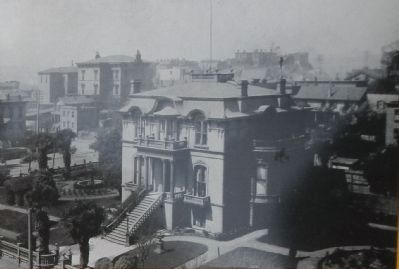
Carefully manicured Victorian gardens of the 1880’s at the corner of Bryant and Second streets are the setting for the forty room spread of Peter Donahue, an Irish blacksmith turned capitalist.
Carefully manicured Victorian gardens of the 1880’s at the corner of Bryant and Second streets are the setting for the forty room spread of Peter Donahue, an Irish blacksmith turned capitalist.
Photographed by Barry Swackhamer, March 20, 2014
6. Photograph detail from Remnants of Rincon Hill Marker
Photograph: Bottom row, left
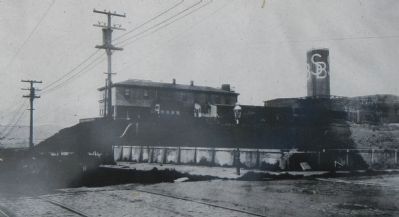
The same corner of Essex and Harrison in 1916. Nothing survived the April 18, 1906 fire but the original stone wall put up in 1861.
The same corner of Essex and Harrison in 1916. Nothing survived the April 18, 1906 fire but the original stone wall put up in 1861.
Photographed by Barry Swackhamer, March 20, 2014
7. Photograph detail from Remnants of Rincon Hill Marker
Photograph: Bottom row, right
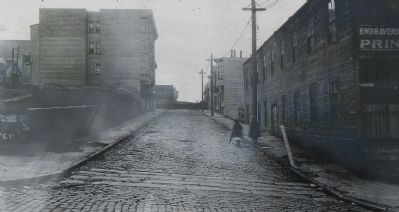
Guy Place ended at the edge of Babcock’s garden. By 1919 tenement flats had been built alongside industrial buildings, filling space left by the 1906 fire. The 1910 census revealed over-crowded conditions where European immigrants struggled to survive.
Guy Place ended at the edge of Babcock’s garden. By 1919 tenement flats had been built alongside industrial buildings, filling space left by the 1906 fire. The 1910 census revealed over-crowded conditions where European immigrants struggled to survive.
Photographed by Barry Swackhamer, March 20, 2014
8. Remnants of Rincon Hill Marker
Credits. This page was last revised on February 7, 2023. It was originally submitted on March 31, 2014, by Barry Swackhamer of Brentwood, California. This page has been viewed 1,078 times since then and 30 times this year. Photos: 1, 2, 3, 4, 5, 6, 7, 8. submitted on March 31, 2014, by Barry Swackhamer of Brentwood, California. • Bill Pfingsten was the editor who published this page.
