Near Newark in New Castle County, Delaware — The American Northeast (Mid-Atlantic)
The Chambers House
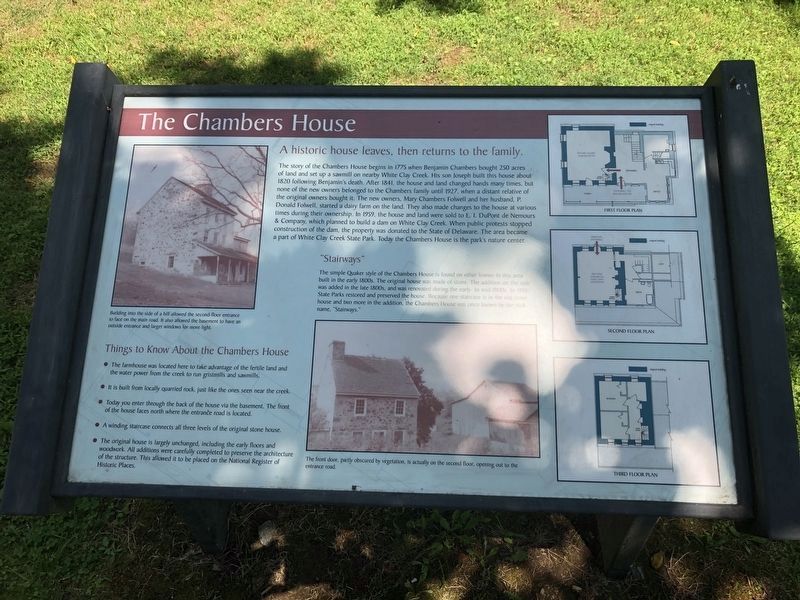
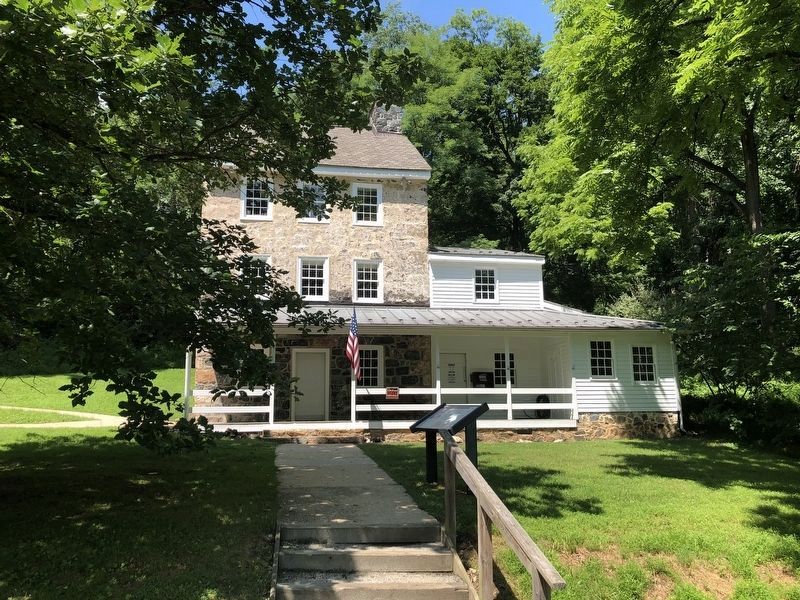
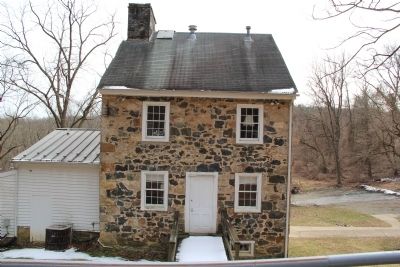
A historic house leaves, then returns to the family. The story of the Chambers House begins in 1775 when Benjamin Chambers bought 250 acres of land and set up a sawmill on nearby White Clay Creek. His son Joseph built this house about 1820 following Benjamin's death. After 1841, the house and land changed hands many times, but none of the new owners belonged to the Chambers family until 1927, when a distant relative of the original owners bought it. The new owners, Mary Chambers Folwell and her husband, P. Folwell, started a dairy farm on the land. They also made changes to the house at various times during their ownership. In 1959, the house and land were sold to E. I. DuPont de Nemours & Company, which planned to build a dam on White Clay Creek. When public protests stopped construction of the dam, the property was donated to the State of Delaware. The area became a part of White Clay Creek State Park. Today the Chambers House is the park's nature center.
"Stairways"
The simple Quaker style of the Chambers House is found on other homes in this area built in the early 1800's. The original house was made of stone.
this page online
Things to Know About the Chambers House:
•The farmhouse was located here to take advantage of the fertile land and the water power from the creek to run gristmills and saw mills.
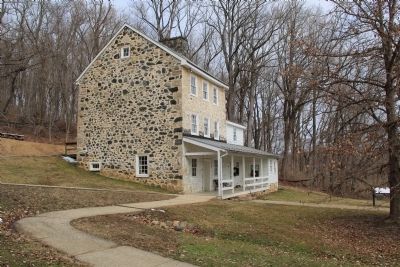
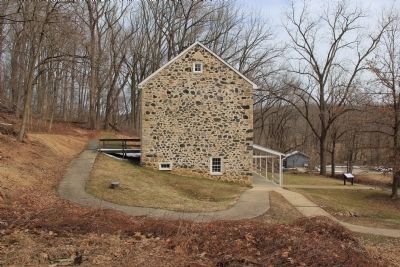
•It is built from locally quarried rock, just like the ones seen near the creek.
•Today you enter through the back of the house via the basement. The front of the house faces north where the entrance road is located.
•A winding staircase connects all three levels of the original stone house.
•The original house is largely unchanged, including the early floors and woodwork. All additions were carefully completed to preserve the architecture of the structure. This allowed it to be placed on the National Register of Historic Places.
Topics and series. This historical marker is listed in these topic lists: Agriculture • Industry & Commerce. In addition,
Location. 39° 43.627′ N, 75° 46.088′ W. Marker is near Newark, Delaware, in New Castle County. It can be reached from Creek Road. The house is located in White Clay Creek State Park. Touch for map. Marker is in this post office area: Newark DE 19711, United States of America. Touch for directions.

Regionally, this marker is in Greater Wilmington and in Greater Philadelphia. It is also in the American Mid-Atlantic, on the Delmarva Peninsula, and on the Eastern Seaboard. Globally, it is in the North Atlantic Region, North America, the Western Hemisphere, the Western World, and the Anglosphere. Historically, it finds itself in what was once New Netherland and also one of the original Thirteen Colonies.
Other nearby markers. At least 8 other markers are within 3 miles of this marker, measured as the crow flies: Dorothy P. Miller: Champion of Preservation (about 300 feet away, measured in a direct line); Arc Corner Monument Stone (approx. half a mile away); a different marker also named The Wedge (approx.
Photographed by Stephen J Duncan, March 18, 2014
3. The Chambers House Marker
Another marker is no longer nearby. The Wedge (was approx. 1.1 miles away but has been replaced with another marker now near it).
More about this marker. The marker is located in front of the house.
Also see . . . Chambers House - National Register of Historic Places Nomination Form.
The Chambers house stands on a rise of land near White Clay Creek, for which the Hundred is named, and overlooks the site on which a saw and gristmill stood in the eighteenth and nineteenth centuries. There is nothing in deed records or other material to pinpoint the precise date of construction. Tax records, deeds, other historical documents, and the fabric of the house indicate that it was built between 1816 and 1852, and probably nearer the earlier date, by Joseph Chambers.(Submitted on April 23, 2025, by Pete Skillman of Wilmington, Delaware.)
Photographed by Stephen J Duncan, March 18, 2014
4. The Chambers House Marker
Photographed by Stephen J Duncan, March 18, 2014
5. The Chambers House Marker
Credits. This page was last revised on April 23, 2025. It was originally submitted on April 1, 2014, by Stephen J Duncan of Wilmington, Delaware. This page has been viewed 1,738 times since then and 66 times this year. Photos: 1, 2. submitted on July 29, 2020, by Devry Becker Jones of Washington, District of Columbia. 3, 4, 5. submitted on April 1, 2014, by Stephen J Duncan of Wilmington, Delaware. • Bill Pfingsten was the editor who published this page.
