King George in King George County, Virginia — The American South (Mid-Atlantic)
Emmanuel Episcopal Church
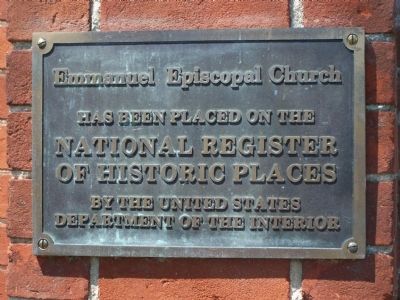
Photographed by William Pfingsten, April 18, 2008
1. Emmanuel Episcopal Church Marker
Topics. This historical marker is listed in these topic lists: Cemeteries & Burial Sites • Notable Buildings • Religion & Religious Structures.
Location. 38° 10.769′ N, 77° 11.142′ W. Marker is in King George, Virginia, in King George County. It is on James Madison Parkway (U.S. 301) north of Walsingham Road, on the right when traveling south. Touch for map. Marker is at or near this postal address: 17062 James Madison Parkway, King George VA 22485, United States of America. Touch for directions.

Regionally, this marker is in the American South, specifically in the Upper South, in the Mid-Atlantic, in the Tidewater, in the Chesapeake Bay Region, and on the Eastern Seaboard. Globally, it is in the North Atlantic Region, North America, the Western Hemisphere, the Western World, and the Anglosphere. Historically, it finds itself in what was once the territory of the Mississippian Culture, one of the original Thirteen Colonies, one of the Confederate
this page online
Other nearby markers. At least 8 other markers are within walking distance of this marker: Emmanuel Church (here, next to this marker); a different marker also named Emmanuel Church (here, next to this marker); James Madison's Birthplace (a few steps from this marker); King George County / Caroline County (a few steps from this marker); This monument, until 1983 located on the Belle Grove Lawn (within shouting distance of this marker); Belle Grove Plantation (about 500 feet away, measured in a direct line); Port Royal Harbor (approx. half a mile away); Port Royal (approx. half a mile away). Touch for a list and map of all markers in King George.
Another marker is no longer nearby. Birthplace of Madison (was a few steps from this marker but has been replaced with another marker now near it).
Also see . . .
1. Colonial Dames: Marker Placed at Church. The George Mason I Chapter, National Society Colonial Dames XVII Century, placed a marker at the historic Emmanuel Episcopal Church in old Port Conway in November, 2013. (Submitted on December 11, 2013, by Kevin W. of Stafford, Virginia.)
2. 048-0007 Emmanuel Church 1987 Final Nomination.
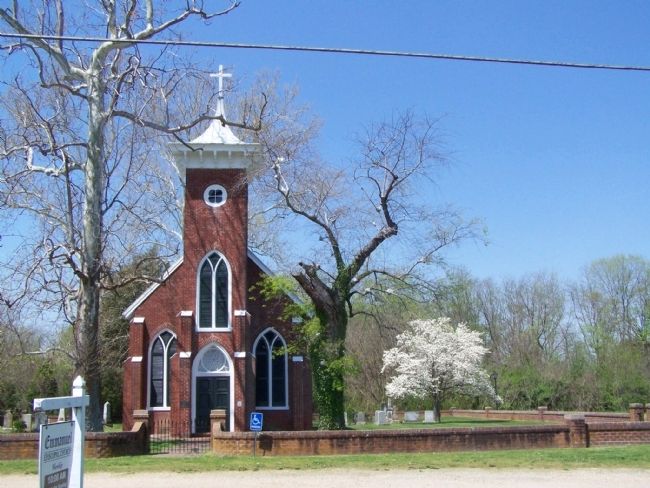
Photographed by William Pfingsten, April 18, 2008
2. Emmanuel Episcopal Church
The town of Port Conway was established in 1784 at the site of the Rappahannock ferry crossing from Port Royal. To attend church, Port Conway residents had to take the ferry south to St. Peter’s Church, Port Royal or travel to St. Paul’s at Owens or (after 1843) to St. John’s Church, King George Court House. To end this inconvenience, Cornelius Turner (1812-1876) of Belle Grove donated plantation land for use as a church site.(Submitted on July 17, 2026.)
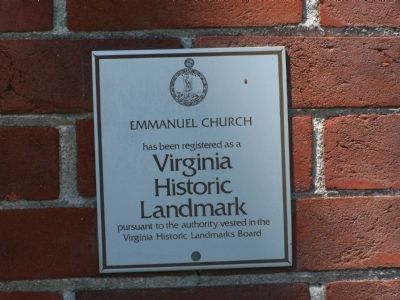
Belle Grove itself was part of a land grant dating from the 1660s, the decade in which Governor Berkeley granted Thomas Chetwood and John Prosser 5,274 acres as consideration for transporting 100 persons to the colony. Less than three years after acquiring the tract, Prosser sold 1,000 acres to Anthony Sevedge. That portion of the tract then passed from the Conway family (1720-90) to the Bernard family (1790-1839) to the Turners (1839-93). George Washington was afrequent visitor to Belle Grove, and in 1751 the plantation became the birthplace of James Madison.Photographed by William Pfingsten, April 18, 20083. Emmanuel Church PlaqueEmmanuel Church has been registered as a Virginia Historic Landmark pursuant to the authority vested in the Virginia Historic Landmarks Board.
Emmanuel Church, Port Conway, was constructed 1859-60 and consecrated on July 2, 1860 by Bishop Johns. Unfortunately, the name of the architect is not recorded; however, on the basis of the design and the date, the church may be attributed to the Baltimore architectural firm of Niernsee and Neilson. The firm was responsible for building other churches in the Gothic style in Virginia which share similar design details with Emmanuel Church.
J. Crawford Neilson and John R. Niernsee practiced architecture in Baltimore. Neilson was born in that city in 1817 and studied civil engineering in Brussels, Belgium and subsequently practiced his profession in the United States, entering into a partnership with Niernsee in 1848. Niernsee came to Baltimore from Vienna, Austria, where he had attended the Vienna Polytechnic.
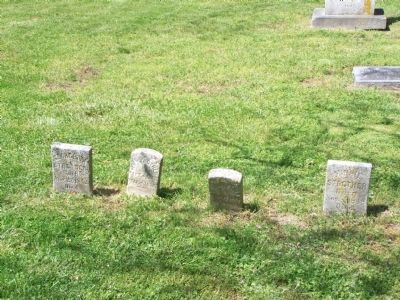
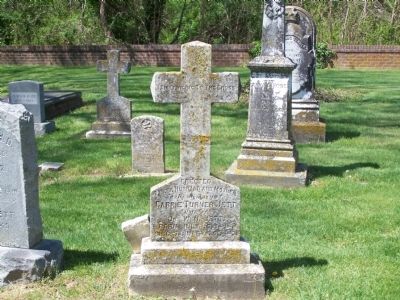
In Virginia the architects are thought to be associated with the design of two Episcopal churches: St. Paul’s Church, Petersburg of 1855-57 and Martin’s Brandon Church, Prince George County of 1855-56. St. Paul’s is documentedin the church vestry records as the work of Neilson and Niernsee. A Gothic Revival-style edifice, St. Paul’s is among the most elaborate antebellum churches in Petersburg. Martin’s Brandon is a country church also attributed to Neilson and Niernsee. While predominantly Italianate in style, Martin’s Brandon Church, like Emmanuel, features a tall tower distinguished by an unusual flaring pyramidal roof. The design of the two church roofs suggests the same hand. Martin’s Brandon Church is, of course, larger than Emmanuel. However, both churches have excellent proportions and fine detailing. The location of Emmanuel on the Northern Neck makes the attribution to Neilson and Niernsee more probable. During the 19th century, the proximity of the area to Baltimore exerted a marked influence on Northern Neck architecture. Baltimore is also known to have provided the Northern Neck with building components. It is therefore not surprising to learn that a Baltimore architectural firm may have designed a small country church for a Northern Neck congregation.Photographed by William Pfingsten, April 18, 20084. Grave stones in Emmanuel Cemetery
In 1861, the Rev. Alexander Shiras was rector of both St. John’s Church, King George CourtHouse and Emmanuel Church. He reported in 1862: “The war has borne somewhat heavily upon the Parish (Hanover Parish), scattering its families, carrying off its young men, and almost dissolving the congregation. Regular services were steadily kept up, and others held for the soldiers occasionally stationed in the neighborhood.”Photographed by William Pfingsten, April 18, 20085. Grave stones in Emmanuel Cemetery
The Rev. Henry Wall, who became the rector of Hanover Parish, King George County, in September, 1865, reported: “Emmanuel Church at Port Conway was now fit for occupation. It has been repaired by aid of the liberality of kind friends of the Church in Baltimore & New York, and by many personal friends of the subscriber in Alexandria.”
Ultimately, the church recovered from the war and has continued to serve the citizens of Port Conway to this day. The church retains its original interior gallery and its Henry Erban organ. The organ has a Gothic Revival-style case and dates to the third quarter of the 19th century.
Credits. This page was last revised on July 17, 2026. It was originally submitted on April 23, 2008, by Bill Pfingsten of Bel Air, Maryland. This page has been viewed 1,724 times since then and 49 times this year. Photos: 1, 2, 3, 4, 5. submitted on April 23, 2008, by Bill Pfingsten of Bel Air, Maryland.
