Bethesda in Montgomery County, Maryland — The American Northeast (Mid-Atlantic)
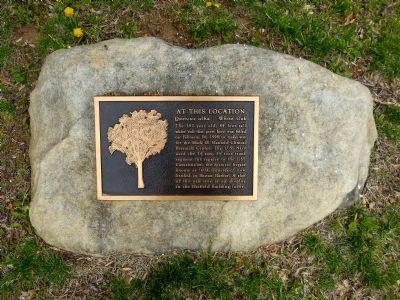
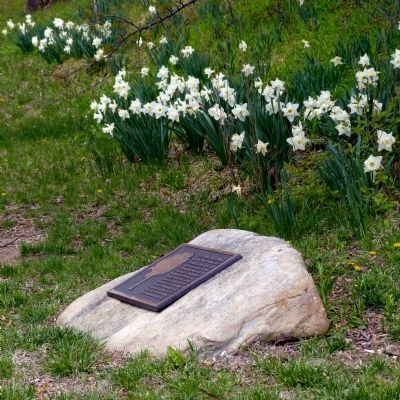
At This Location
Quercus alba -- White Oak
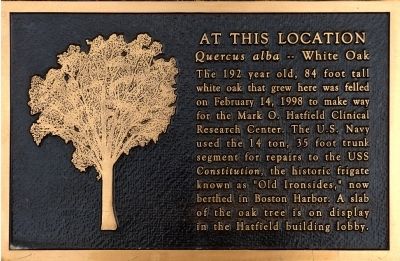
Photographed by Allen C. Browne, April 28, 2014
1. At This Location Marker
Topics. This historical marker is listed in these topic lists: Environment • Horticulture & Forestry • Waterways & Vessels. A significant historical month for this entry is February 1915.
Location. 39° 0.215′ N, 77° 6.198′ W. Marker is in Bethesda, Maryland, in Montgomery County. It is at the intersection of Center Drive and North Drive, on the right when traveling west on Center Drive. On the NIH Campus. Touch for map. Marker is at or near this postal address: 8 Center Drive, Bethesda MD 20814, United States of America. Touch for directions.

Regionally, this marker is in the Washington Metropolitan Area. It is also in the American Mid-Atlantic. Globally, it is in North America, the Western Hemisphere, the Western World, and the Anglosphere.
this page online
Other nearby markers. At least 8 other markers are within walking distance of this marker: Tree of Hippocrates (within shouting distance of this marker); Sky Horizon (about 400 feet away, measured in a direct line); Claude Denson Pepper Building (about 600 feet away); President Franklin D. Roosevelt dedicated the NIH Bethesda campus on this site, October 31, 1940 (approx. 0.2 miles away); The Paul G. Rogers Plaza (approx. 0.2 miles away); The Centennial Anchor (approx. ¼ mile away); The Louis Stokes Laboratories (approx. ¼ mile away); The Mary Woodard Lasker Center for Health Research and Education (approx. 0.3 miles away). Touch for a list and map of all markers in Bethesda.
Photographed by Allen C. Browne, April 28, 2014
2. At This Location Marker
Photographed by Allen C. Browne, April 28, 2014
3. At This Location Marker
Photographed by Allen C. Browne, April 28, 2014
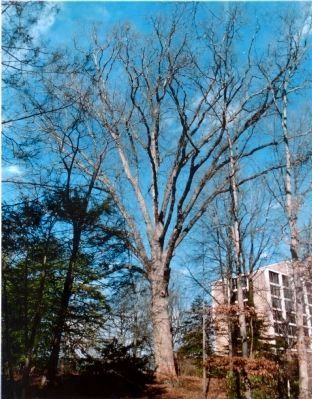
4. White Oak
Photographed by Allen C. Browne, April 28, 2014
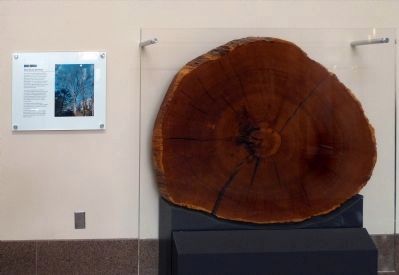
5. White Oak #154 Slice
Photographed by Allen C. Browne, April 28, 2014
6. White Oak Tree #154 History
The white oak tree sprouted around 1800, surrounded by farmland. When the tree was about 40, surgeons first used ether-induced general anesthesia. When it was about 60, Louis Pasteur perfected the process of pasteurization. The tree's rings reveal that the oak suffered a near-fatal injury around this time, perhaps a lightning strike. The result was slowly spreading and ultimately became a lethal heartwood decay.
X-rays were discovered when the tree was approaching 100 and penicillin when it was about 125. In 1937, the tree shaded workers building NIH's first Bethesda laboratories. It was still standing in 1953, when the original NIH Clinical Center opened, but rotting from within by the time the new hospital was being built.
This expertly preserved 168--pound cross-section is from the tree, felled in 1998 as construction began on the Mark O. Hatfield Clinical Research Center.
A l4-ton, 35-foot segment of this oak was given to the U.S. Navy and used for repairs to the USS Constitution, the historic frigate known as "Old Ironsides" now berthed in Boston Harbor.Close-up of picture on sign describing the cross-section of the White Oak tree.
X-rays were discovered when the tree was approaching 100 and penicillin when it was about 125. In 1937, the tree shaded workers building NIH's first Bethesda laboratories. It was still standing in 1953, when the original NIH Clinical Center opened, but rotting from within by the time the new hospital was being built.
This expertly preserved 168--pound cross-section is from the tree, felled in 1998 as construction began on the Mark O. Hatfield Clinical Research Center.
A l4-ton, 35-foot segment of this oak was given to the U.S. Navy and used for repairs to the USS Constitution, the historic frigate known as "Old Ironsides" now berthed in Boston Harbor.
Photographed by Allen C. Browne, April 28, 2014
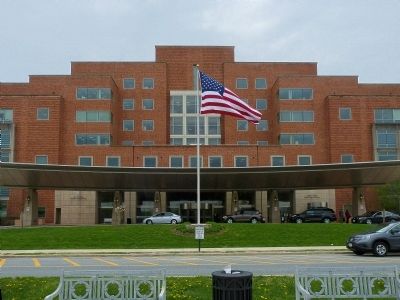
7. The Mark O. Hatfield Clinical Center
Credits. This page was last revised on September 21, 2019. It was originally submitted on April 29, 2014, by Allen C. Browne of Silver Spring, Maryland. This page has been viewed 749 times since then and 42 times this year. Photos: 1, 2, 3, 4, 5, 6, 7. submitted on April 29, 2014, by Allen C. Browne of Silver Spring, Maryland. • Bill Pfingsten was the editor who published this page.
