Ellisville in Jones County, Mississippi — The American South (East South Central)
Amos Deason Home
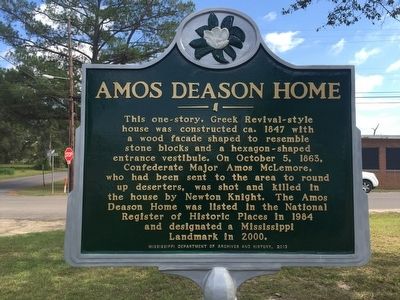
Photographed by Robert M. Cook, Jr., October 1, 2015
1. Amos Deason Home Marker
Erected 2013 by Mississippi Department of Archives and History.
Topics and series. This historical marker is listed in these topic lists: Architecture • Landmarks • War, US Civil. In addition, it is included in the Mississippi State Historical Marker Program series list. A significant historical year for this entry is 1847.
Location. 31° 36.584′ N, 89° 11.801′ W. Marker is in Ellisville, Mississippi, in Jones County. It is at the intersection of Anderson Street and North Deason Street, on the left when traveling west on Anderson Street. Touch for map. Marker is at or near this postal address: 410 Anderson St, Ellisville MS 39437, United States of America. Touch for directions.

Regionally,
this page online
Other nearby markers. At least 8 other markers are within 5 miles of this marker, measured as the crow flies: Jones County Courthouse (approx. 0.4 miles away); Lynching of John Hartfield (approx. half a mile away); Newt Knight: Robin Hood or Renegade? / The Amos Deason Home (approx. 0.8 miles away); Mississippi National Guard Korean War Memorial (approx. one mile away); JCJC Bobcats Defy Segregation (approx. one mile away); Ellisville State School (approx. 1.9 miles away); Skirmish At Rocky Creek (approx. 2.1 miles away); Ralph Boston (approx. 5 miles away). Touch for a list and map of all markers in Ellisville.
Also see . . .
1. Deason Home Restoration (archived). (Submitted on November 3, 2016, by Mark Hilton of Montgomery, Alabama.)
2. NRHP Nomination Form (National Park Service).
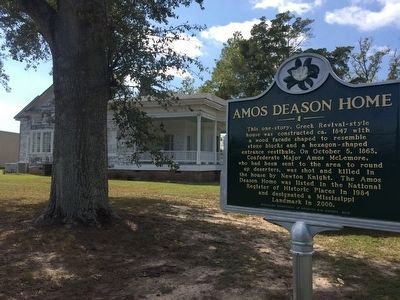
Photographed by Robert M. Cook, Jr., October 1, 2015
2. Amos Deason Home Marker
Greek Revival architecture. Stylistically, the house dates from 1855 to 1860, and, according to a published newspaper interview with A. D. Anderson, grandson of Amos Deason, the house was constructed for Amos Deason after he came to Jones County, Mississippi, from North Carolina about 1855. The house derives its significance from its unusual architectural character, from its historical association with the murder of Confederate Army officer Major Amos McLemore, and from its long history of family ownership. The semioctagonal, well detailed, entrance vestibule is the only one of its kind known to exist in Mississippi. The simulated rusticated stone treatment of the facadeMand side elevations, while not unique, is unusual and well executed. The plan of the housle with its two-room central block and side "cabinet" rooms is a floor plan not yet associated with any other house in the state. The interplay of the semi-octagonal gallery projection with the semioctagonal entrance vestibule and the deeply recessed end bays combine to create an aesthetically pleasing, very distinctive facade. According to local tradition, Confederate Army(Submitted on October 22, 2025, by Mark Hilton of Montgomery, Alabama.)officer Major Amos McLemore, supposedly on a mission to round up Confederate Army deserters, was shot and killed in the house by Newton Knight, a real man with a legendary reputation. Considered to the oldest house in Ellisville, the Amos Deason House remains the home of Deason descendants.Photographed by Robert M. Cook, Jr., October 1, 20153. Amos Deason Home Marker
Credits. This page was last revised on October 22, 2025. It was originally submitted on May 5, 2014, by Robert M. Cook, Jr. of Biloxi, Mississippi. This page has been viewed 1,324 times since then and 39 times this year. Photos: 1, 2, 3. submitted on October 1, 2015, by Robert M. Cook, Jr. of Biloxi, Mississippi. • Bill Pfingsten was the editor who published this page.
