Tybee Island in Chatham County, Georgia — The American South (South Atlantic)
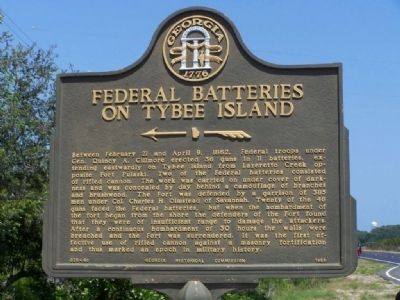
Federal Batteries on Tybee Island
Photographed by Mike Stroud, April 2008
1. Federal Batteries on Tybee Island Marker
Erected 1958 by Georgia Historical Commission. (Marker Number 025-60.)
Topics and series. This historical marker is listed in these topic lists: Notable Events • Notable Places • War, US Civil. In addition, it is included in
this page online
Location. 32° 0.923′ N, 80° 52.195′ W. Marker is on Tybee Island, Georgia, in Chatham County. It is at the intersection of Islands Expressway (U.S. 80) and Catalina Drive, on the right when traveling west on Islands Expressway. Touch for map. Marker is in this post office area: Tybee Island GA 31328, United States of America. Touch for directions.

Regionally, this marker is on the Coastal Plain, on the Georgia Coast and the Golden Isles, in Greater Savannah, and on the Sea Islands. It is also in the American South, specifically in the Deep South, and on the Eastern Seaboard. Globally, it is in the North Atlantic Region, North America, the Western Hemisphere, the Western World, and the Anglosphere. Historically, it finds itself in what was once New Spain, the territory of the Mississippian Culture, one of the original Thirteen Colonies, one of the Confederate States of America, and the Antebellum South.
Other nearby markers. At least 8 other markers are within 2 miles of this marker, measured as the crow flies: Lazaretto (approx.
Photographed by Mike Stroud, 2008
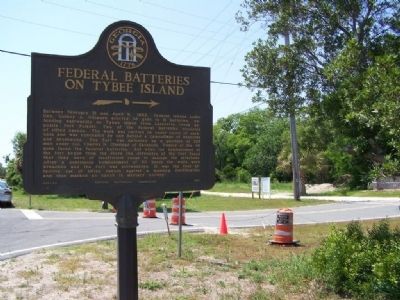
2. Federal Batteries on Tybee Island Marker
Other markers no longer nearby. A Turning Point In History (was about 300 feet away, measured in a direct line but has been permanently removed); Long Range Artillery Duel (was about 500 feet away but has been permanently removed); Cockspur Island Lighthouse (was about 600 feet away but has been permanently removed).
Also see . . . National Park Service. On April 10th-11th, 1862, those cannon batteries would fire a new weapon called "Rifled Cannon" at Fort Pulaski and change forever the way the world protected its coastal areas. Within 30 hours, the rifled guns had such a devastating effect on the brick fort that it was surrendered and all forts like Pulaski were considered
Photographed by Bill Coughlin, August 5, 2013
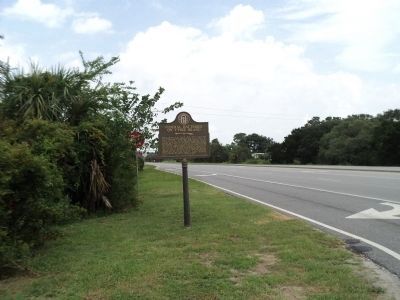
3. Marker on Tybee Island
Additional commentary.
1. Batteries Facing Fort Pulaski
The Federal batteries facing Fort Pulaski included:
Battery Totten with four 10-inch mortars.
Battery McClellan with two 84-pdr James Rilfes (modified 42-pdr smoothbores) and two 64-pdr James Rifles (modified 32-pdr smoothbores).
Battery Sigel with five 4.2-in Parrott Rifles and 1 48-pdr James Rifle (modified 24-pdr Smoothbore).
Battery Scott with three 10-in Columbiads and one 8-in Columbiad.
Battery Halleck with two 13-in seacoast mortars.
Battery Sherman with three 13-in seacoast mortars.
Battery Burnside with a single 13-in seacoast mortar.
Battery Lincoln with three 8-in Columbiads.
Battery Lyon with three 10-in Columbiads.
Battery Grant with three 13-in seacoast mortars.
Battery Stanton with three 13-in seacoast mortars.
— Submitted May 3, 2008, by Craig Swain of Leesburg, Virginia.
Photographed by Mike Stroud, 2008
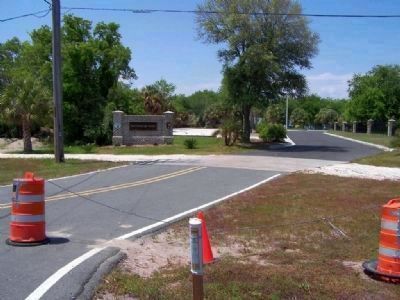
4. Future entrance for Battery Park
The location of the Federal Batteries will be a component of a future rails-to-trails addition to Fort Pulaski National Monument. The trail follows the former bed of the Savannah and Atlantic Railroad along the Savannah River. Battery Park will feature a reconstructed earthwork.
Photographed by Mike Stroud, 2008
5. Federal Batteries on Tybee Island, as seen from Fort Pulaski
Left: Battery Stanton, Battery Grant, Battery Lyon, Battery Lincoln
Middle: Battery Burnside, Battery Sherman
Right: Battery Halleck, Battery Scott, Battery Sigel, Battery McClellan, Battery Totten
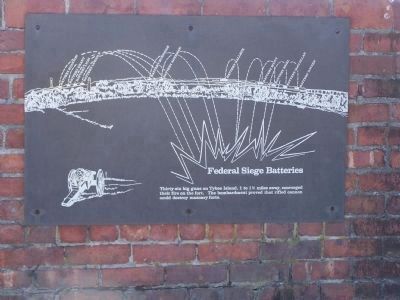
Federal Siege Batteries Thirty-six big guns on Tybee Island, 1 to 1½ miles away, converged their fire on the fort. The bombardment proved that rifled cannon could destroy masonry forts.
Middle: Battery Burnside, Battery Sherman
Right: Battery Halleck, Battery Scott, Battery Sigel, Battery McClellan, Battery Totten
Federal Siege Batteries Thirty-six big guns on Tybee Island, 1 to 1½ miles away, converged their fire on the fort. The bombardment proved that rifled cannon could destroy masonry forts.
Credits. This page was last revised on May 3, 2020. It was originally submitted on May 2, 2008, by Mike Stroud of Bluffton, South Carolina. This page has been viewed 3,381 times since then and 125 times this year. Photos: 1, 2. submitted on May 2, 2008, by Mike Stroud of Bluffton, South Carolina. 3. submitted on December 20, 2013, by Bill Coughlin of Woodland Park, New Jersey. 4, 5. submitted on May 2, 2008, by Mike Stroud of Bluffton, South Carolina. • Craig Swain was the editor who published this page.
