St. Catharines in Niagara Region, Ontario — Central Canada (North America)
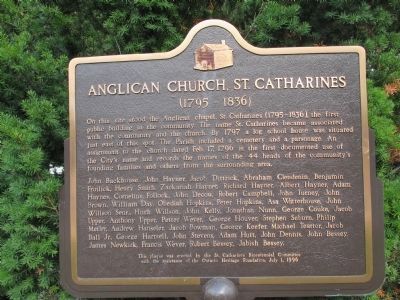
Anglican Church, St. Catharines
(1795 - 1836)
Photographed by Anton Schwarzmueller, July 27, 2014
1. Anglican Church, St. Catharines Marker (post)
John Backhouse, John Hayner, Jacob Dittrick, Abraham Clendenin, Benjamin Froilick, Henry Smith, Zackariah Hayner, Richard Hayner, Albert Hayner, Adam Haynes, Cornelius Follock, John Decow, Robert Campbell, John Turney, John Brown, William Day, Obediah Hopkins, Peter Hopkins, Asa Waterhouse, John Willson Senr., Hugh Willson, John Kelly, Jonathan Nunn, George Couke, Jacob Upper, Anthony Upper, Petter Wever, George Houver, Stephen Seburn, Philip Metler, Andrew Hanseler, Jacob Bowman, George Keefer, Michael Teattor, Jacob Ball Jr., George Hartsell, John Stevens, Adam Hutt, John Dennis, John Bessey, James Newkirk, Francis
this page online
Erected 1996 by St. Catharines Bicentennial Committee.
Topics. This historical marker is listed in these topic lists: Religion & Religious Structures • Settlements & Settlers. A significant historical year for this entry is 1795.
Location. 43° 9.255′ N, 79° 14.763′ W. Marker is in St. Catharines, Ontario, in Niagara Region. It is at the intersection of St. Paul Street West (County Route 81) and McGuire Street, on the left when traveling south on St. Paul Street West. Marker is located is a small circular green space called Merritt Park containing the Merritt statue. Southbound, the markers are just before a long bridge. Touch for map. Marker is at or near this postal address: 1 St Paul Street West, St Catharines ON L2R 3N8, Canada. Touch for directions.

Regionally, this marker is on the Golden Horseshoe and in Niagara Canada. It is also in Central Canada. Globally, it is in North America, on the Great Lakes, in the Western Hemisphere, in the Western World, and in the Anglosphere. Historically, it finds itself in what was once a British colony, the Viceroyalty of New France,
Photographed by Anton Schwarzmueller, July 27, 2014
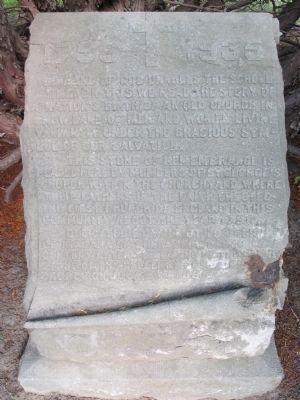
2. St. George's Church Marker
This stone adjacent to the posted marker is set back between large bushes. The inscription reads as follows:
1796 + 1935
The hand of God unrolls the scroll [of] time. On this we read the story of a nation's birth, of an old church, a new land of men and women living valiantly under the gracious symbol of our salvation.
This stone of remembrance is placed whereby members of St. George's church within the churchyard where their fathers in the faith erected the first church of England in this community about the year 1796.
Dedicated by Wilmot, Lord Bishop of Niagara on Sunday Nov. 3rd, 1935, a century after the laying of the [?] stone of the present St. George's church on July 20th 1835.
1796 + 1935
The hand of God unrolls the scroll [of] time. On this we read the story of a nation's birth, of an old church, a new land of men and women living valiantly under the gracious symbol of our salvation.
This stone of remembrance is placed whereby members of St. George's church within the churchyard where their fathers in the faith erected the first church of England in this community about the year 1796.
Dedicated by Wilmot, Lord Bishop of Niagara on Sunday Nov. 3rd, 1935, a century after the laying of the [?] stone of the present St. George's church on July 20th 1835.
Other nearby markers. At least 8 other markers are within walking distance of this marker: 1796 - 1935 (here, next to this marker); William Hamilton Merritt 1793 - 1862 (a few steps from this marker); This Statue of the Honorable William Hamilton Merritt (a few steps from this marker); The Battle of Vimy Ridge / The History of Vimy Oak Trees (within shouting distance of this marker); St. Catharines Cenotaph (within shouting distance of this marker); The NS&T and Western Hill (within shouting distance of this marker); This Boulder Was Once The Half-way Mark Between Niagara-on-the-Lake And Queenston (within shouting distance of this marker); Niagara District United Empire Loyalists Memorial (within shouting distance of this marker). Touch for a list and map of all markers in St. Catharines.
Photographed by Anton Schwarzmueller, July 27, 2014
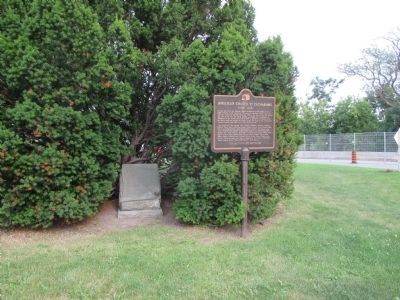
3. Anglican Church, St. Catharines Marker
McGuire Street in background
Photographed by Anton Schwarzmueller, July 27, 2014
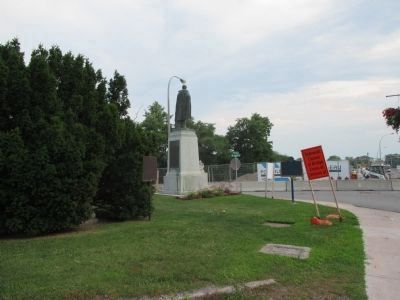
4. Anglican Church, St. Catharines Marker
Southward view. The markers are at the left with the bushes.
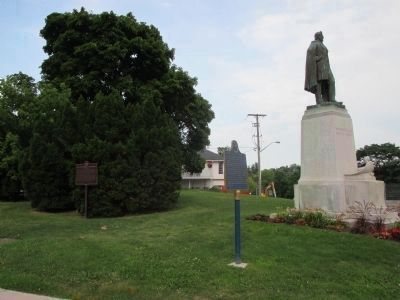
Photographed by Anton Schwarzmueller, July 27, 2014
5. Anglican Church, St. Catharines Marker
Northward, looking right, the stone marker is hidden by bushes, and the William Hamilton Merritt marker and statue are dominant.
Credits. This page was last revised on September 27, 2019. It was originally submitted on August 8, 2014, by Anton Schwarzmueller of Wilson, New York. This page has been viewed 938 times since then and 43 times this year. Photos: 1, 2, 3. submitted on August 8, 2014, by Anton Schwarzmueller of Wilson, New York. 4, 5. submitted on August 9, 2014, by Anton Schwarzmueller of Wilson, New York. • William J. Toman was the editor who published this page.
