Near Fort Washington in Prince George's County, Maryland — The American Northeast (Mid-Atlantic)
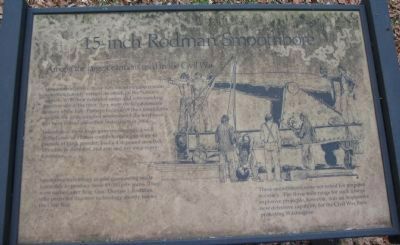
15-inch Rodman Smoothbore
Photographed by Craig Swain, March 1, 2008
1. 15-inch Rodman Smoothbore Marker
In need of some cleaning.
Among the largest cannon used in the Civil War
Monumental in size, these two immense guns remain as sentinels ready to repel an attack on the Nation's capital. With their extended range and commanding location above the river, they were the key defensive feature of the fort. Perhaps because of their formidable weight, the guns (original armament of the fort) have not been moved since their installation in 1864.
Immobile as these huge guns may appear, a well drilled crew of 12 men could charge a gun with 40 pounds of black powder, load a 434-pound iron ball, 15 inches in diameter, and aim and fire once every 4 minutes.
Innovative technology in iron gun-casting made it possible to produce these 49,000 pdr. guns. They were named after Brig. Gen. Thomas J. Rodman, who perfected this new technology shortly before the Civil War.
These smoothbores were not noted for pinpoint accuracy. The three-mile range for such a large explosive projectile, however, was an impressive new defensive capability for the Civil War forts protecting Washington.
Topics and series. This historical marker is listed in these topic lists: Forts and Castles
this page online
Location. This marker has been replaced by another marker nearby. It was located near 38° 46.076′ N, 77° 1.759′ W. Marker was near Fort Washington, Maryland, in Prince George's County. It could be reached from the intersection of Fort Foote Road and Jessica Drive, on the right when traveling south. Located inside the Fort Foote National Park. Touch for map. Marker was in this post office area: Fort Washington MD 20744, United States of America. Touch for directions.

Regionally, this marker was in the Washington Metropolitan Area. It was also in the American South, specifically in the Upper South, in the Mid-Atlantic, and on the Eastern Seaboard. Globally, it was in the North Atlantic Region, North America, the Western Hemisphere, the Western World, and the Anglosphere. Historically, it found itself in what was once one of the original Thirteen Colonies and also the Antebellum South.
Other nearby markers. At least 8 other markers are within walking distance of this location: Load. Ready. Fire!
Photographed by Craig Swain, March 1, 2008
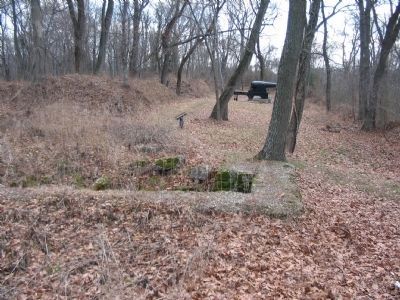
2. Rodman Gun Wayside
Using the map feature, in hybrid mode, these guns are visible on their mounts.
Other markers no longer nearby. 15-inch Rodman Smoothbore (was here, next to this marker but has been permanently removed); Northwest Bastion (was within shouting distance of this marker but has been permanently removed); The Defenses of Washington (was within shouting distance of this marker but has been permanently removed); King's Depression Carriage (was within shouting distance of this marker but has been permanently removed); Fort Foote (was about 300 feet away, measured in a direct line but has been reported to have been replaced with another marker now near it); a different marker also named Fort Foote (was about 700 feet away but has been reported to have been replaced
Photographed by Allen C. Browne, September 18, 2011
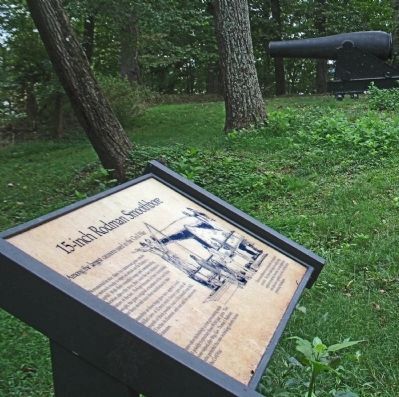
3. 15-inch Rodman Smoothbore Marker
More about this marker. The background of the marker is a depiction of a 15-inch Rodman Gun serviced by its crew.
This marker was replaced by a new one also named 15-inch Rodman Smoothbore (see nearby markers).
Related marker. Click here for another marker that is related to this marker. 15-inch Rodman Smoothbore - Civil War Defenses of Washington
Also see . . . Fort Foote. National Park Service site providing a short history of the fort. (Submitted on May 6, 2008, by Craig Swain of Leesburg, Virginia.)
Additional commentary.
1.
I published it as a new (replacement) marker. You are given full credit. /Bernie Fisher Note To Editor only visible by Contributor and editor
— Submitted April 5, 2019, by Allen C. Browne of Silver Spring, Maryland.
Photographed by Craig Swain, March 1, 2008
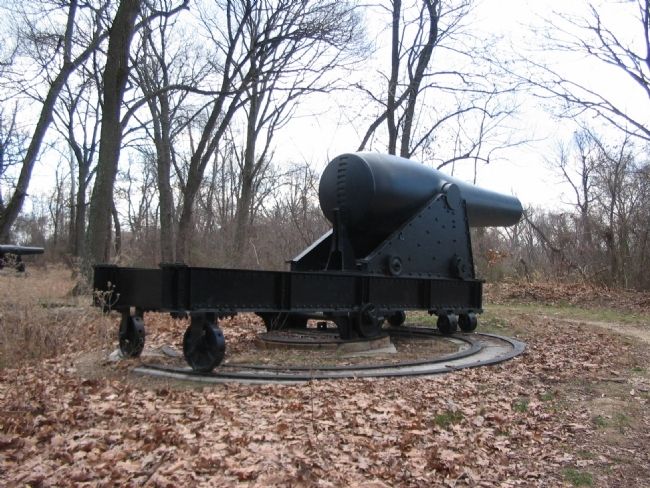
4. 15-inch Rodman Guns in Center Pivot Barbette Mounts
The center pivot barbette mountings allowed 360 degree traverse for these massive guns. Surprisingly, these weapons were so well balanced, very little effort could move the guns.
Photographed by Craig Swain, March 1, 2008
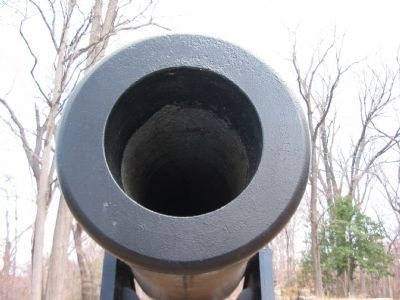
5. 15-inch Muzzle
Markings on the muzzle indicate this weapon is registry "No. 1" produced by Cyrus Alger and Company, of Boston Massachusetts. It was accepted for service in 1863, after an inspection by none other than Thomas Rodman himself. His initials, TJR, and the year are stamped on the muzzle. Finally the weight is indicated as 49,392 pounds.
Photographed by Craig Swain, March 1, 2008
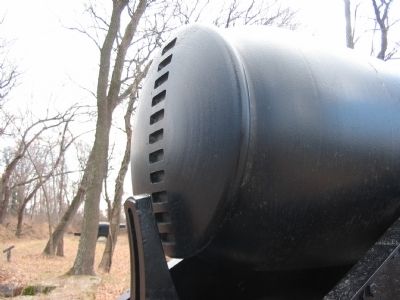
6. Breech of Rodman Gun
The breech end of the Rodman gun shows two of the General's adaptations to improve the gun. First, guns of this size could not be easily elevated by the traditional hand screw systems. So the sockets seen here allowed a very simple handspike system to raise and lower the gun. Second, the groove around the breech, replacing the traditional knob and neck, provided lifting tackle a purchase to firmly move the gun. The "mushroom," as it is often called, was more durable.
Photographed by Craig Swain, March 1, 2008
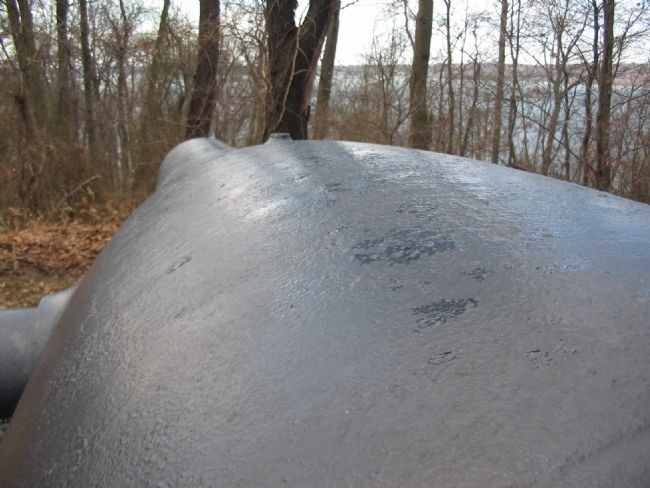
7. Looking Down the Barrel of the Gun
The knob over the center of the gun was a front sight block. With most smoothbores, accuracy was more a function of crew persistence and luck.
Credits. This page was last revised on September 30, 2022. It was originally submitted on May 6, 2008, by Craig Swain of Leesburg, Virginia. This page has been viewed 3,462 times since then and 47 times this year. Photos: 1, 2. submitted on May 6, 2008, by Craig Swain of Leesburg, Virginia. 3. submitted on September 14, 2013, by Allen C. Browne of Silver Spring, Maryland. 4, 5, 6, 7. submitted on May 6, 2008, by Craig Swain of Leesburg, Virginia.
