Seminary Hill in Alexandria, Virginia — The American South (Mid-Atlantic)
Fort Ward
1861-1865
Photographed by Craig Swain, March 1, 2008
1. Fort Ward Marker
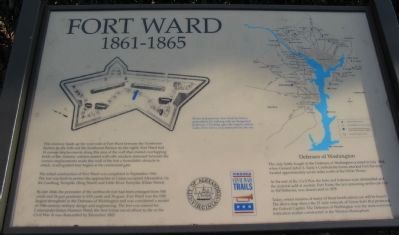
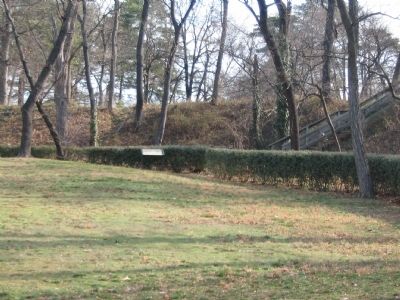
This stairway leads up the west wall of Fort Ward between the Northwest Bastion (to the left) and the Southwest Bastion (to the right). Fort Ward had 14 cannon emplacements along this area of the wall that created overlapping fields of fire. Infantry soldiers armed with rifle muskets stationed between the cannon emplacements made this wall of the fort a formidable obstacle to attack. A self-guided tour begins at the ceremonial gate.
The initial construction of Fort Ward was completed in September 1861. The fort was built to protect the approaches to Union-occupied Alexandria via the Leesburg Turnpike (King Street) and Little River Turnpike (Duke Street).
By late 1864, the perimeter of the earthwork fort had been enlarged from 540 yards and 24 gun positions to 818 yards and 36 guns. Fort Ward was the fifth largest stronghold in the Defenses of Washington and was considered a model of 19th-century military design and engineering. The fort was named for Commander James Harmon Ward, the first Union naval officer to die in the Civil War. It was dismantled by December 1865.
Defenses of Washington
The only battle fought in the Defenses
this page online
At the end of the Civil War, the forts and batteries were dismantled and the materials sold at auction. Fort Foote, the last remaining earthwork fort in the Defenses, was deactivated in 1878.
Today, extant remains of many of these fortifications can still be found. The above map shows the 37-mile network of Union forts that protected the Federal Capital. The Defenses of Washington was the most extensive fortification system constructed in the Western Hemisphere.
Erected by City of Alexandria - Virginia Civil War Trails.
Topics and series. This historical marker is listed in these topic lists: Forts and Castles • War, US Civil. In addition, it is included in the Defenses of Washington, the Virginia Civil War Trails, and the Virginia, The City of Alexandria series lists. A significant historical month for this entry is July 1864.
Location. This marker has been replaced by another marker nearby. It was located near 38° 49.808′ N, 77° 6.154′ W. Marker was in Alexandria,
Photographed by Craig Swain, March 1, 2008
2. Fort Ward Marker near the Stairway

Regionally, this marker was in the Washington Metropolitan Area and in Northern Virginia. It was also in the American South, specifically in the Upper South, in the Mid-Atlantic, and on the Eastern Seaboard. Globally, it was in the North Atlantic Region, North America, the Western Hemisphere, the Western World, and the Anglosphere. Historically, it found itself in what was once the territory of the Mississippian Culture, one of the original Thirteen Colonies, one of the Confederate States of America, and the Antebellum South.
Other nearby markers. At least 8 other markers are within walking distance of this location: A different marker also named Fort Ward (here, next to this marker); Jackson Cemetery Memorial (a few steps from this marker); Jackson Cemetery (within shouting distance of this marker); From Fort to Community
Photographed by Craig Swain, March 1, 2008
3. Soutwest Bastion
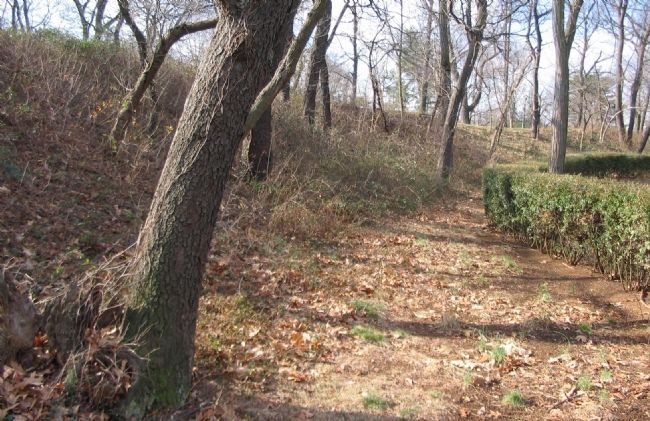
Looking south from the stairways along the ditch of the fort, the base of the Southwest Bastion forms an angle in the earthworks. The hedges here mimic the location of the abatis which stood just outside the fort beyond the ditch.
Other markers no longer nearby. Bombproof (was within shouting distance of this marker but has been replaced with another marker now near it); a different marker also named Powder Magazine and Filling Room (was within shouting distance of this marker but has been replaced with another marker now near it); a different marker also named Northwest Bastion (was within shouting distance of this marker but has been replaced with another marker now near it).
More about this marker. On the left below the title is an engineering diagram of the main part of Fort Ward, with the location of the stairway indicated in blue. On the right above the Defenses of Washington section is a map showing the fortification chain around Washington, D.C. A small caption
Photographed by Craig Swain, March 1, 2008
4. Exterior of the Nortwest Bastion
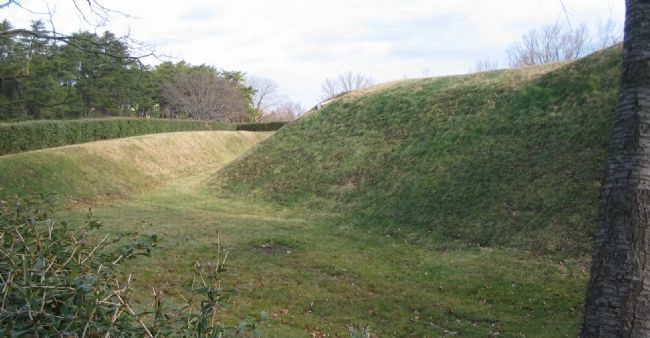
The Northwest Bastion is in considerably better shape than the Southwest Bastion. The ditch and glacis outside the fort are evident, to the left. Note the height of the bastion's parapet on the right.
Also see . . . Fort Ward Historic Site. (Submitted on May 15, 2008, by Craig Swain of Leesburg, Virginia.)
Credits. This page was last revised on April 26, 2025. It was originally submitted on May 15, 2008, by Craig Swain of Leesburg, Virginia. This page has been viewed 3,031 times since then and 51 times this year. Photos: 1, 2, 3, 4. submitted on May 15, 2008, by Craig Swain of Leesburg, Virginia.
