Swansboro in Onslow County, North Carolina — The American South (South Atlantic)
Hammocks Beach State Park
Jacksonville•Onslow African-American Heritage Trail
Photographed by Don Morfe, August 16, 2014
1. Hammocks Beach State Park Marker
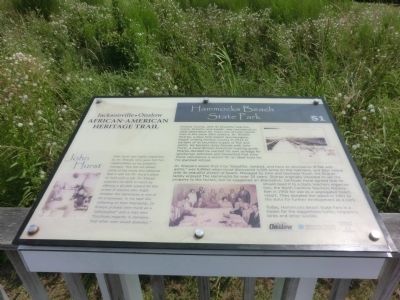
Onslow County, with its beautiful beaches, rivers, streams and woods, was considered an ideal destination for many out of town sportsmen in the early 20th century. Dr. William Sharpe, a New York based neurosurgeon, began visiting Onslow County in 1914 to partake of its bountiful supply of fish and game. He became close friends with John Hurst, a local African-American hunting guide. Sharpe decided he wanted his own acreage for sportsman activities and requested that John Hurst commence a search for an ideal tract for his planned retreat.
Dr. Sharpe’s desire that it be “beautiful, isolated, and have an abundance of fish and game,” was fulfilled when Hurst discovered 4,600 acres on the mainland, and Bear Island with its beautiful stretch of beach. Managed by John and Gertrude Hurst, the Sharpe family enjoyed The Hammocks for over 30 years. Sharpe originally intended to will the property to the Hursts, but he suggested and alternative; Gertrude Hurst agreed that he deed it to a black teachers organization, the North Carolina Teachers Association in 1950 for use as segregated beach resort. They donated the
this page online
Today, Hammocks Beach State Park is a haven for the loggerhead turtle, migratory birds and other wildlife.
(sidebar)
John Hurst
John Hurst was highly respected by Dr. Sharpe, who gave him full responsibility as his property manager. This did not please some of the locals who believed that it was not Mr. Hurst’s place to hold such a job. Dr. Sharpe asserted his faith in Hurst by offering a $5,000 reward for the arrest of anyone who might threaten the Hammocks or any of its employees. In his later life, reflecting on their friendship, Dr. Sharpe praised John Hurst as a “philosopher” and a man who “functions expertly in domains that other men would abandon.”
Erected by Jacksonville•Onslow Chamber of Commerce, Onslow County Museum. (Marker Number S1.)
Topics. This historical marker is listed in these topic lists: African Americans • Waterways & Vessels. A significant historical year for this entry is 1914.
Location. 34° 40.196′ N, 77° 8.602′ W. Marker is in Swansboro, North Carolina, in Onslow County. It can be reached from Fla Camp Road
Photographed by Don Morfe, August 16, 2014
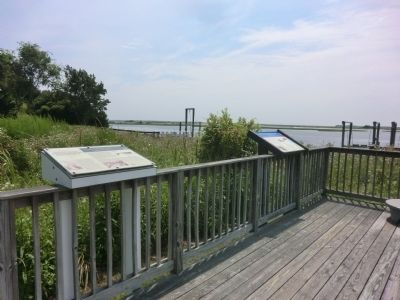
2. Hammocks Beach State Park Marker

Regionally, this marker is in North Carolina’s Coastal Plain. It is also in the American South, specifically in the Upper South, in the Tidewater, and on the Eastern Seaboard. Globally, it is in the North Atlantic Region, North America, the Western Hemisphere, the Western World, and the Anglosphere. Historically, it finds itself in what was once the territory of the Mississippian Culture, one of the original Thirteen Colonies, one of the Confederate States of America, and the Antebellum South.
Other nearby markers. At least 8 other markers are within 15 miles of this marker, measured as the crow flies: Huggins Island Battery (here, next to this marker); Huggins' Island Fort (approx. 1.9 miles away); Port Swannsborough (approx. 1.9 miles away); "Prometheus" (approx. 1.9 miles away); Col. John Starkey (approx. 1.9 miles away); Hofmann Forest (approx. 14.6 miles away); James Melville Jones (approx. 14.6 miles away); Julius Valentine Hofmann
Photographed by Don Morfe, August 16, 2014
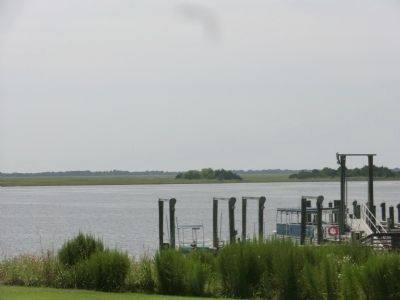
3. Hammocks Beach State Park Waterfront
Another marker is no longer nearby. Camp Lejeune (was approx. 12.2 miles away but has been confirmed missing).
Photographed by Don Morfe, August 16, 2014
4. Sign at the entrance to Hammocks Beach State Park
Credits. This page was last revised on June 16, 2016. It was originally submitted on September 13, 2014, by Don Morfe of Baltimore, Maryland. This page has been viewed 978 times since then and 52 times this year. Photos: 1, 2, 3, 4. submitted on September 13, 2014, by Don Morfe of Baltimore, Maryland. • Bernard Fisher was the editor who published this page.
