Near Yellow Springs in Greene County, Ohio — The American Midwest (Great Lakes)
John Bryan
| — | Part of the Clifton Gorge/ Glen Helen Complex | — |
Photographed by Rev. Ronald Irick, September 12, 2014
1. John Bryan State Park Marker
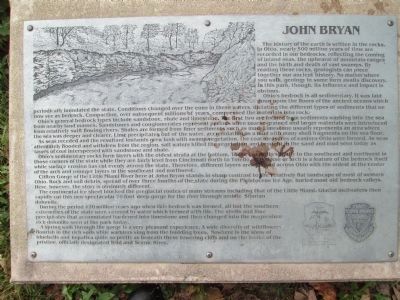
Ohio’s bedrock is all sedimentary. It was laid down upon the floors of the ancient oceans which periodically inundated the state. Conditions changed over the eons in these waters, dictating the different types of sediments that we now see as bedrock. Compaction over subsequent millions of years, compressed the materials into rock.
Ohio’s general bedrock types include sandstone, shale and limestone. The first two are formed from sediments washing into the sea from nearby land masses. Sandstones and comglomerates represent periods when coarse-grained and larger materials were introduced from relatively swift flowing rivers. Shales are former from finer sediments such as
this page online
As seas receded and the resultant lowlands grew lush with swamp vegetation, the coal measures of eastern Ohio were formed. As seas alternately flooded and withdrew from the region, salt waters killed the vegetation, and brought in the sand and mud seen today as layers of coal interspersed with sandstone and shale.
Ohio’s sedimentary rocks form layers with the oldest strata at the bottom. These layers dip slightly to the southeast and northwest in the corners of the state while they are fairly level from Cincinnati north to Toledo. This dome or arch is a feature of the bedrock itself while surface erosion has cut evenly across the state. Therefore, different layers are exposed across Ohio with the oldest at the center of the arch and younger layers in the southeast and northwest.
Clifton Gorge of the Little Miami River here at John Bryan stands in sharp contrast to the relatively flat landscape of most of western Ohio. Rock and soil debris, spread
Photographed by Rev. Ronald Irick, September 12, 2014
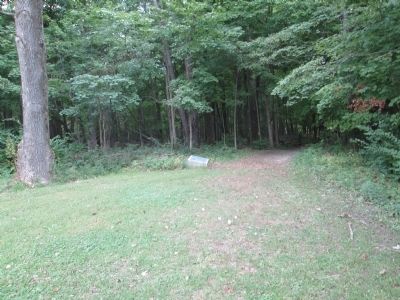
2. John Bryan State Park,
facing northeast
marker is to the left side of the trail
The continental ice sheet blocked the preglacial routes of many streams including that of the Little Miami. Glacial meltwaters then rapidly cut this new spectacular 70 foot deep gorge for the river through middle Silurian dolomite.
During the period 420 million years ago when this bedrock was formed, all but the southern extremeties of the state were covered by water which teemed with life. The shells and lime precipitants that accumulated hardened into limestone and then changed into the magnesium rich dolomite seem in the park today.
A spring walk through the gorge is a very pleasant experience. A wild diversity of wildflowers flourish in the rich soils while warblers sing from the budding trees. Nowhere is the show of bluebells and hepatica quite so pretty as beneath these towering cliffs and on the banks of the pristine, officially designated Wild and Scenic River.
Erected by Ohio Department of Natural Resources.
Topics. This historical marker is listed in this topic
Photographed by Rev. Ronald Irick, September 12, 2014
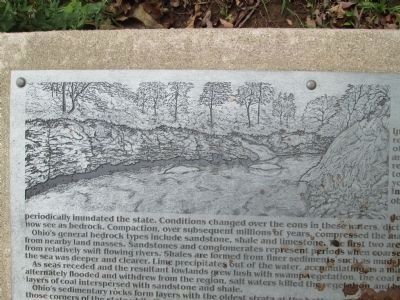
3. Artwork on the Marker
Location. 39° 47.653′ N, 83° 50.468′ W. Marker is near Yellow Springs, Ohio, in Greene County. It is on Orton Memorial Parking Lot, on the right when traveling north. enter John Bryan State Park through the main gate at St Rt 370. Continue on park service roads to the east as far as possible, approx. 1 1/2 miles, to the Orton Memorial Parking lot. This marker is off the northeast corner of the parking lot, at a trail head. Touch for map. Marker is at or near this postal address: 3790 State Route 370, Yellow Springs OH 45387, United States of America. Touch for directions.

Regionally, this marker is in the Dayton Metro and in the Miami Valley. It is also in the American Midwest and in the Corn Belt. Globally, it is in North America, the Western Hemisphere, the Western World, and the Anglosphere. Historically, it finds itself in what was once the Haudenosaunee (Iroquois) Confederacy, the territory of the Mississippian Culture, and the Northwest Territory.
Other nearby markers. At least 8 other markers are within walking distance of this marker: Paper Mill (approx.
Photographed by Rev. Ronald Irick, September 12, 2014
4. John Bryan State Park Main Gate
entrance off St Rt 370, south of St Rt 343
More about this marker. Text is VERY extensive, other than the Lion’s Club Marker in West Liberty, this is the wordiest marker I have found yet.
Photographed by Rev. Ronald Irick, September 12, 2014
5. Emblems on the Marker
this is an etched steel plate, mounted on a masonry base
Photographed by Rev. Ronald Irick, September 12, 2014
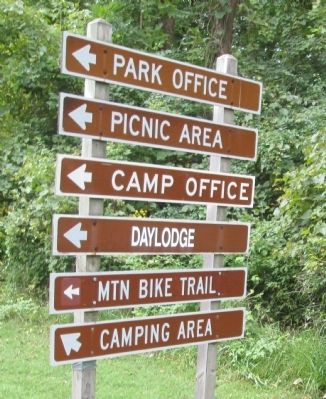
6. John Bryan State Park directory
if you get to the "Day Lodge", you are half way to the Orton Picnic Area parking lot
Photographed by Rev. Ronald Irick, September 13, 2014
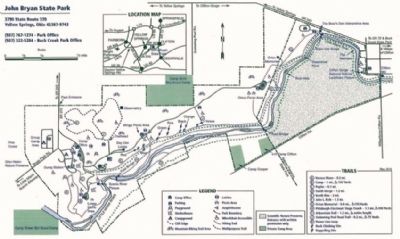
7. John Bryan State Park Map
published by Ohio Department of Natural Resources
printed 8-2013
Orton Memorial Picnic Area and parking lot are to the far east portion of the park. Both the John Bryan Marker, and the Orton Memorial can be accessed from this lot. Orton memorial Trail is at the north, John Bryan Marker at northeast.
Credits. This page was last revised on June 16, 2016. It was originally submitted on September 15, 2014, by Rev. Ronald Irick of West Liberty, Ohio. This page has been viewed 1,399 times since then and 71 times this year. Photos: 1, 2, 3, 4, 5, 6, 7. submitted on September 15, 2014, by Rev. Ronald Irick of West Liberty, Ohio. • Al Wolf was the editor who published this page.
