Near Greenwood in Leflore County, Mississippi — The American South (East South Central)
Robert Johnson
| — | Mississippi Blues Trail | — |
Photographed by Mark Hilton, September 13, 2014
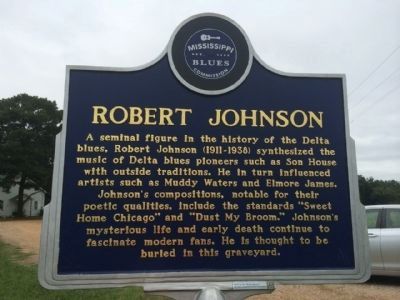
1. Robert Johnson Marker (Front)
A seminal figure in the history of the Delta blues, Robert Johnson (1911-1938) synthesized the music of Delta blues pioneers such as Son House with outside traditions. He in turn influenced artists such as Muddy Waters and Elmore James. Johnson's compositions, notable for their poetic qualities, include the standards “Sweet Home Chicago” and “Dust My Broom.” Johnson's mysterious life and early death continue to fascinate modern fans. He is thought to be buried in this graveyard.
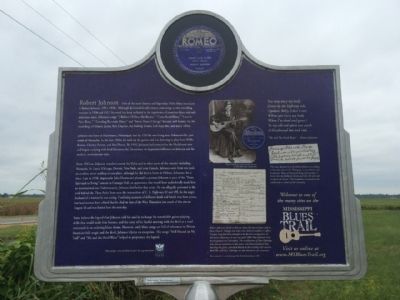
Robert Johnson One of the most famous and legendary Delta blues musicians is Robert Johnson (1911-1938). Although he recorded only twenty nine songs at two recording sessions in 1936 and 1937, his work has been included in the repertoires of countless blues and rock musicians since. Johnson’s songs “I Believe I’ll Dust My Broom,” “Cross Road Blues,” “Love in Vain Blues,” “Traveling Riverside Blues” and “Sweet Home Chicago” became well known via the recordings of Elmore James, Eric Clapton, the Rolling Stones, Led Zeppelin and many others.
Johnson was born in Hazlehurst, Mississippi, but by 1920 he was living near Robinsonville, just
this page online
From 1933 on, Johnson traveled around the Delta and to other parts of the country including Memphis, St. Louis, Chicago, Detroit, New York, and even Canada. Johnson went from one jook to another, never settling in one place, although he did have a home in Helena, Arkansas, for a time. Late in 1938, impresario John Hammond planned to present Johnson as part of the “From Spirituals to Swing” concert at Carnegie Hall, an appearance that would have undoubtedly made him an international star. Unfortunately, Johnson died before that event. He was allegedly poisoned by the angry husband of a woman he was seeing. He died on Star of the West plantation just south of this site on August 16 and was buried here the following day.
Some believe the myth that Johnson sold his soul in exchange for
Photographed by Mark Hilton, September 13, 2014
2. Robert Johnson Marker (Rear)
Erected 2007 by the Mississippi Blues Commission. (Marker Number 11.)
Topics and series. This historical marker is listed in these topic lists: African Americans • Arts, Letters, Music • Cemeteries & Burial Sites • Entertainment. In addition, it is included in the Mississippi Blues Trail series list. A significant historical year for this entry is 1936.
Location. 33° 33.796′ N, 90° 12.923′ W. Marker is near Greenwood, Mississippi, in Leflore County. It is on Money Road (County Road 518) 0.2 miles north of County Road 151, on the left when traveling north. Touch for map. Marker is at or near this postal address: 63530 County Road 518, Greenwood MS 38930, United States of America. Touch for directions.

Regionally,
Photographed by Mark Hilton, September 13, 2014
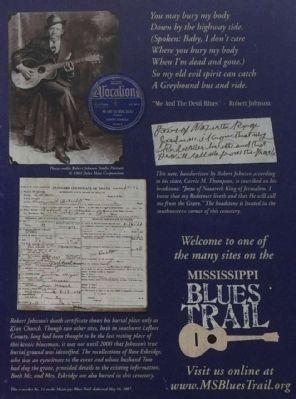
3. Robert Johnson Marker photos
** Click picture for more detail **
Other nearby markers. At least 8 other markers are within 4 miles of this marker, measured as the crow flies: Guitar Slim (approx. 1.3 miles away); Bobbie Gentry (approx. 2.1 miles away); Sgt. John A. Pittman (approx. 2.4 miles away); Fort Pemberton Park (approx. 2½ miles away); Captain Samuel Gwin Home (approx. 2.6 miles away); Hubert Sumlin (approx. 3.2 miles away); Greenwood (approx. 3.4 miles away); Greenwood Cotton Row District (approx. 3½ miles away). Touch for a list and map of all markers in Greenwood.
Another marker is no longer nearby. Fort Pemberton (was approx. 2½ miles away but has been confirmed missing).
Related marker. Click here for another marker that is related to this marker.
Also see . . .
1. Robert Johnson Blues Foundation.
Photographed by Mark Hilton, September 13, 2014
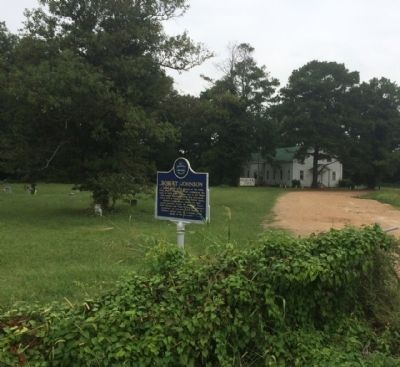
4. Wide shot of Robert Johnson Marker
2. Mississippi Blues Trail. (Submitted on September 17, 2014.)
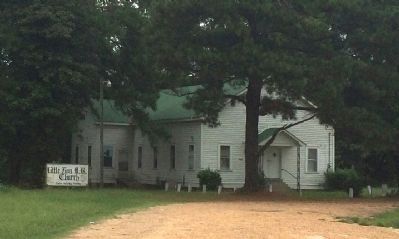
Photographed by Mark Hilton, September 13, 2014
5. Little Zion Missionary Baptist Church & Cemetery
He is thought to be buried in this graveyard.
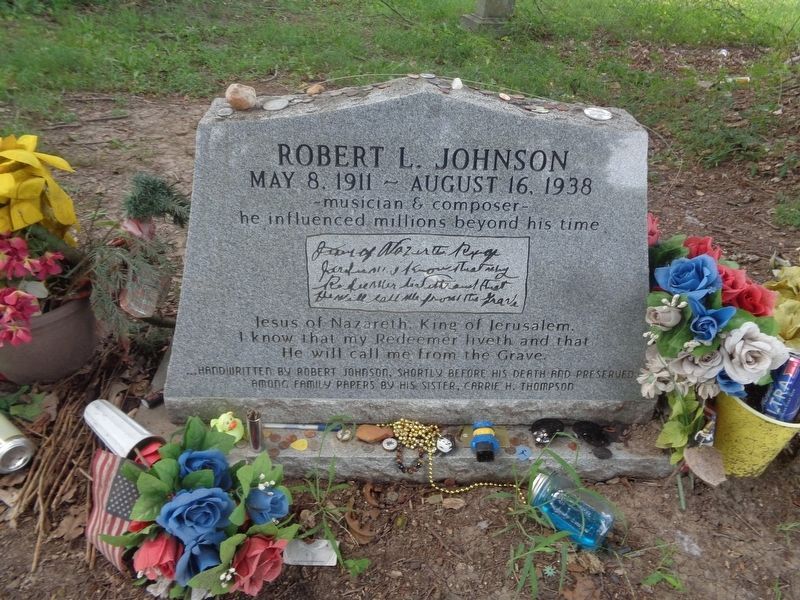
Photographed by Jason Voigt, July 31, 2024
6. Robert Johnson gravesite
One of three places Johnson is allegedly buried.
Credits. This page was last revised on August 25, 2026. It was originally submitted on September 17, 2014, by Mark Hilton of Montgomery, Alabama. This page has been viewed 1,499 times since then and 51 times this year. Photos: 1, 2, 3, 4, 5. submitted on September 17, 2014, by Mark Hilton of Montgomery, Alabama. 6. submitted on August 7, 2024, by Jason Voigt of Glen Carbon, Illinois. • Bernard Fisher was the editor who published this page.
