
Warsaw in Duplin County, North Carolina — The American South (South Atlantic)
The War Comes to Warsaw
Lewis's Railroad Raid
| — | Confederate Lifeline | — |
Photographed by Don Morfe, August 18, 2014
1. The War Comes to Warsaw Marker
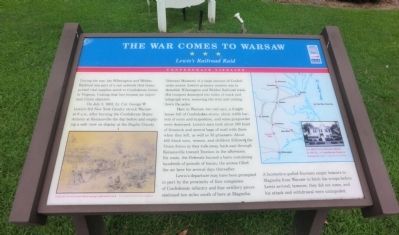
During the war, the Wilmington and Weldon Railroad was part of a rail network that transported vital supplies north to Confederate forces in Virginia. Cutting that line became an important Union objective.
On July 5, 1863, Lt. Col. George W. Lewis’s 3rd New York Cavalry struck Warsaw at 6 a.m., after burning the Confederated States Armory at Kenansville the day before and emptying a safe (now on display at the Duplin County Veterans Museum) of a large amount of Confederate money. Lewis’s primary mission was to demolish Wilmington and Weldon Railroad track. His troopers destroyed two miles of track and telegraph wire, removing the wire and cutting down the poles.
Here in Warsaw, two rail cars, a freight house full of Confederate stores, about 4,000 barrels of resin and turpentine, and some gunpowder were destroyed. Lewis’s men took about 150 head of livestock and several bags of mail with them when they left, as well as 30 prisoners. About 400 black men, women, and children followed the Union forces as they rode away, back east through Kenansville toward Trenton in the afternoon. En route, the Federals burned a barn
this page online
Lewis’s departure may have been prompted in part by the proximity of four companies of Confederate infantry and four artillery pieces stationed ten miles south of here at Magnolia. A locomotive pulled fourteen empty boxcars to Magnolia from Warsaw to fetch the troops before Lewis arrived; however, they did not come, and his attack and withdrawal were unimpeded.
(captions)
(lower left) Federal cavalrymen destroying railroad track - Courtesy Library of Congress
(upper right) Ca. 1845 Pierce-Bowden House, W. Hill St., a Confederate hospital during the war - Courtesy Leon Sikes
Erected by North Carolina Civil War Trails.
Topics and series. This historical marker is listed in these topic lists: Railroads & Streetcars • War, US Civil. In addition, it is included in the North Carolina Civil War Trails series list. A significant historical date for this entry is July 5, 1863.
Location. 35° 0.102′ N, 78° 5.466′ W. Marker is in Warsaw, North Carolina, in Duplin County. It is at the intersection of East Hill Street and North Center Street,
Photographed by Don Morfe, August 18, 2014
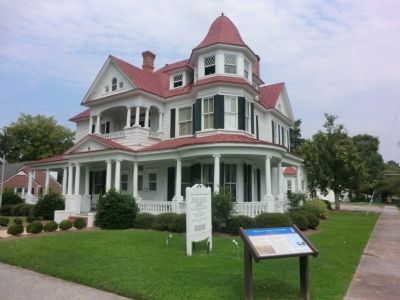
2. The War Comes to Warsaw Marker

Regionally, this marker is in North Carolina’s Coastal Plain. It is also in the American South and specifically in the Upper South. Globally, it is in North America, the Western Hemisphere, the Western World, and the Anglosphere. Historically, it finds itself in what was once the territory of the Mississippian Culture, one of the original Thirteen Colonies, one of the Confederate States of America, and the Antebellum South.
Other nearby markers. At least 8 other markers are within 8 miles of this marker, measured as the crow flies: Henry L. Stevens, Jr. (about 800 feet away, measured in a direct line); Veteran’s Memorial (approx. 2½ miles away); James Kenan (approx. 3.2 miles away); Duplin Old Courthouse Site (approx. 3.2 miles away); Thomas O. Moore (approx. 5.3 miles away); Grove Academy (approx. 7.4 miles away); Confederate Armory (approx. 7½ miles away);
Photographed by Don Morfe, August 18, 2014
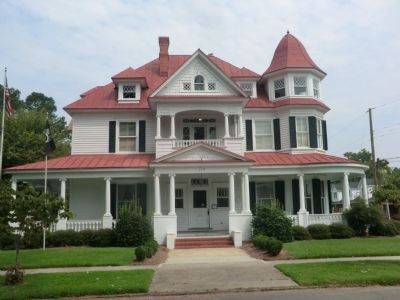
3. Front view of the Duplin County Veterans Museum
Also see . . . Duplin County Veterans’ Memorial Museum. Museum website homepage (Submitted on September 20, 2014.)
Photographed by Don Morfe, August 18, 2014
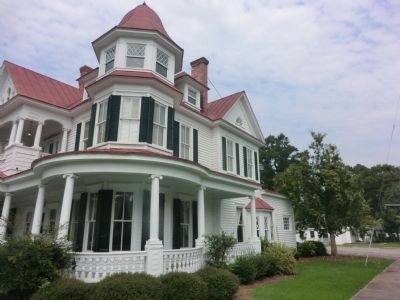
4. Side View of the Duplin County Veterans Museum
Credits. This page was last revised on November 8, 2024. It was originally submitted on September 20, 2014, by Don Morfe of Baltimore, Maryland. This page has been viewed 1,442 times since then and 38 times this year. Photos: 1, 2, 3, 4. submitted on September 20, 2014, by Don Morfe of Baltimore, Maryland. • Bernard Fisher was the editor who published this page.
