
Outdoor Museum
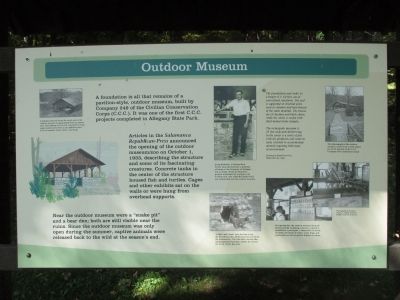
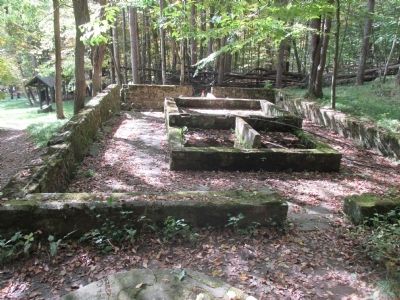
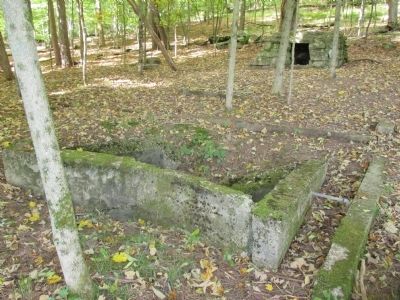
Articles in the Salamanca Republican-Press announced the opening of the outdoor museum/zoo on October 1, 1933, describing the structure and some of its fascinating creatures. Concrete tanks in the center of the structure housed fish and turtles. Cages and other exhibits sat on walls or were hung from overhead supports.
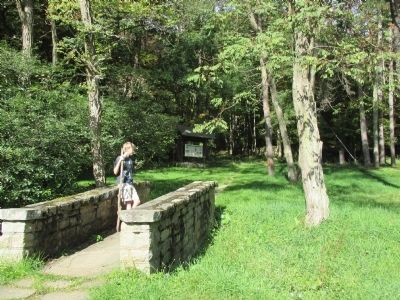
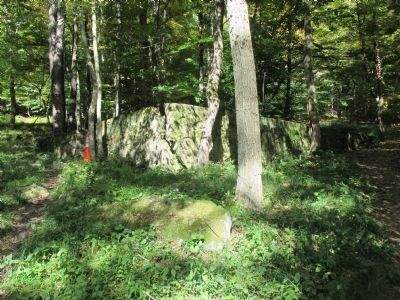
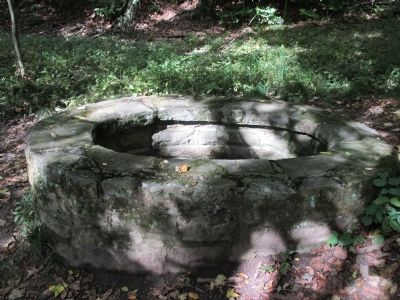
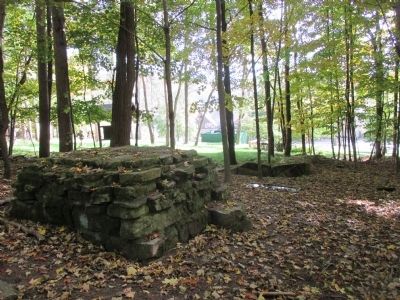
Near the outdoor museum were a "snake pit" and a bear den; both still visible near the ruins. Since the outdoor museum was only open during the summer, captive animals were released back into the wild at season's end.
A popular postcard shows the north end of the museum as approached from the nature trail. The building was cleverly concealed by huge sugar maples and served as an exhibition place for local animals, rocks, insects and fungi.
The foundations and walls, to a height of 3 1/2 feet, are of vari-colored sandstone. The roof is supported on chestnut poles used as columns and knee-braced of the same material. The trusses are of chestnut and black cherry, while the whole is roofed with thick-butted shake shingles.
The rectangular museum is 25 feet wide and 40 feet long. In the center is a series of pits with dry platforms and water in each, screened to accommodate animals requiring both types of environment.
Salamanca-Republican Press, September 30, 1933.
This
this page online
Irving Knobloch, a National Park Service naturalist and later a professor of botany at the University of Michigan, was in charge of trail development projects undertaken by Company 249. A nature trail, now called Red Jacket Trail, was constructed near the outdoor museum.
"Cubby" and "Suzie" were the first to use the fenced bear den, which may have pre-dated the museum/zoo. The cubs were rescued after being separated from their mother by a forest fire in the Crick's Run area.
On opening day, the outdoor museum featured several animals, including a racoon, a skunk, a woodchuck, a porcupine, a chipmunk, five kinds of turtles, five kinds of snakes, toads, frogs and salamanders as well as special displays on nature.
Photographs of Outdoor Museum exhibits courtesy Buffalo Museum of Science.
Topics and series. This historical marker is listed in these topic lists: Animals • Charity & Public Work • Education • Environment. In addition, it is included in the Civilian Conservation Corps (CCC)
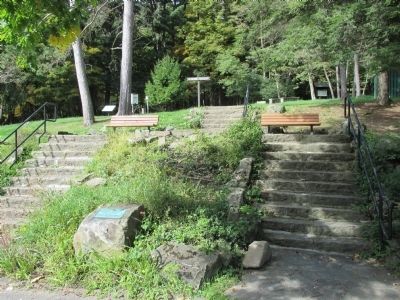
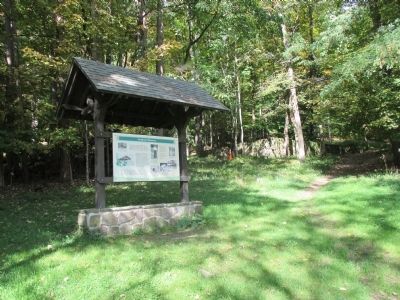
Location. 42° 6.024′ N, 78° 45.013′ W. Marker is in Red House, New York, in Cattaraugus County. It can be reached from Allegany State Park Road. Marker is in Allegany State Park on a path up the hillside behind the Administration Building in the Red House area of the park. Touch for map. Marker is in this post office area: Salamanca NY 14779, United States of America. Touch for directions.

Regionally, this marker is in Upstate New York, specifically in Western New York, and in the Southern Tier. It is also in the American Northeast, in the Mid-Atlantic, in Appalachia, and specifically in Northern Appalachia. Globally, it is in North America, the Western Hemisphere, the Western World, and the Anglosphere. Historically, it finds itself in what was once the Haudenosaunee (Iroquois) Confederacy, New Netherland, and one of the original Thirteen Colonies.
Other nearby markers. At least 8 other markers are within 4 miles of this marker, measured as the crow flies: Weather Station (here, next to this marker); Civilian Conservation Corps (about 300 feet away, measured
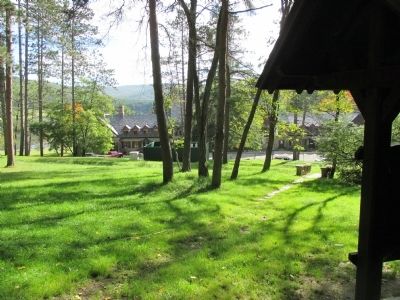
More about this marker. A motor vehicle entrance fee to the park is typically required during regular business hours in season.
Also see . . . Zoo Ruins Allegany State Park - You Tube. A short vignette of the site by Paul Crawford of the Friends of Allegany State Park. (Submitted on June 30, 2018, by Anton Schwarzmueller of Wilson, New York.)
Additional keywords. Civilian Conservation Corp, Red Jacket Hiking Trail
Credits. This page was last revised on September 3, 2020. It was originally submitted on September 28, 2014, by Anton Schwarzmueller of Wilson, New York. This page has been viewed 1,310 times since then and 79 times this year. Photos: 1, 2, 3, 4, 5, 6, 7, 8, 9, 10. submitted on September 28, 2014, by Anton Schwarzmueller of Wilson, New York. • Bill Pfingsten was the editor who published this page.
