Downtown Halifax in Halifax Region, Nova Scotia — The Atlantic Provinces (North America)
Major General
⎯⎯⎯
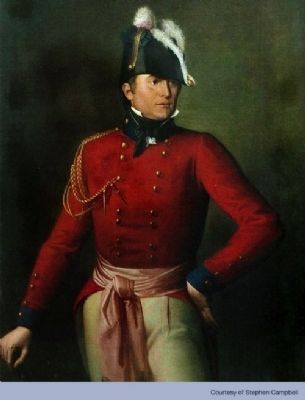
Major-Général Robert Ross 1766-1814
Photographed by Barry Swackhamer, June 14, 2014
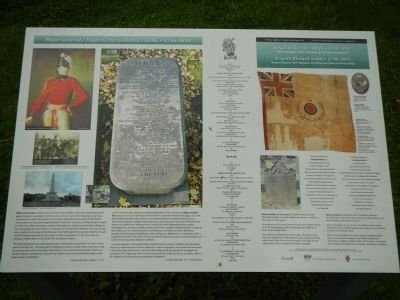
1. Major General / Major-Général Robert Ross 1766-1814 Marker
Captions: (left side) Major General / Major-Général Robert Ross; The death of Robert Ross / La mort de Robert Ross; Ross Monument - Rostrevor, County Down, Ireland / Le Monument Ross - Rostrevor, Comté de Down, Irlande; (Inscription on the tomb of Robert Ross; (right side) Officiers silver belt plate; Regimental Colours of the 104th (New Brunswick) Regiment; Gravestone of Richard Smith.
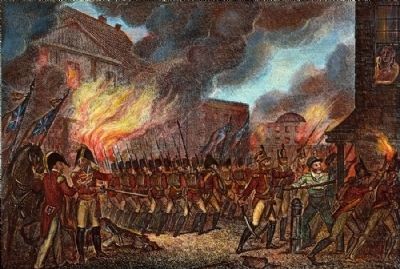
Major General Ross sailed to North America in the summer of 1814 from the Peninsular War against France to command the British army on the east coast of the United States, opening a second front to relieve the pressure on the Niagara Peninsula. He personally lead the British troops ashore and marched through Maryland to attack the Americans at Bladensberg on August 24, 1814. From Bladensberg Ross captured Washington D.C. and burned the public buildings of the city, including the White House, in retaliation for the destructive American raids into Canada, most notably the burning of York (Toronto). From Washington Ross marched on Baltimore and was killed approaching that city by a sniper’s bullet on September 12, 1814. His body was brought to Halifax where it was buried with full military honours.
The body of the gallant and much lamented Major General Ross was interred in St. Paul’s Church yard on Thursday last. The Corpse left the Flagship precisely at 3 o’clock under a discharge of half-minute guns and arrived at the King’s Wharf where it was received by the Grenadier Company of the 64th Regiment and followed to the grave by all the principal Naval and Military officies and a large number of inhabitants.” - Acadian Recorder,
this page online
French
L’été 1814, après avoir participé à la guerre péninsulaire contre la France, le Major-Général Ross prend la mer pour l’Amérique de Nord afin de commander l’armée britannique sur la côté est des États-Unis dans le but d’ouvrir un deuxième front pour soulager la pression sur la péninsule du Niagara. Il dirige la débarquement de ses troops qui traversent le Maryland pour attaquer les Américains à Bladensberg le 24 août 1814. Après Bladensberg, Ross capture Washington, D.C., incendie les édifices publics de la ville, y compris la Maison Blanc. Il s’agit de représailles pour les raids destructeurs des Américains au Canada, surtout le fait d’avoir incendié York (Toronto). De Washington, Ross se dirige vers Baltimore. Le 12 septembre 1814, à l’approche de la ville, il est tué par la balle d’un tireur d’élite. Son corps est ramené à Halifax où il est enterré avec les pleins honneurs militaires.
«Le corps du galant et très regretté Major-Général Ross fut enterró au cimetière Saint-Paul jeudi dernier. Le dépouille quitta le navire étendard à 3 heures exactement, sous le salute des cannons tirés à intervalles d’une demi-minute, et arriva du Quai Kings où elle fut reçue par la Compagnie des grenadiers du 64ᵉ Régiment, et de là elle fut suivie jusqu’à la tombe par tous les principaux officiers de la Marine et de l’Armée et un grand nombre d’habitants». - Acadian Recorder,
Photographed by Barry Swackhamer, June 14, 2014
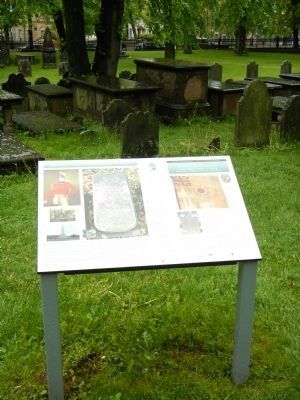
2. Major General / Major-Général Robert Ross 1766-1814 Marker
The tomb of Major General Ross is in the background.
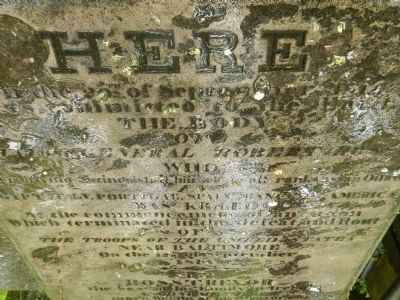
(Inscription on the tomb of Major General Robert Ross)
English
French
Photographed by Barry Swackhamer, June 14, 2014
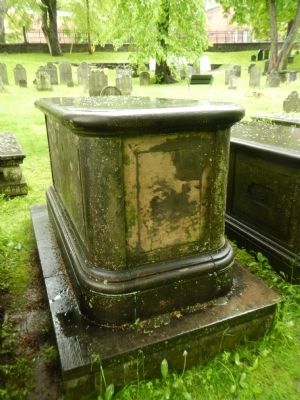
3. The Tomb of Major General Robert Ross
To your right at 15 paces is the grave of … / À 15 pas a votre droite se trouver la tombe du…
Sergeant / Sergent Richard Smith • 1790-1819
Colour Sergeant, 104th Regiment of Foot (New Brunswick) / Sergent Couleur, 104ᵉ Régiment de Fantassins (Nouveau Brunswick)
(Inscription on the gravestone of Sergeant Richard Smith)
English
Photographed by Barry Swackhamer, June 14, 2014
4. Inscription on the tomb of Major General Robert Ross
French
English
Richard Smith was discharged in 1815.
Photographed by Unknown, n.a
5. Major General / Major-Général Robert Ross 1766-1814 Marker
In recognition of his service, he was buried in the military section of the Burying Grounds not far from the grave of another hero, Major-General Robert Ross.
Richard Smith symbolizes the ‘other ranks’ - enlisted men who were called from the Maritime Provinces, endured the 1813 winter march from Fredericton to Kingston and fought bravely with great sacrifice throughout the Niagara campaign.
French
Richard Smith fut réformé en 1815. Il rentra au Nouveau Brunswick pour commencer un nouvelle vie à Bouctouche. Il est mort à Halifax en 1819 âgé de 29 ans.
En reconnaissance de son service, il fut enterré dans la section militaire du View cimetière non loin de la tombe d’un autre héros, le Major-Général Robert Ross.
Richard Smith symbolise les autres rangs, les hommes (enlisais,?) dans le provinces Maritimes qui ont enduré la marche du Fredericton à Kingston pendant l’hiver 1813 et qui sont battus avec d’énormes sacrifices tout au long de la Campagne du Niagara.
Erected by Old Burying Ground Foundation.
Topics. This
Photographed by Unknown, n.a
6. The British Burning Washington
Location. 44° 38.594′ N, 63° 34.369′ W. Marker is in Halifax, Nova Scotia, in Halifax Region. It is in Downtown Halifax. It can be reached from Barrington Street close to Spring Garden Road, on the right when traveling south. Touch for map. Marker is at or near this postal address: 1480 Barrington Street, Halifax NS B3J B3J, Canada. Touch for directions.

Regionally, this marker is in the Maritimes and in Atlantic Canada. Globally, it is in the North Atlantic Region, North America, the Western Hemisphere, the Western World, and the Anglosphere. Historically, it finds itself in what was once a British colony, the Viceroyalty of New France, and Acadia.
Other nearby markers. At least 8 other markers are within walking distance of this marker: Carved in Stone (a few steps from this marker); Mr. John Samwell (within shouting distance of this marker); The Welsford Parker Monument (within shouting distance of this marker); The Old Burying Ground (within shouting distance of this marker); a different marker also named Old Burying Ground (within shouting distance of this marker); Why Aren’t We Americans? • Pourquoi ne sommes-nous pas des Américains? (within shouting distance of this marker); a different marker also named Old Burying Ground (within shouting distance of this marker); Government House (within shouting distance of this marker). Touch for a list and map of all markers in Halifax.
More about this marker. The tomb of Major General Robert Ross is in the Old Burying Ground cemetery.
Credits. This page was last revised on October 23, 2020. It was originally submitted on October 11, 2014, by Barry Swackhamer of Brentwood, California. This page has been viewed 1,872 times since then and 143 times this year. Photos: 1, 2, 3, 4, 5, 6. submitted on October 11, 2014, by Barry Swackhamer of Brentwood, California. • Andrew Ruppenstein was the editor who published this page.
