Dinwiddie in Dinwiddie County, Virginia — The American South (Mid-Atlantic)
The War of 1812
⎯⎯⎯
Winfield Scott
Photographed by Bernard Fisher, October 17, 2014
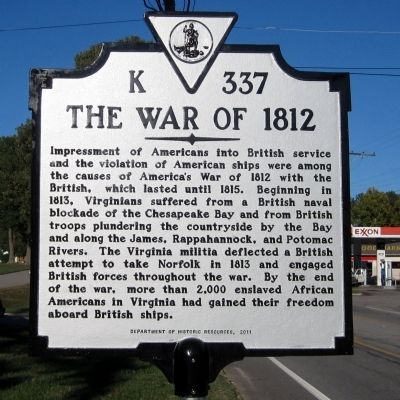
1. The War of 1812 Marker
The War of 1812. Impressment of Americans into British service and the violation of American ships were among the causes of America’s War of 1812 with the British, which lasted until 1815. Beginning in 1813, Virginians suffered from a British naval blockade of the Chesapeake Bay and from British troops’ plundering the countryside by the Bay and along the James, Rappahannock, and Potomac rivers. The Virginia militia deflected a British attempt to take Norfolk in 1813, and engaged British forces throughout the war. By the end of the war, more than 2,000 enslaved African Americans in Virginia had gained their freedom aboard British ships.
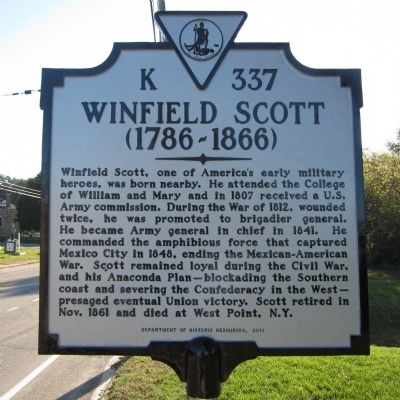
Winfield Scott (1786-1866). Winfield Scott, one of America’s early military heroes, was born nearby. He attended the College of William and Mary and in 1807 received a U.S. Army commission. During the War of 1812, wounded twice, he was promoted to brigadier general. He became Army general in chief in 1841. He commanded the amphibious force that captured Mexico City in 1848, ending the Mexican-American War. Scott remained loyal during the Civil War, and his Anaconda Plan—blockading the
this page online
Erected 2011 by Department of Historic Resources. (Marker Number K-337.)
Topics and series. This historical marker is listed in these topic lists: African Americans • Patriots & Patriotism • War of 1812 • War, Mexican-American • War, US Civil. In addition, it is included in the Virginia Department of Historic Resources (DHR) series list. A significant historical month for this entry is October 1861.
Location. 37° 4.699′ N, 77° 35.19′ W. Marker is in Dinwiddie, Virginia, in Dinwiddie County. It is at the intersection of Boydton Plank Road (U.S. 1) and Main Street, on the right when traveling south on Boydton Plank Road. Touch for map. Marker is in this post office area: Dinwiddie VA 23841, United States of America. Touch for directions.

Regionally, this marker is in Virginia’s Piedmont, in Southside Virginia, and specifically in Central Virginia. It is also in the American South and specifically in the Upper South. Globally, it is in North America, the Western Hemisphere,
Photographed by Bernard Fisher, October 17, 2014
2. Winfield Scott Marker
Other nearby markers. At least 8 other markers are within walking distance of this marker: Dinwiddie Confederate Monument (about 400 feet away, measured in a direct line); Early Education in Dinwiddie County (about 400 feet away); The Battle of Dinwiddie Court House (about 400 feet away); Dinwiddie Court House (about 400 feet away); a different marker also named Battle of Dinwiddie Court House (about 400 feet away); Scott's Law Office (about 700 feet away); Dinwiddie Courthouse (about 800 feet away); Vaughan Road (approx. 0.3 miles away). Touch for a list and map of all markers in Dinwiddie.
Another marker is no longer nearby. Early Education in Dinwiddie County (was about 400 feet away but has been replaced with another marker now near it).
Photographed by Bernard Fisher, October 17, 2014
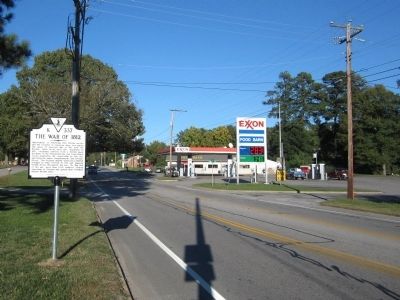
3. Boydton Plank Rd (facing north)
Photographed by Bernard Fisher, October 17, 2014
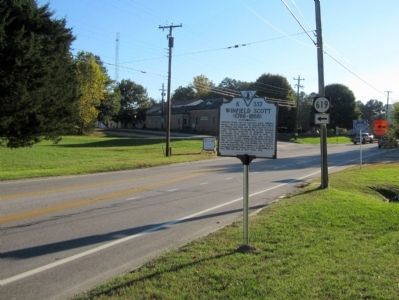
4. Boydton Plank Rd (facing south)
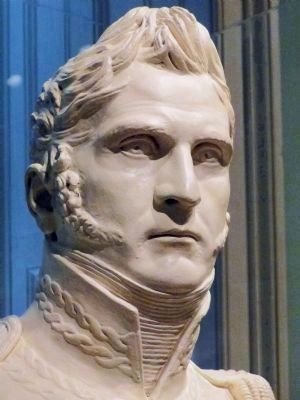
Photographed by Allen C. Browne, February 16, 2015
5. Winfield Scott
This 1814 plaster sculpture by William Rush is in the National Portrait Gallery Washington DC.
“At six feet, five inches, Winfield Scott was a ‘God of War’ Young and arrogant, Scott emerged during the war of 1812, when new military leadership was desperately needed. ‘Shall war come at last,’ he wrote, ‘my enthusiasm will be rekindled; and then who knows but that I may yet write my history with my sword.’ His victory at Chippewa and his bravery at Lundy's Lane quickley elevated him to hero status. Scott went on to become the commander of the American army, creating the forces that would fight the Mexican American War and the Civil War.” — National Portrait Gallery
“At six feet, five inches, Winfield Scott was a ‘God of War’ Young and arrogant, Scott emerged during the war of 1812, when new military leadership was desperately needed. ‘Shall war come at last,’ he wrote, ‘my enthusiasm will be rekindled; and then who knows but that I may yet write my history with my sword.’ His victory at Chippewa and his bravery at Lundy's Lane quickley elevated him to hero status. Scott went on to become the commander of the American army, creating the forces that would fight the Mexican American War and the Civil War.” — National Portrait Gallery
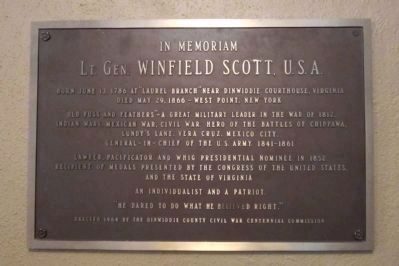
Photographed by Bernard Fisher, November 22, 2014
6. Lt. Gen. Winfield Scott, U.S.A.
Civil War Centennial memorial plaque displayed in the Dinwiddie Courthouse
Credits. This page was last revised on July 6, 2021. It was originally submitted on October 17, 2014, by Bernard Fisher of Richmond, Virginia. This page has been viewed 1,347 times since then and 60 times this year. Photos: 1, 2, 3, 4. submitted on October 17, 2014, by Bernard Fisher of Richmond, Virginia. 5. submitted on May 2, 2015, by Allen C. Browne of Silver Spring, Maryland. 6. submitted on November 22, 2014, by Bernard Fisher of Richmond, Virginia.
