Covington in Kenton County, Kentucky — The American South (East South Central)
John James Audubon
Photographed by Rev. Ronald Irick, October 12, 2014
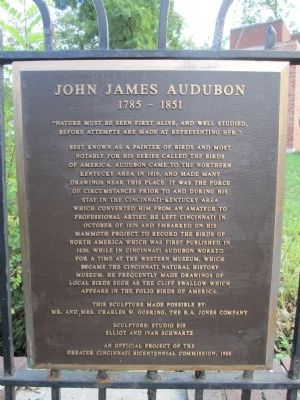
1. John James Audubon Marker
close up of text
Best known as a painter of birds and most notably for his series called the Birds of America. Audubon came to the northern Kentucky area in 1819, and made many drawings near this place. it was the force of circumstances prior to and during his stay in the Cincinnati- Kentucky area which converted him from an amateur to professional artist. He left Cincinnati in October of 1829 and embarked on his mammoth project to record the birds of North America which was first published in 1826. While in Cincinnati Audubon worked for a time at the Western Museum, which became the Cincinnati Natural History Museum. He frequently made drawings of local birds such as the Cliff Swallow which appears in the folio Birds of America.
This sculpture made possible by:
Mr. & Mrs. Charles Goering, - the R. A. Jones Company
Sculptors: Studio Eis Elliot and Ivan Schwartz
Erected 1988 by An Official Project of - - The Greater Cincinnati Bicentennial Commoission.
Topics. This historical marker is
this page online
Location. 39° 5.492′ N, 84° 30.246′ W. Marker is in Covington, Kentucky, in Kenton County. It is on Shelby near Riverside Dr., on the right when traveling north. Riverside Dr. at Shelby, marker is on the "River Walk" at the confluence of the Licking and Ohio Rivers on right, when traveling north on Shelby, from the end of East 2nd Str. Touch for map. Marker is at or near this postal address: 420 Riverside Dr, Covington KY 41011, United States of America. Touch for directions.

Regionally, this marker is in Kentucky’s Outer Bluegrass. It is also in the American South, specifically in the Upper South, and in the Ohio River Valley. Globally, it is in North America, the Western Hemisphere, the Western World, and the Anglosphere. Historically, it finds itself in what was once the territory of the Mississippian Culture and also the Antebellum South.
Other nearby markers. At least 8 other markers are within walking distance of this marker: Chief Little Turtle (a few steps from this marker); James Bradley (about 400 feet away, measured in
Photographed by Rev. Ronald Irick, October 12, 2014
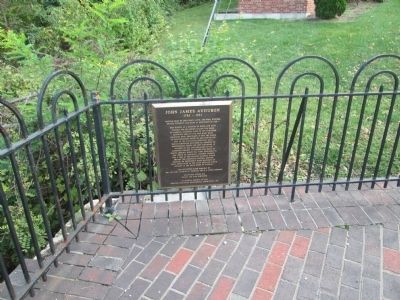
2. John James Audubon Marker
full view
Photographed by Rev. Ronald Irick, October 12, 2014
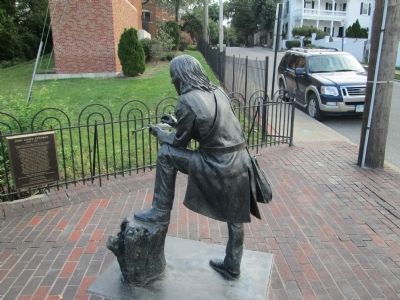
3. John James Audubon Site
marker plaque and statue
Photographed by Rev. Ronald Irick, October 12, 2014
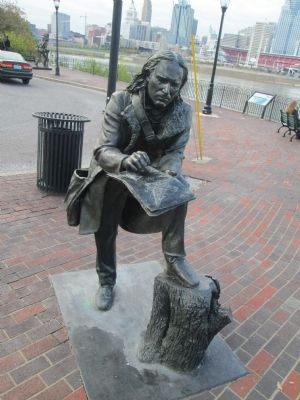
4. John James Audubon Statue
on the River Walk in Covington,Kentucky
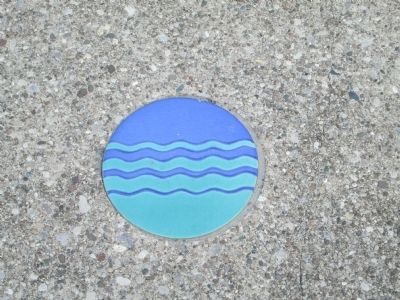
Photographed by Rev. Ronald Irick, October 12, 2014
5. River Walk logo
in brick pavement near the statue
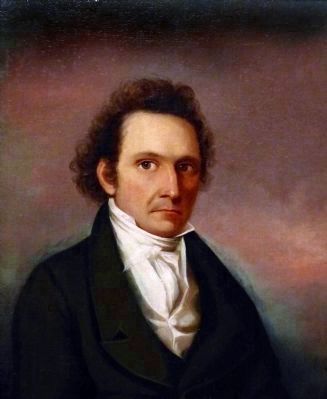
Photographed by Allen C. Browne, February 16, 2015
6. John James Audubon
This self portrait hangs in the National Portrait Gallery in Washington DC
“Naturalist John James Audubon painted this self portrait when he was thirty-seven. Until that time his drawings of birds had been a hobby while he worked as an import merchant and later as a mill operator in Kentucky. As the idea for a publication called The Birds of America took form, he traveled to Louisiana and began to create large watercolors of birds in their natural settings. In Natchez, in 1822 an itinerant portrait painter named John Steen gave Audubon some lessons in oil painting, and this self-portrait was a result. The precision of the features is similar to the portrait drawings Audubon made in Louisville a few years earlier. Audubon went to England in 1826; the first engravings for Birds of America were created that year.The full set of ‘elehant folio’ volumes was completed in 1838.“ — National Portrait Gallery
“Naturalist John James Audubon painted this self portrait when he was thirty-seven. Until that time his drawings of birds had been a hobby while he worked as an import merchant and later as a mill operator in Kentucky. As the idea for a publication called The Birds of America took form, he traveled to Louisiana and began to create large watercolors of birds in their natural settings. In Natchez, in 1822 an itinerant portrait painter named John Steen gave Audubon some lessons in oil painting, and this self-portrait was a result. The precision of the features is similar to the portrait drawings Audubon made in Louisville a few years earlier. Audubon went to England in 1826; the first engravings for Birds of America were created that year.The full set of ‘elehant folio’ volumes was completed in 1838.“ — National Portrait Gallery
Credits. This page was last revised on January 5, 2020. It was originally submitted on October 21, 2014, by Rev. Ronald Irick of West Liberty, Ohio. This page has been viewed 1,439 times since then and 55 times this year. Photos: 1, 2, 3, 4, 5. submitted on October 21, 2014, by Rev. Ronald Irick of West Liberty, Ohio. 6. submitted on March 26, 2015, by Allen C. Browne of Silver Spring, Maryland. • Al Wolf was the editor who published this page.
