Lunenburg in Lunenburg County, Nova Scotia — The Atlantic Provinces (North America)
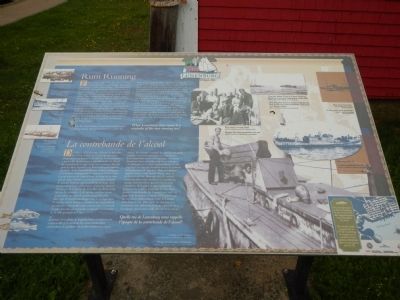
Rum Running
La contrebande de l’alcool
Photographed by Barry Swackhamer, June 16, 2014
1. Rum Running Marker
Captions (English / French): Rum runners alongside, Lunenbug, 1930. / Navires contrebandiers d’quai, Lunenburg, 1930.; The rum runner Narmada. / Le navire contrebandier Narmada.; The rum runner Josephine K. / Le navire contrebandier Josephine K.; (bottom, centre) Loading a rum runner. / Chargement d’un navire contrebandier.; (right side, clockwise from the top) Dory from the schooner Tessie & Aubrey transferring kegs of rum to rum runner Nashwaak on LaHave Bank. / Doris de la goélette Tessie & Aubrey transbordant des barils de rhum sur le navire contrebandier Nashwaak sur le Banck de LaHave.; Rum runner Narmada. / Le Narmada, navire contrebandier.; Rum runner Rio II. / Le navire contrebandier Rio II. Rum runner’s crew and friends. / Équipage d’un navire contrebandier et des amis.

English
From 1920 until 1933, the sale of alcohol was prohibited due to the strong “Temperance Movement” in the United States. This prompted a demand for smuggled liquor which proved to be a lucrative business for organized crime in the United States and for Nova Scotian fishing vessels an their crews. They would load barrels of liquor at the French port of Saint Pierre off the south coast of Newfoundland or from larger ships off shore and transport their valuable cargo to just outside the United States 12-mile limit where it was transferred to smaller American craft for the “run” to shore. Although dangerous work, it was legal as long as the Canadian vessel did not enter United States territorial waters. It paid better than fishing and provided a boost to the Town’s economy during the Great Depression.
When the United States Coast Guard cutters began patrolling outside American territorial waters, the slower, black-hulled fishing schooners or “blacks” as they were known to the Coast Guard, proved unsuited for the trade. Construction of a new type of motor-powered vessel, built specifically to elude detection
this page online
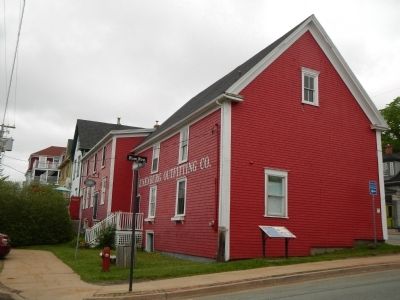
What Lunenburg street name is a reminder of the rum running era?
French
Photographed by Barry Swackhamer, June 16, 2014
2. Rum Running Marker
Lorsque les vedettes de la garde côtière commencent à patrouiller à l’extérieur des eaux territoriales américaines, les goélettes de pêches lentes et à coques noires, les «blacks» comme les appellent la garde côtière, s’avèrent impropres à ce commerce. La construction d’un nouveau type de bateau à moteur conçu spécialement pour échapper à la détection et s’enfuir rapidement en cas de repérage, occupe les chantiers navals de partout dans la province. Il s’agit de la «flotte de bananiers», appelés ainsi à cause de leur forme pure et de leur profil bas. Bien que peu de navires contrebandiers sont construits à Lunenburg même, bon nombre appartiennent à des entreprises
Photographed by Unknown, circa 1922
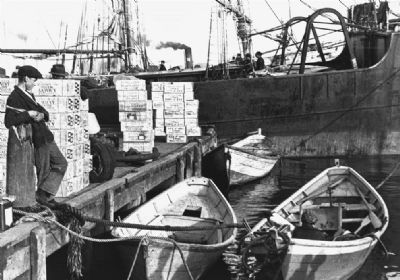
3. Loading champagne at St. Pierre
Quelle rue de Lunenburg nous rappelle l’époque de la contrebande de l’alcool?
Erected by Town of Lunenburg.
Topics. This historical marker is listed in this topic list: Waterways & Vessels. A significant historical month for this entry is March 1929.
Location. 44° 22.56′ N, 64° 18.539′ W. Marker is in Lunenburg, Nova Scotia, in Lunenburg County. It is at the intersection of Rum Row and Bluenose Drive, on the right when traveling south on Rum Row. Touch for map. Marker is in this post office area: Lunenburg NS B0J, Canada. Touch for directions.

Regionally, this marker is on the Lighthouse Route. It is also in the Maritimes and in Atlantic Canada. Globally, it is in the North Atlantic Region, North America, the Western Hemisphere, the Western World, and the Anglosphere. Historically,
Photographed by Unknown, circa 1920s
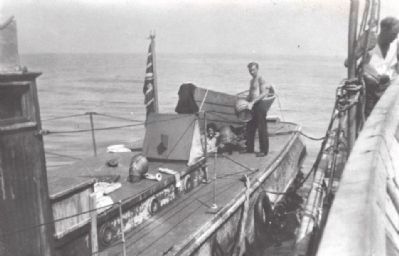
4. Transferring cargo to a rum runner.
Other nearby markers. At least 8 other markers are within walking distance of this marker: Lunenburg - Home of the Bluenose & Bluenose II (about 90 meters away, measured in a direct line); Lunenburg’s Shipbuilding Tradition (about 120 meters away); Lunenburg’s Fishing Industry Since 1940’s (about 150 meters away); The Labrador Whaler Anderson Bros. (about 150 meters away); Lunenburg’s Fishing Industry 1870’s - 1940’s (about 180 meters away); Old Town Lunenburg Historic District (about 180 meters away); Lunenburg’s Fishing Industry to the 1870’s (approx. 0.3 kilometers away); The Fire / Le Feu (approx. 0.3 kilometers away). Touch for a list and map of all markers in Lunenburg.
Related marker. Click here for another marker that is related to this marker.
Also see . . .
1. Rum-running - Wikipedia. The term "rum-running" most likely originated at the start of Prohibition in the United States (1920–1933), when ships from Bimini in the western Bahamas transported cheap Caribbean rum to Florida speakeasies. But rum's cheapness
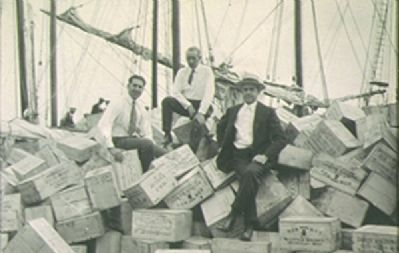
Photographed by Unknown, circa 1920s
5. Rum Runners
2. Recalling cops and rum runners in Prohibition -CBC. This is a 45 minute radio presentation. (Submitted on October 25, 2014, by Barry Swackhamer of Brentwood, California.)
Additional keywords. Prohibition
Credits. This page was last revised on March 18, 2025. It was originally submitted on October 25, 2014, by Barry Swackhamer of Brentwood, California. This page has been viewed 2,886 times since then and 83 times this year. It was the Marker of the Week October 25, 2015. Photos: 1, 2, 3, 4, 5. submitted on October 25, 2014, by Barry Swackhamer of Brentwood, California. • Andrew Ruppenstein was the editor who published this page.
