Downtown in St. Louis, Missouri — The American Midwest (Upper Plains)
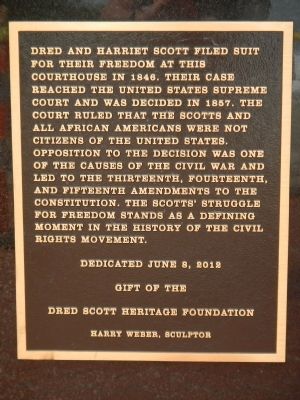
Dred and Harriet Scott
Photographed by Barry Swackhamer, August 16, 2014
1. Dred and Harriet Scott Marker
Erected 2012 by Dred Scott Heritage Foundation.
Topics. This historical marker is listed in these topic lists: African Americans • Civil Rights. A significant historical year for this entry is 1846.
Location. 38° 37.528′ N, 90° 11.333′ W. Marker is in St. Louis, Missouri. It is in Downtown. It is on North 4th Street near Market Street, on the left when traveling north. Touch for map. Marker is at or near this postal address: 50 North 4th Street, Saint Louis MO 63102, United States of America. Touch for directions.

Regionally, this marker is in the American Midwest, in the Lewis & Clark Corridor,
this page online
Other nearby markers. At least 8 other markers are within walking distance of this marker: The Old Courthouse (a few steps from this marker); Sold on the Steps of Justice (within shouting distance of this marker); International Fur Exchange (within shouting distance of this marker); a different marker also named Western Reach of the Revolution (within shouting distance of this marker); Abraham Lincoln Slept Here (about 300 feet away, measured in a direct line); KMOX (about 300 feet away); La Rue Missouri (about 400 feet away); St. Charles Rock Road (about 400 feet away). Touch for a list and map of all markers in St. Louis.
Other markers no longer nearby. Joseph Pulitzer (was a few steps from this marker but has been confirmed missing); a different marker also named Sold on the Steps of Justice (was within shouting distance of
Photographed by Barry Swackhamer, August 16, 2014
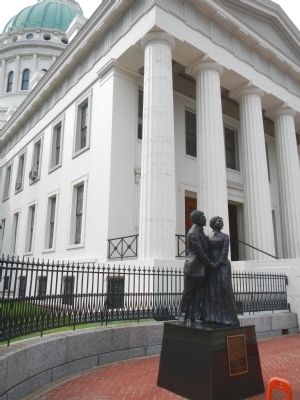
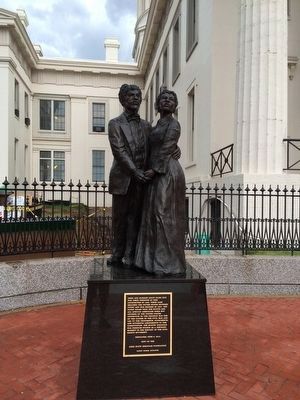
2. Dred and Harriet Scott Statue
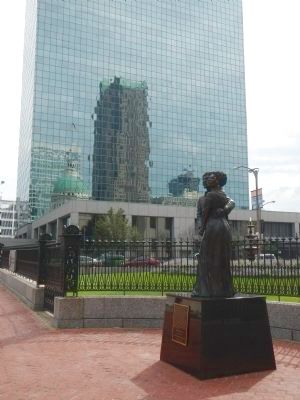
More about this marker. The Dred and Harriet Scott statue is located in front of the Old Courthouse.
Also see . . .
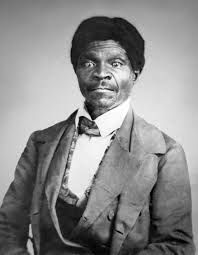
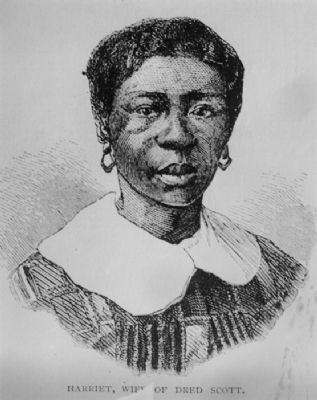
1. Dred Scott - Wikipedia. In 1836 Dred Scott met a teenaged slave named Harriet Robinson whose slave owner was Major Lawrence Taliaferro, an army officer from Virginia. Taliaferro allowed Scott and Harriet to marry and transferred his ownership of Harriet to Dr. Emerson so the couple could be together. In 1838, Harriet gave birth to their first child, Eliza. In 1840, they had another daughter they named Lizzie. Eventually, they would also have two sons, but neither survived past infancy. (Submitted on November 12, 2014, by Barry Swackhamer of Brentwood, California.)
2. Dred Scott v. Sandford - Wikipedia. Dred Scott v. Sandford, 60 U.S. 393 (1857), was a landmark decision by the U.S. Supreme Court in which the Court held that African Americans, whether enslaved or free, could not be American citizens and therefore had no standing to sue in federal court, and that the federal government had no power to regulate slavery in the federal territories acquired after the creation of the United States.
Photographed by Barry Swackhamer, August 16, 2014
3. Dred and Harriet Scott Statue
Public Domain, n.d.
4. Dred Scott
Public Domain, n.d.
5. Harriet Scott
Photographed by Pat Filippone, August 18, 2015
6. Dred and Harriet Scott Marker
Credits. This page was last revised on January 30, 2023. It was originally submitted on November 12, 2014, by Barry Swackhamer of Brentwood, California. This page has been viewed 1,253 times since then and 35 times this year. Photos: 1, 2, 3, 4, 5. submitted on November 12, 2014, by Barry Swackhamer of Brentwood, California. 6. submitted on November 26, 2015, by Pat Filippone of Stockton, California. • Al Wolf was the editor who published this page.
