
Canton in Baltimore, Maryland — The American Northeast (Mid-Atlantic)
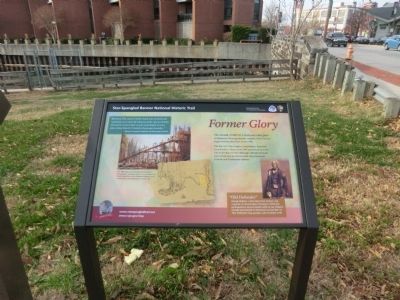
Former Glory
Star-Spangled Banner National Historic Trail
| — | National Park Service, U.S. Department of the Interior | — |
Photographed by Don Morfe, December 13, 2014
1. Former Glory Marker
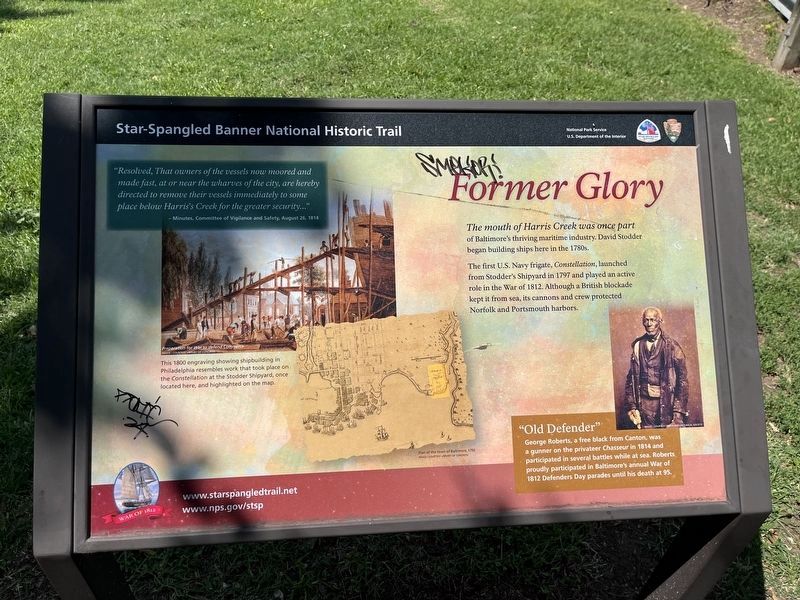
“Resolved, That owners of the vessels now moored and mad fast, at or near the wharves of the city, are hereby directed to remove their vessels immediately to some place below Harris’s Creek for the greater security…”
Minutes, Committee of Vigilance and Safety, August 26, 1814.
The mouth of Harris Creek was once part of Baltimore’s thriving maritime industry. David Stodder began building ships here in the 1780s.
The first U.S. Navy frigate, Constellation, launched from Stodders Shipyard in 1797 and played an active role in the War of 1812. Although a British blockade kept if from sea, its cannon and crew protected Norfolk and Portsmouth harbors.
“Old Defender” George Roberts, a free black from Canton, was a gunner on the privateer Chasseur in 1814 and participated in several battles while at sea. Roberts proudly participated in Baltimore’ annual War of 1812 Defenders Day parades until his death at 95.
"Old Defender"
George Roberts, a free black man from Canton, was a gunner on the privateer Chasseur in 1814 and participated in several battles while at sea Roberts proudly participated in Baltimore's annual War of 1812 Defenders Day parades until his death at 95.
[Captions:]
This 1800 engraving showing shipbuilding in Philadelphia resembles work that took place on the Constitution at the Stodder Shipyard, once located here, and highlighted on the map.
Plan of the town of Baltimore, 1793-Image courtesy Library of Congress.
Erected by National
this page online
Topics and series. This historical marker is listed in these topic lists: African Americans • War of 1812 • Waterways & Vessels. In addition, it is included in the Star-Spangled Banner National Historic Trail series list. A significant historical year for this entry is 1797.
Location. 39° 16.804′ N, 76° 34.788′ W. Marker has been reported damaged. Marker is in Baltimore, Maryland. It is in Canton. It is at the intersection of Boston Street and South Lakewood Avenue, on the right when traveling south on Boston Street. The marker is located in Boston Street Pier Park. Touch for map. Marker is at or near this postal address: 2601 Boston St, Baltimore MD 21224, United States of America. Touch for directions.

Regionally, this marker is in Central Maryland. It is also in the American Mid-Atlantic, in the Chesapeake Bay Region, and on the Eastern Seaboard. Globally, it is in the North Atlantic Region, North America, the Western Hemisphere, the Western World, and the Anglosphere. Historically, it finds itself in what was once one of the original Thirteen Colonies and also the
Photographed by Devry Becker Jones (CC0), August 24, 2024
2. Former Glory Marker
The marker has been defaced but remains generally readable.
Other nearby markers. At least 8 other markers are within walking distance of this location: Baltimore Regional Trail (here, next to this marker); The Harris Creek Rain Garden (a few steps from this marker); Professor Trash Wheel (within shouting distance of this marker); Historic Canton (about 500 feet away, measured in a direct line); The Railroad to Freedom (approx. ¼ mile away); Frederick Douglass' Escape from Slavery (approx. ¼ mile away); a different marker also named Historic Canton (approx. ¼ mile away); a different marker also named Historic Canton (approx. 0.3 miles away). Touch for a list and map of all markers in Baltimore.
Another marker is no longer nearby. Captain John O'Donnell (was approx. ¼ mile away but has been permanently removed).
Also see . . . George Roberts. National Park Service (Submitted on November 10, 2015, by Allen C. Browne of Silver Spring, Maryland.)

Photographed by Don Morfe, December 13, 2014
3. Former Glory Marker
Photographed by Allen C. Browne, September 5, 2015
4. George Roberts
Bold Privateer and Honored Defender
Bold Privateer and Honored Defender
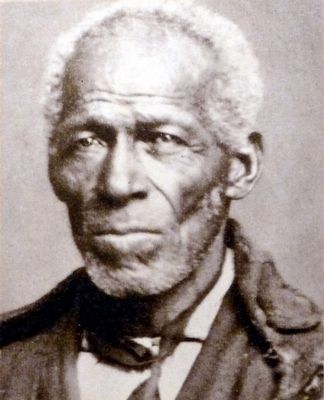
This c.1850 photo of George Roberts is on display in the Museum of the Historical Society of Maryland in Baltimore.
“While African American sailors comprised a significant portion of the crew on Baltimore's private armed vessels, none proved more legendary than George Roberts.
Surviving British capture and imprisonment in Jamaica, Roberts later served as a gunner on Captain Thomas Boyle's (1775-1825) Chasseur. During the War of 1812, Baltimoreans were flooded with news of the Chasseur outgunning and outsailing British ships in the West Indies and celebrated the safe return of the ship and crew, including Roberts, in March of 1815. For decades, Roberts lived in Baltimore as a honored defender. In death, Roberts carried with him the same honor, memorialized as ‘a man whose patriotism, good sense and high moral character have won him many friends for whom the news of his death will cause heartfelt sorrow.’” — Maryland Historical Society.
“While African American sailors comprised a significant portion of the crew on Baltimore's private armed vessels, none proved more legendary than George Roberts.
Surviving British capture and imprisonment in Jamaica, Roberts later served as a gunner on Captain Thomas Boyle's (1775-1825) Chasseur. During the War of 1812, Baltimoreans were flooded with news of the Chasseur outgunning and outsailing British ships in the West Indies and celebrated the safe return of the ship and crew, including Roberts, in March of 1815. For decades, Roberts lived in Baltimore as a honored defender. In death, Roberts carried with him the same honor, memorialized as ‘a man whose patriotism, good sense and high moral character have won him many friends for whom the news of his death will cause heartfelt sorrow.’” — Maryland Historical Society.
Photographed by Allen C. Browne, September 5, 2015
5. George Roberts, 1812
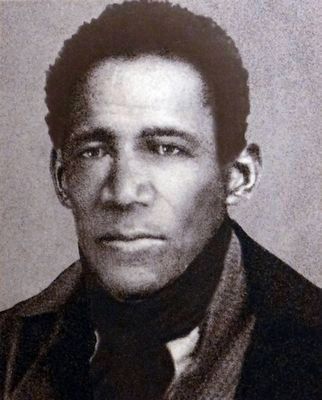
This age-regression sketch by Michael W. Steed, the SketchCop, shows George Roberts as he might have looked at age 35 in 1812. It is on display at the Museum of the Historical Society of Maryland in Baltimore.
Credits. This page was last revised on August 24, 2024. It was originally submitted on December 15, 2014, by Don Morfe of Baltimore, Maryland. This page has been viewed 1,260 times since then and 37 times this year. Photos: 1. submitted on December 15, 2014, by Don Morfe of Baltimore, Maryland. 2. submitted on August 24, 2024, by Devry Becker Jones of Washington, District of Columbia. 3. submitted on December 15, 2014, by Don Morfe of Baltimore, Maryland. 4, 5. submitted on November 10, 2015, by Allen C. Browne of Silver Spring, Maryland. • Bill Pfingsten was the editor who published this page.
